

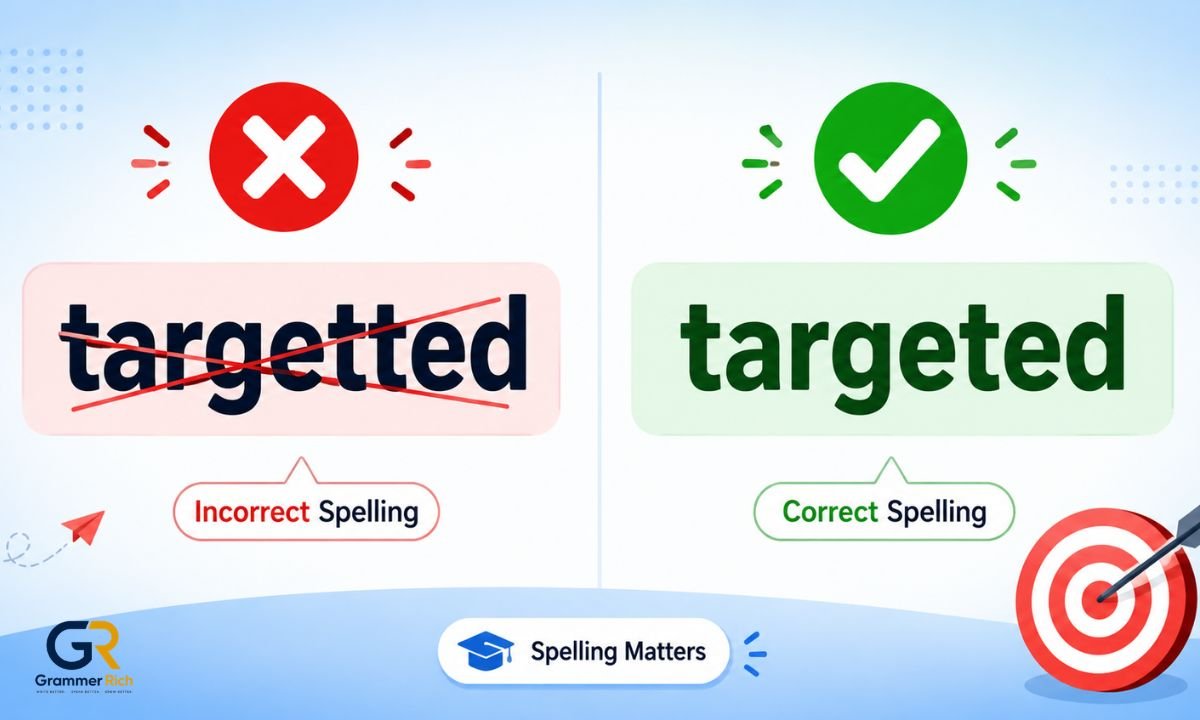
“Targeted” is the correct spelling — one T — used as both the simple past tense and past participle of “target.” “Targetted” (double T) is a common misspelling that doesn’t follow standard English spelling rules for words ending in a single consonant after an unstressed syllable. Stick with “targeted” in all writing, whether formal or casual.
Ever paused mid-sentence, unsure whether to type one T or two? You’re not alone. The Targetted vs Targeted mix-up trips up even experienced writers, especially since spellcheck doesn’t always catch it. This guide breaks down the grammar rule behind it, shows real examples, and clears up the confusion for good — so you’ll never second-guess it again.
Quick Answer:
If you’re in a hurry, here’s the short version of the Targetted vs Targeted debate: “targeted” is correct. “Targetted” is not a recognized word in any major dictionary, including Merriam-Webster, Cambridge, or Oxford. No matter the context — marketing, writing, casual conversation — you always want one T.
Meaning of “Targeted”
“Targeted” comes from the base verb “target,” meaning to aim at, focus on, or direct something toward a specific goal. When you add the suffix “-ed,” it becomes both the past tense and the past participle of the verb.
- Past tense example: “The company targeted a younger audience last year.”
- Past participle example: “The ad has been targeted at teenagers.”
As an adjective, “targeted” also describes something that’s specific, focused, or deliberately aimed, as in a “targeted approach” or “targeted campaign.” Understanding this dual role is key to resolving the Targetted vs Targeted question, because the correct spelling stays the same regardless of grammatical function.
Why “Targetted” Is Incorrect
The double-T version doesn’t follow standard English spelling conventions. Normally, English doubles a final consonant before adding “-ed” or “-ing” only when the last syllable is stressed, as in “stop” becoming “stopped.” But “target” is stressed on the first syllable (TAR-get), not the second. Since the final syllable is unstressed, the consonant doesn’t double.
This is the same rule that governs words like “visit” (visited, not “visitted”) and “benefit” (benefited, not “benefitted” — though this one has debated exceptions). Once you understand the logic, the Targetted vs Targeted question becomes much easier to answer on sight.
Targetted vs Targeted Reddit

Search online forums like Reddit, and you’ll find plenty of writers asking the same question. Threads about Targetted vs Targeted pop up regularly in grammar and writing subreddits, often from marketers, students, and non-native English speakers unsure which version to use in professional documents. The consensus across these communities is unanimous: “targeted” is the accepted spelling, and “targetted” is treated as a typo or spelling error, not a valid variant.
Simple Rule to Remember
Here’s an easy way to settle the Targetted vs Targeted debate for good:
- Identify where the stress falls in the base word.
- If the stress is on the last syllable, double the consonant (“permit” → “permitted”).
- If the stress is on an earlier syllable, don’t double it (“target” → “targeted”).
But:
English spelling isn’t always perfectly consistent, and a handful of words break this pattern in informal or regional use. “Targeted” isn’t one of them, though — dictionaries are consistent here, which makes it one of the more reliable examples of the double consonant rule in action.
Also, read this Blog: Reinforce or Reenforce: Which Spelling Is Correct?
Targetted or Targeted: British Spelling
A common assumption is that British English might allow the double-T spelling, similar to how British English doubles the L in words like “travelled” or “cancelled.” However, this isn’t the case with “target.” Both American and British English agree: “targeted” is correct, and “targetted” is incorrect in either variety.
Targeted vs Targetted Comparison Table
| Feature | Targeted (Correct) | Targetted (Incorrect) |
| Spelling | One T | Two T’s |
| Dictionary status | Listed in Merriam-Webster, Cambridge, Oxford | Not a recognized word |
| American English | Correct | Incorrect |
| British English | Correct | Incorrect |
| Grammar function | Past tense & past participle | N/A |
| Common in | Marketing, writing, everyday speech | Typos, autocorrect errors |
American vs British English Differences
Spelling differences between American and British English usually involve words like “colour/color” or “organise/organize.” But when it comes to Targetted vs Targeted, there’s no regional split — both dialects treat single-T “targeted” as standard. This makes it simpler than many other spelling debates, since you don’t need to adjust based on your audience’s location.
Targetted vs Targeted Oxford Dictionary

If you check the Oxford Dictionary, you’ll only find an entry for “targeted,” confirming it as the standard spelling used in formal, academic, and published writing. The absence of “targetted” from Oxford, Cambridge, and Merriam-Webster alike is strong evidence that this spelling is simply a mistake, not an accepted alternate form.
Common Mistakes People Make
- Doubling the T out of habit, following patterns from other “-ed” words.
- Assuming British spelling always doubles consonants.
- Relying on autocorrect, which doesn’t always catch this error.
- Confusing “targeted” with words that do double the consonant, like “committed” or “regretted.”
Being aware of these patterns helps you avoid falling into the Targetted vs Targeted trap in your own writing.
Example Sentences Using “Targeted” Correctly
- The marketing team targeted millennials with a new social media campaign.
- Her feedback felt targeted, but it was meant to help.
- The therapist recommended a targeted approach to treat the injury.
- Investors targeted emerging markets for higher returns.
- The email was targeted specifically at returning customers.
Synonyms and Related Words
Words closely related to “targeted” include aimed, focused, directed, intended, tailored, and specific. These synonyms often show up in similar contexts — targeted advertising, targeted marketing, or a targeted strategy — and understanding them can help reinforce why the single-T spelling makes sense grammatically.
When Should You Use “Targeted”?
Use “targeted” any time you’re describing something aimed at a specific goal, audience, or outcome. It works as a verb (past tense/participle) and as an adjective. Whether you’re writing a business report, a school essay, or a casual email, “targeted” is always the safe, correct choice — there’s no version of the Targetted vs Targeted comparison where the double-T spelling wins.
Memory Trick to Never Misspell It Again
Here’s a simple trick: think of the phrase “one target, one T.” Since “target” already has a natural rhythm with stress on the first syllable, just remember that stress stays put — no extra letters needed. Picture a single arrow hitting a single target, and let that image remind you to skip the second T.
Conclusion
The Targetted vs Targeted debate has a clear winner: “targeted,” spelled with one T, is correct in every context, dialect, and grammatical form. “Targetted” simply isn’t recognized by any major dictionary and breaks standard English spelling conventions around consonant doubling. Remember the rule — stress falls on the first syllable of “target,” so the T doesn’t double — and you’ll spell it correctly every time. Now you’ll never mix them up again.

Welcome to Grammarrich.com, your trusted source for grammar tips, writing guides, and language learning. With 5 years of experience in the grammar niche, our goal is to provide clear, accurate, and easy-to-understand content that helps everyone write with confidence.