

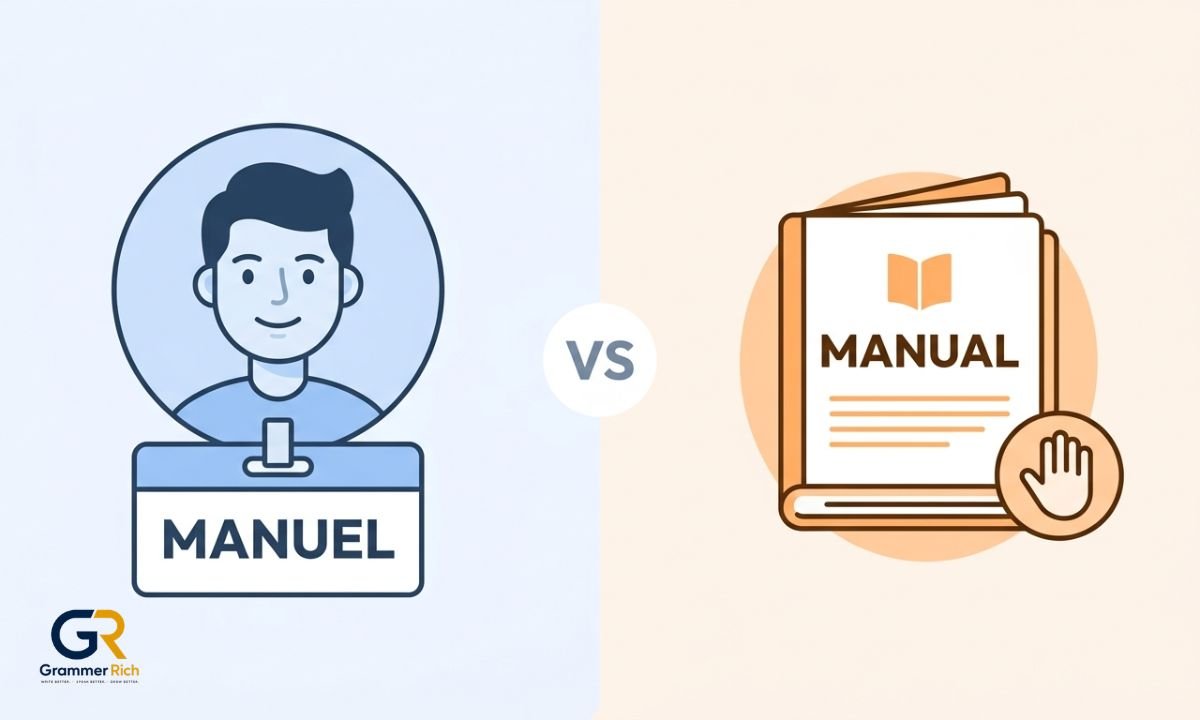
Manuel and manual are often confused because they look and sound similar, but they aren’t grammatical variants of the same word. Manuel is a proper name (a variant of Emmanuel), while manual is a common English word meaning “done by hand” or “a guidebook.” Use Manuel only for names; use manual for instructions, labor, or transmissions.
Mixing these up is an easy mistake, especially in fast typing or autocorrect. This guide breaks down Manuel vs Manual with clear examples, so you’ll never second-guess which one fits. We’ll cover spelling tricks, common errors, and quick ways to remember the difference for good.
Manuel vs Manual

At a glance, the Manuel vs Manual mix-up looks harmless. But one is a person’s name, and the other is a working English word with several meanings. Knowing which is which matters more than you’d think, especially in professional writing.
Search engines see thousands of queries every month for this exact pairing, which tells you something: this isn’t a one-off typo. It’s a genuine pattern that affects students, professionals, and even native English speakers. Understanding the Manuel vs Manual difference early saves you from repeated corrections later.
Quick Comparison
| Feature | Manuel | Manual |
| Word type | Proper noun (name) | Common noun / adjective |
| Meaning | A person’s name (variant of Emmanuel) | Done by hand; a guidebook |
| Capitalization | Always capitalized | Lowercase unless starting a sentence |
| Example | “Manuel works at the bank.” | “Read the manual first.” |
| Plural form | Manuels (rare, refers to multiple people) | Manuals |
Simple Rule to Remember
If you’re naming a person, it’s Manuel. If you’re talking about hands-on work or a set of instructions, it’s manual. That one rule solves most Manuel vs Manual confusion instantly.
What Does Manual Mean?
Manual is a flexible English word. It functions as both a noun and an adjective, and its meaning shifts slightly depending on context.
Manual Definition in English
According to standard dictionary definitions, manual refers to something operated or done by hand, or a book of instructions. Merriam-Webster and Cambridge Dictionary both confirm this dual meaning, listing it as one of the more commonly searched terms in the Manuel vs Manual comparison.
Because manual carries two distinct uses — noun and adjective — it shows up in far more contexts than Manuel ever will. That versatility is part of why the Manuel vs Manual question keeps coming up in grammar forums and search results alike.
Manual Meaning as a Noun
As a noun, manual describes a reference book. Think of any product you’ve bought that came with a booklet explaining how to use it. Whether it’s a two-page pamphlet or a three-hundred-page technical guide, the underlying function stays the same: it walks the reader through steps, features, or procedures they need to understand.
Manuals also vary by industry. A software manual might focus on screenshots and click-by-click instructions, while a medical device manual emphasizes safety warnings and compliance details. The format changes, but the goal — clear, step-based guidance — never does.
Common Examples
- User manual
- Instruction manual
- Training manual
- Operations manual
- Safety manual
- Repair manual
Examples of Manual in a Sentence
- “I lost the manual for my washing machine.”
- “The training manual explains every safety procedure.”
- “Check the repair manual before opening the engine.”
Manual Meaning as an Adjective
As an adjective, manual describes something done using human effort rather than a machine. This sense of the word has been around for centuries, tracing back to the Latin “manus,” meaning hand — which is also where words like “manufacture” and “manuscript” come from.
Understanding that root helps explain why manual attaches so naturally to physical, hands-on tasks. It’s baked into the word’s DNA.
Common Uses
- Manual labor
- Manual work
- Manual control
- Manual operation
- Manual transmission
- Manual mode
Example Sentences
- “This job requires a lot of manual labor.”
- “She prefers driving a car with manual transmission.”
- “The camera has a manual mode for advanced photographers.”
What Does Manuel Mean?
Unlike manual, Manuel isn’t a descriptive word at all. It’s a given name, popular across Spanish, Portuguese, and French-speaking cultures.
Manuel Meaning
Manuel is a variant of Emmanuel, a name with Hebrew origins meaning “God is with us.” It’s used exclusively as a first name and has no dictionary definition beyond that.
This is where the Manuel vs Manual comparison gets interesting: one side of the pair carries centuries of cultural and religious history, while the other is a purely functional English term. They simply happen to look alike on paper.
Where These Words Come From
Understanding word origins makes the Manuel vs Manual distinction stick even better. Manual traces back to the Latin word “manualis,” meaning “of the hand,” which itself comes from “manus” (hand). That root shows up in dozens of English words — manufacture, manuscript, manipulate — all connected by the idea of hands-on creation or control.
Manuel has a completely different lineage. It comes from the Hebrew name Immanuel, meaning “God is with us,” and traveled into Spanish, Portuguese, and French as a personal name over centuries of religious and cultural exchange. The two words never crossed paths linguistically — they only look similar because of a coincidence in spelling, not shared history.
Also, read this Blog:Targetted vs Targeted
Is Manuel a Word in English?

No — Manuel is not a standard English word. It’s a proper noun, so it doesn’t appear in general dictionaries the way manual does. This is the core reason the Manuel vs Manual mistake happens so often; people assume both are interchangeable spellings of the same term.
Example Sentences
- “Manuel moved to Chicago last spring.”
- “My neighbor Manuel fixed my fence.”
- “Manuel and his brother own a small bakery.”
When Both Words Appear Together
Some workplaces actually create this exact mix-up in real life. A company might employ someone named Manuel who also writes or updates a manual for the team. In this case, both words are correct in the same sentence: “Manuel updated the training manual this week.” The capital letter is the only thing separating a person from a document.
Why Writers Confuse Manuel vs Manual
The Manuel vs Manual error usually comes down to habit, not ignorance. Both words share the same first six letters, and autocorrect tools sometimes swap them without warning.
Main Reasons for the Mistake
- Similar spelling and pronunciation
- Autocorrect and predictive text errors
- Typing quickly without proofreading
- Unfamiliarity with proper noun capitalization rules
- Regional name familiarity (Manuel is common in several languages)
ESL learners in particular sometimes struggle here, since English capitalization rules for proper nouns don’t always exist in their native language. That gap makes the visual difference between Manuel and manual less obvious at a glance, even though the words serve completely different grammatical roles.
Why Manuel Is Incorrect Spelling in Most Writing
Outside of referring to a person named Manuel, using it instead of manual is simply a spelling error.
Incorrect Example
“Please read the Manuel before assembling the shelf.”
Correct Version
“Please read the manual before assembling the shelf.”
Situations Where Manual Is Used

Manual shows up constantly in everyday and professional writing. Here’s where you’ll see it most — and where the Manuel vs Manual mix-up would look most out of place.
Technology and Software
Tech companies rely on manuals to explain setup, troubleshooting, and features. A user manual is often the first thing customers open after unboxing a device. Nobody searches for a “Manuel” when their Wi-Fi router stops working — they search for a manual.
Software companies have also adapted the word for digital use. Online help centers, PDF guides, and in-app walkthroughs are all modern versions of the traditional manual. Some companies even call these resources a “digital manual” or “interactive manual” to distinguish them from printed booklets, but the core meaning stays the same: step-by-step, hands-on guidance.
Automotive Industry
Car buyers frequently compare manual vs automatic transmissions. A manual transmission requires the driver to shift gears by hand, while automatic does it for them. This is one more everyday reminder of how the Manuel vs Manual distinction plays out in real life.
Mechanics, dealerships, and driving instructors use the word constantly, and rarely with any ambiguity. “Can you drive manual?” is a common question in job interviews and car sales alike, and everyone instantly understands it refers to gear-shifting skill, not a person named Manuel.
Workplace Training and Documentation
Businesses depend on training manuals and operations manuals to keep employees aligned. These documents standardize processes and reduce onboarding time. In HR writing, misspelling manual as Manuel can make an entire document look unpolished.
Safety manuals carry even higher stakes. In industries like construction or manufacturing, a poorly written or mislabeled safety manual isn’t just a spelling problem — it’s a liability risk. Clear, correctly spelled documentation genuinely protects people.
Manual vs Automatic Meaning
This is a related but separate comparison from Manuel vs Manual. Manual vs automatic refers to control methods — manual means hands-on, automatic means machine-controlled. It’s a common phrase in cars, cameras, and industrial equipment. Don’t confuse this pairing with the spelling question at the heart of this guide; they’re two different topics that just happen to share a word.
Manuel vs Manual Examples in Sentences
Seeing both words side by side makes the Manuel vs Manual distinction easier to internalize.
Sentences Using Manuel
- “Manuel graduated from university last year.”
- “I met Manuel at a conference in Madrid.”
- “Manuel’s restaurant just opened downtown.”
Sentences Using Manual
- “The manual walked us through every installation step.”
- “Manual data entry takes longer than automated systems.”
- “She switched the machine to manual mode.”
A Small Spelling Error With Big Consequences
Writing Manuel instead of manual — or the reverse — can look careless in resumes, emails, and official documents. Small errors like this quietly damage credibility, even when the rest of the writing is strong. Getting Manuel vs Manual right signals attention to detail.
Editors and hiring managers notice these slips more than people expect. A single Manuel vs Manual mistake in a cover letter won’t sink an application, but it does chip away at the polished impression you’re trying to make.
Easy Tricks to Remember the Correct Spelling
A few simple tricks make the Manuel vs Manual choice automatic.
Trick One
If you can replace the word with “by hand,” it’s manual. “Manuel” can never be swapped that way.
Trick Two
Names are always capitalized. If the word is capitalized mid-sentence and it’s not starting a new sentence, double-check whether you actually mean a person.
Trick Three
Say it out loud in context. “Read the Manuel” sounds odd because Manuel is a person, not a book.
Why Correct Spelling Matters in Writing
Spelling accuracy isn’t just about grammar rules — it affects how readers perceive your writing. The Manuel vs Manual pair is a small example of a much bigger principle: precision builds trust.
Effects of Spelling Errors
- Reduces trust and perceived professionalism
- Confuses readers about intended meaning
- Hurts SEO rankings when keywords are misspelled
- Slows down editing and proofreading time
Writers who consistently get Manuel vs Manual right tend to be more careful across the board — it’s a small but telling signal of overall attention to detail.
Quick Manuel vs Manual Comparison
| Situation | Correct Word |
| Referring to a person’s name | Manuel |
| Referring to a guidebook | Manual |
| Describing hand-operated tasks | Manual |
| Talking about someone named Manuel | Manuel |
| Discussing car transmissions | Manual |
Other Common English Spelling Confusions
The Manuel vs Manual issue isn’t unique. English is full of similar-sounding word pairs that trip up even experienced writers, like affect vs effect, complement vs compliment, and stationary vs stationery. Once you understand why this particular pair causes confusion, spotting these other patterns gets a lot easier.
Reference Cambridge Dictionary Definitions
For an authoritative definition of manual as both noun and adjective, Cambridge Dictionary offers clear, well-sourced explanations that confirm everything covered in this guide. Merriam-Webster echoes the same core definitions, listing manual as both “of, relating to, or involving the hands” and “a small book giving instructions.”
Neither dictionary lists Manuel, because dictionaries generally exclude personal names unless they’ve taken on a broader cultural meaning. That absence is itself useful evidence: if a word doesn’t appear in a standard dictionary, it’s almost certainly a proper noun rather than a common English term.
Quick Self-Check
Before hitting publish or send, ask one question: am I referring to a task, a document, or a person? If the answer is “a person,” keep the capital M. If it’s anything else — labor, instructions, control — lowercase manual is the only correct choice.
Conclusion
The Manuel vs Manual mix-up comes down to one simple rule: Manuel names a person, manual describes hands-on work or a set of instructions. Keep that distinction in mind, and the confusion disappears for good.
Whenever you’re unsure, pause and ask what you actually mean — a person or a process. That one-second check is really all the Manuel vs Manual decision takes. Now you’ll never mix them up again.

Welcome to Grammarrich.com, your trusted source for grammar tips, writing guides, and language learning. With 5 years of experience in the grammar niche, our goal is to provide clear, accurate, and easy-to-understand content that helps everyone write with confidence.