

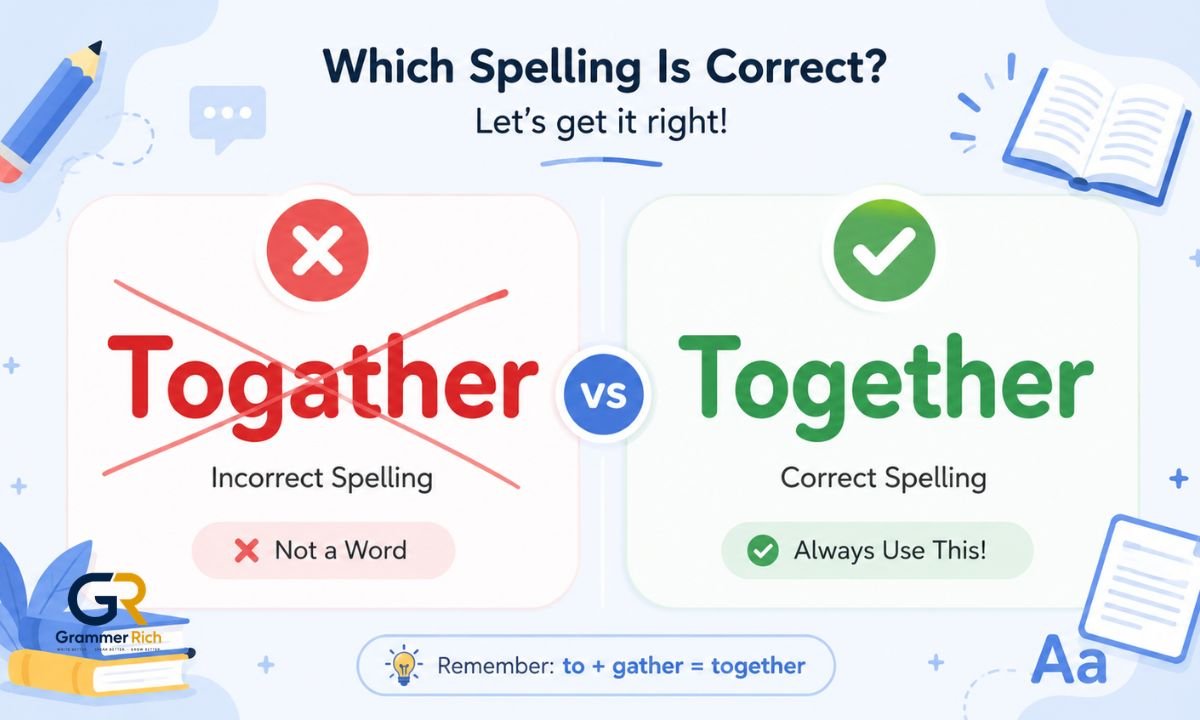
“Togather” is not a real word — it’s a common misspelling of “together,” which means “in the same place, time, or group” or “as one unit.” No dictionary or style guide recognizes “togather” as a valid variant. In every context, formal or casual, “together” is the correct spelling to use.
So why does this mix-up happen so often? Blame it on how English sounds versus how it’s spelled. The togather vs together mistake usually comes down to typing speed, autocorrect gone rogue, or just muscle memory misfiring. Below, we’ll break down where this confusion started, how to spot it instantly, and simple tricks to make sure you never type it wrong again.
Togather vs Together Correct Spelling
Which is correct togather or together?
Let’s settle this right away: “together” is correct, and “togather” is incorrect in every context — formal, casual, academic, or professional. There’s no version of English, no regional dialect, and no dictionary that lists “togather” as an acceptable spelling. It’s simply a misspelling that spreads because it sounds like it could be right.
If you’re still debating togather vs together in your head, stop. The rule doesn’t change based on tone or context. Together is the word. Full stop.
Why Correct Spelling Matters
Spelling errors like this one might seem small, but they add up fast. A single “togather” in a resume, email, or article can:
- Undermine your credibility as a writer
- Distract readers from your actual message
- Signal carelessness to editors, teachers, or hiring managers
- Hurt your content’s SEO and readability scores
Getting togather vs together right isn’t just about grammar pride — it’s about being taken seriously in writing.
The Meaning of “Together”
Together Definition
According to standard dictionary definitions, “together” is an adverb meaning “in or into one place, group, or mass” or “in a way that involves mutual action, cooperation, or company.” It describes unity, shared action, or things happening at the same time.
How “Together” Works in Real Sentences
Here are a few natural examples:
- “We walked together to the station.”
- “The team worked together to hit the deadline.”
- “Let’s put the pieces together.”
Notice how “together” always connects people, objects, or actions into one shared unit. That’s the core idea behind the word, and it’s why the togather vs together confusion trips people up — the concept feels casual, so the spelling feels like it should be casual too. It isn’t.
Meaning Across Contexts
“Together” flexes across situations without changing spelling:
- Physical closeness: “They sat together on the bench.”
- Collaboration: “We built the project together.”
- Emotional bond: “They’ve been through a lot together.”
- Timing: “The events happened together, almost simultaneously.”
No matter the context, the spelling stays the same. That consistency is exactly what makes the togather vs together error so avoidable once you know the rule.
Togather vs Together on Reddit

Search any grammar forum, including Reddit threads, and you’ll find the same consensus repeated by native speakers and ESL learners alike: “togather” isn’t a word, and people who type it are almost always just typing fast or mishearing the pronunciation. Community answers to togather vs together questions consistently point back to one source — standard dictionaries — rather than debating the issue.
Why “Togather” Appears So Often
Primary Causes of the Mistake
The togather vs together mistake isn’t random. It has identifiable causes rooted in how we hear, type, and process language.
Phonetic Spelling Errors
English spelling doesn’t always match pronunciation. “Together” is pronounced with a schwa sound in the first syllable, which can blur into what sounds like “togather” when spoken casually or quickly.
Spelling vs Pronunciation Differences
This is a classic case of spelling and pronunciation disagreeing. Many English words don’t sound the way they’re spelled, and “together” is a textbook example of why relying purely on ear can lead you astray.
Typing Habits
Fast typing, autocorrect gaps, and muscle memory all contribute. Once someone types “togather” a few times without correction, the error can start to feel familiar — even normal.
Cognitive Simplification
Our brains like patterns. Because “gather” is a common, standalone word, some writers unconsciously merge “to” and “gather,” assuming “togather” makes logical sense. It doesn’t, but the mental shortcut is understandable.
Example
Compare: “Let’s togather our things” (incorrect) versus “Let’s gather our things together” (correct). The second sentence shows how “gather” and “together” are related in meaning but never combined into one misspelled word.
Also, read this blog : Manuel vs Manual: Meaning, Spelling, and Correct Usage
Together Spelling in English

Standard English has one accepted spelling: t-o-g-e-t-h-e-r. There’s no hyphenated version, no alternate British/American spelling split, and no acceptable shorthand in formal writing. This consistency is part of why the togather vs together question has such a clear-cut answer.
The Origin of “Together” (Why the Spelling Makes Sense)
“Together” comes from Old English “tōgædere,” a combination of “tō” (to) and “gædere” (related to “gathered”). Over centuries, the spelling evolved into the modern form we use today, but the core idea — bringing things into one place — never changed.
What This Means Today
Understanding the word’s origin helps explain the spelling. It wasn’t built from “gather” as a modern verb attached to “to.” It evolved as one unit, which is why breaking it apart into “to” + “gather” (or misspelling it as “togather”) doesn’t reflect how the word actually developed.
Memory Tip
Here’s a simple trick: think of “get” hiding inside “together” — to-GET-her. If you can spell “get,” you can spell “together” correctly every time, no more togather vs together guessing required.
Pronunciation vs Spelling: The Root of the Problem

Standard Pronunciation
“Together” is pronounced tuh-GEH-ther, with stress on the second syllable. The first syllable is often reduced to a quick, soft sound.
Why It Gets Misheard
That soft first syllable is exactly where “togather” comes from. Speakers hear something close to “tuh” and mentally round it up to “to,” pairing it with the more familiar word “gather.”
Practical Solution
Read the word aloud slowly, syllable by syllable: to-geth-er. Saying it deliberately, rather than quickly, reinforces the correct spelling and helps end the togather vs together habit for good.
Common Misspellings Related to “Together”
Frequent Errors
Beyond “togather,” writers commonly produce these variants:
- Toghether
- Togeather
- Togeder
- Togethor
All of these are incorrect. Only “together” is standard.
Clarifying a Common Question
Some people also wonder about “to gather” as two separate words. That phrase is legitimate — but it means something different, as in “we need to gather the documents.” It’s not a variant spelling of “together,” just a coincidental lookalike that fuels the togather vs together confusion.
How to Use “Together” Correctly in Sentences
Examples by Context
Everyday Use
“My family eats dinner together every Sunday.”
Workplace
“Our departments collaborated together to launch the campaign.”
Relationships
“They’ve built a life together over the past decade.”
Instructions
“Mix the dry ingredients together before adding the eggs.”
Case Study: Writing Impact
A small business once ran an email campaign with the subject line “Let’s Grow Togather in 2026.” The typo drew public mockery on social media and was cited as a reason open rates dropped for follow-up emails. It’s a small but real example of how one togather vs together slip can affect brand trust.
Togather vs Together: Examples
| Incorrect (Togather) | Correct (Together) |
| We stayed togather all night. | We stayed together all night. |
| Let’s work togather on this. | Let’s work together on this. |
| They grew up togather. | They grew up together. |
| Put it all togather. | Put it all together. |
Together vs Altogether vs All Together
Together vs Altogether
“Altogether” means “completely” or “entirely,” as in “The plan was altogether different.” It has nothing to do with location or grouping — it’s an intensifier.
Together vs All Together
“All together” means everyone or everything in one place at the same time, as in “The family was all together for the holidays.” It’s two words, unlike “altogether.”
Comparison Table
| Word | Meaning | Example |
| Together | In the same place/group | “We traveled together.” |
| Altogether | Completely, entirely | “That’s altogether unnecessary.” |
| All together | Everyone/everything combined at once | “The choir sang all together.” |
Understanding this trio helps clear up more than just togather vs together — it resolves nearly every related mix-up in one go.
Synonyms for “Together”
Common Alternatives
- Jointly
- Collectively
- In unison
- Side by side
- As one
- In collaboration
Example
“The volunteers worked jointly to rebuild the shelter” carries the same meaning as “The volunteers worked together to rebuild the shelter.”
Antonyms of “Together”
Together Antonym
- Apart
- Separately
- Individually
- Alone
Example
“They chose to work separately” is the direct opposite of “They chose to work together,” and neither example ever involves the misspelling “togather.”
Spelling Strategies to Avoid Errors
Effective Techniques
- Break the word into syllables: to-geth-er
- Use the “get” memory trick (toGETher)
- Read your writing aloud before submitting it
- Use a spellchecker, but don’t rely on it fully — some tools miss context errors
- Practice writing the word in full sentences, not isolation
Practical Writing Tip
Every time you’re tempted to type quickly and risk the togather vs together error, pause for two seconds. That small habit prevents most spelling mistakes before they happen.
Fill in the Blanks: Practice Togather vs Together
Instructions
Choose the correct word to complete each sentence.
- We should stay _____ during the storm.
- The kids played _____ in the yard.
- Let’s put this puzzle _____.
- They moved _____ after getting married.
(Answer: all four blanks should be filled with “together.”)
Practice Questions
Choose the Correct Answer
- Which is correct: “togather” or “together”?
- True or False: “Togather” is an accepted informal spelling.
- Fill in the blank: “We built this business _____.”
Answer Key
- Together
- False
- Together
Quick Insight
If you got all three right, you’ve already mastered the togather vs together rule better than a surprising number of native English writers.
Mini Challenge (Trick Round)
Spot the error: “Togather we can acheive anything if we stay commited.”
Mini Challenge Answers
Corrected: “Together we can achieve anything if we stay committed.” Three errors were hiding in that sentence — did you catch all of them?
Final Tip
When in doubt, say the word slowly and picture “get” inside it. That one trick solves the togather vs together dilemma permanently.
Key Points to Remember
- “Together” is always correct; “togather” is always wrong
- The error comes from pronunciation, not logic
- “To gather” (two words) is a separate, valid phrase with a different meaning
- Altogether and all together are different words entirely
- Reading aloud and slow typing both reduce errors
Reference: Dictionary Definitions
Standard dictionaries, including Cambridge Dictionary, consistently define “together” the same way — as being in the same place, time, or unified action — with no alternate spelling listed.
Conclusion
The togather vs together debate really isn’t a debate at all. Together is correct; togather is a misspelling caused by how the word sounds rather than how it’s built. Once you understand the pronunciation trap and use a simple memory trick like spotting “get” inside the word, the mistake becomes easy to avoid for good. Now you’ll never mix them up again.

Welcome to Grammarrich.com, your trusted source for grammar tips, writing guides, and language learning. With 5 years of experience in the grammar niche, our goal is to provide clear, accurate, and easy-to-understand content that helps everyone write with confidence.