

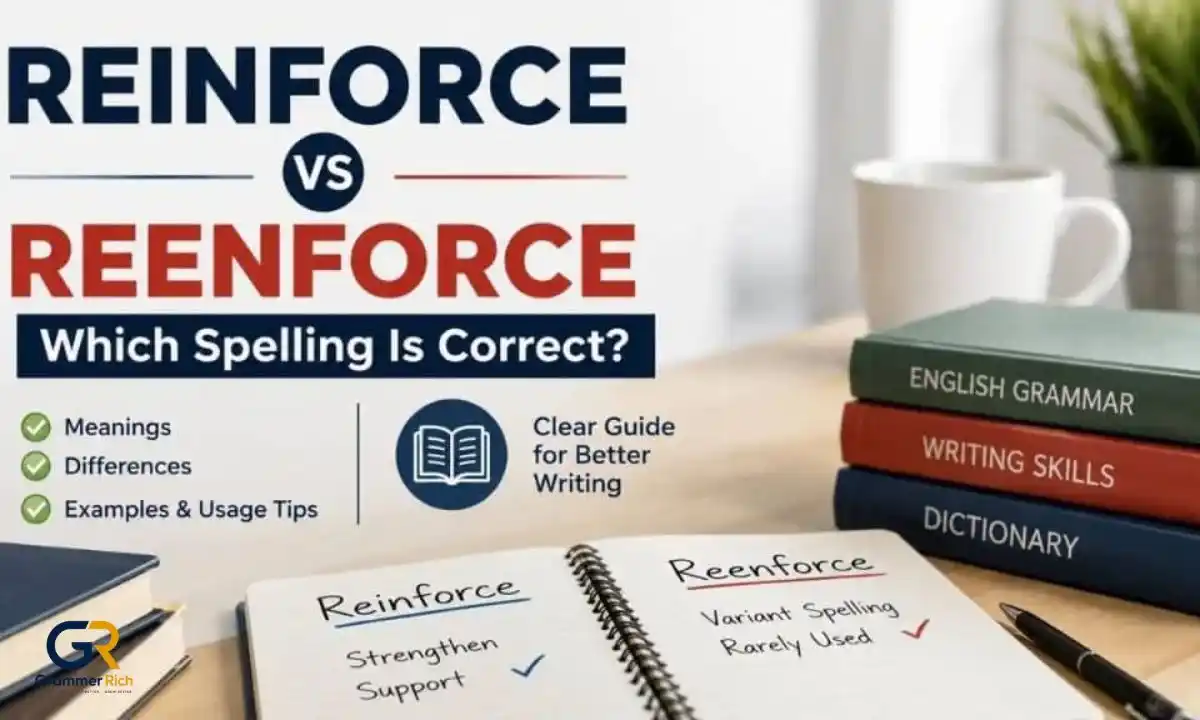
Reinforce is the correct and standard spelling, meaning to strengthen or support something further. Reenforce is a nonstandard variant that occasionally appears in casual writing but isn’t recognized by major dictionaries. So whether you’re reinforcing a wall, an argument, or a habit, “reinforce” is the spelling to use every single time.
Ever paused mid-sentence, unsure whether to write reinforce or reenforce? You’re not alone — this mix-up trips up even confident writers. In this guide, we’ll break down where the confusion comes from, why “reenforce” keeps sneaking into drafts, and how to spell it right without a second thought.
Quick Answer
If you’re in a hurry, here’s the short version: reinforce is the only spelling accepted in modern English. The Reinforce or Reenforce debate isn’t really a debate at all — dictionaries, style guides, and grammar checkers all agree that “reenforce” is not standard. You’ll sometimes spot “reenforce” in old texts or informal writing, but it won’t pass a professional edit today. Save it, bookmark it, or just remember this rule: one word, no extra “e,” always reinforce.
Meaning of Reinforce vs Reenforce
Understanding the Reinforce or Reenforce question starts with meaning, not just spelling. Both forms are meant to describe the same idea — making something stronger — but only one of them is considered correct in modern usage. This distinction matters more than it might seem, especially if you’re writing something that will be published, graded, or reviewed by an editor.
Reinforce
Reinforce means to make something stronger, more solid, or better able to withstand pressure. It applies to physical objects (reinforcing a bridge with steel), abstract ideas (reinforcing an argument with evidence), and behaviors (reinforcing a habit through repetition). This is the version you’ll find in every major dictionary, and it’s the one taught in schools and used in professional, academic, and everyday writing. Whenever the Reinforce or Reenforce question comes up in a classroom or workplace setting, “reinforce” is the answer teachers and editors will expect.
Reenforce
Reenforce carries the same intended meaning as reinforce, but it’s an outdated or archaic spelling that fell out of use as English spelling conventions standardized. You might still see it pop up in older documents, informal online comments, or as a simple typo. When people search for Reinforce or Reenforce, they’re usually trying to confirm that “reenforce” isn’t a modern, acceptable alternative — and it isn’t. Some writers assume “reenforce” must be valid because it looks logical on the page, but logic doesn’t always match dictionary convention.
Reinforce or Reenforce Synonym

Since reinforce is the correct choice, it helps to know its synonyms so your writing doesn’t feel repetitive. Common alternatives include:
- Strengthen
- Support
- Fortify
- Bolster
- Solidify
- Enhance
- Buttress
- Shore up
Swapping in one of these synonyms is often a cleaner solution than second-guessing the Reinforce or Reenforce spelling altogether, especially in formal writing where variety matters.
Why Reinforce Is the Preferred Spelling
The short answer to Reinforce or Reenforce comes down to standardization. English spelling has evolved over centuries, and many words that once had multiple accepted forms have settled into a single standard spelling. Reinforce won out because it aligns with how the prefix “re-” typically attaches to root words without doubling the vowel sound unnecessarily.
Modern dictionaries — including Merriam-Webster and Cambridge Dictionary — list only “reinforce” as the standard spelling. “Reenforce” simply isn’t included as a recognized variant, which means spell-checkers, grammar tools, and editors will flag it every time. If you’re writing for academic, professional, or published work, this makes the Reinforce or Reenforce choice an easy one.
It also helps to think about how language naturally simplifies over time. Early printed English had far more spelling variation than it does today, partly because there was no centralized authority setting the rules. As dictionaries became widely used references, spellings converged, and “reinforce” is one of many words that settled into a single accepted form. This is part of why the Reinforce or Reenforce question rarely comes up in formal grammar guides — it was resolved long ago, even if individual writers haven’t caught up.
Reinforce or Reenforce Examples

Seeing the correct word in context often clears up confusion faster than any rule. Here are a few examples:
- The contractor decided to reinforce the foundation before winter.
- Her calm response helped reinforce his confidence during the interview.
- Teachers often reinforce good habits through positive feedback.
- The company reinforced its safety policies after the incident.
- We need to reinforce this shelf; it’s starting to sag.
Notice that none of these use “reenforce” — that’s intentional, since it’s not the accepted spelling in any context. Whenever you’re drafting a sentence and the Reinforce or Reenforce question pops into your head, picture one of these examples and reach for “reinforce” without hesitation.
Comparison Table: Reinforce vs Reenforce
| Feature | Reinforce | Reenforce |
| Standard spelling | Yes | No |
| Found in modern dictionaries | Yes | No (or listed as obsolete) |
| Used in academic/professional writing | Yes | Rarely, considered an error |
| Common in casual/typo contexts | No | Yes |
| Recommended usage | Always | Never |
This table sums up the entire Reinforce or Reenforce debate in one glance: reinforce wins on every measure that matters for clear, correct writing.
Common Mistakes Writers Make
Even experienced writers slip up on Reinforce or Reenforce from time to time. Here are the most frequent errors:
- Doubling the “e” out of habit. Writers sometimes assume adding an extra “e” after “re-” mirrors other words, but it doesn’t apply here.
- Autocorrect confusion. Some outdated spell-checkers or non-English keyboard settings fail to catch “reenforce” as an error.
- Mixing it up with “re-enforce” (hyphenated). This version sometimes appears in legal or law-enforcement contexts with a different, narrower meaning — reapplying enforcement, like re-enforcing a rule — but it’s still not interchangeable with everyday “reinforce.”
- Copying old texts. Historical documents sometimes used “reenforce,” which can mislead writers into thinking it’s still valid today.
- Second-guessing after seeing it online. Because so many people type “reenforce” in forums, comment sections, and social media, some writers assume it must be an accepted alternative. Popularity online doesn’t equal correctness, and the Reinforce or Reenforce debate is a good reminder of that.
Avoiding these mistakes is mostly about awareness. Once you know the pattern, catching a stray “reenforce” in your own writing becomes second nature.
American vs British English Differences
One reason the Reinforce or Reenforce question keeps coming up is the assumption that it might be a regional spelling difference, similar to “color” versus “colour.” That’s not the case here. Both American English and British English agree: reinforce is correct, and reenforce is not a recognized British variant either. Unlike words such as “organise” versus “organize,” this isn’t a matter of regional preference — it’s simply a standardization that both English dialects share.
When to Use Reinforce (Real-Life Contexts)
The Reinforce or Reenforce question shows up across many types of writing, so it helps to see where “reinforce” naturally fits:
- Construction and engineering: reinforcing concrete, beams, or structures
- Education and psychology: reinforcing behavior or learning through repetition
- Business writing: reinforcing brand messaging or company values
- Everyday conversation: reinforcing an opinion, a relationship, or a routine
- Legal and policy writing: reinforcing rules, regulations, or agreements
In every one of these contexts, reinforce is the word you want — there’s no scenario where “reenforce” becomes the better choice. Whether you’re writing a technical report or a casual email, the Reinforce or Reenforce answer stays the same across every industry and audience.
Synonyms of Reinforce (LSI Keywords)
To keep your writing varied while staying correct, rotate through these related terms instead of second-guessing the Reinforce or Reenforce spelling:
- Strengthen a structure
- Support an idea
- Fortify a position
- Bolster confidence
- Solidify a habit
- Enhance durability
Each of these works well as a substitute depending on tone and context, and all of them sidestep the spelling question entirely. If you’re ever unsure mid-sentence and don’t have time to double-check Reinforce or Reenforce, swapping in a synonym like “strengthen” or “bolster” is a safe workaround while you build confidence with the correct spelling.
Memory Trick to Avoid Confusion
Here’s a simple trick to lock in the Reinforce or Reenforce answer for good: think of the word “force.” Reinforce contains “force” cleanly, with just one “e” before it — re + in + force. There’s no reason to add a second “e,” because the word isn’t built from “en-force” the way “enforce” is. If you can remember that reinforce shares its root with “force,” you’ll never misspell it again. This one mental image resolves the entire Reinforce or Reenforce debate in seconds, no grammar textbook required.
Another trick: say the word out loud slowly. “Re-in-force” naturally breaks into three clear parts, and none of them contain a second “e” before the “n.” Writers who sound out tricky words before typing them tend to make far fewer Reinforce or Reenforce mistakes in their final drafts.
Example Sentences Showing Correct Usage
- The coach’s advice helped reinforce the team’s strategy going into the final game.
- Steel bars are used to reinforce concrete pillars in tall buildings.
- Positive reviews reinforce customer trust in a brand.
- The new policy will reinforce existing safety standards.
- Practicing daily helps reinforce new vocabulary in a second language.
Each sentence above demonstrates how naturally “reinforce” fits into different subjects — physical, emotional, professional, and educational. Reading these examples aloud is a quick, effective way to train your ear for correct usage, so the next time the Reinforce or Reenforce question comes up, the right spelling feels automatic.
A Quick Note on Related Confused Words
The Reinforce or Reenforce mix-up isn’t unique. English has plenty of similar traps, like past tense vs. past participle grammar rules that confuse even native speakers. If you found this guide helpful, it’s worth brushing up on other commonly confused English words, since the same standardization logic that settled “reinforce” also applies to dozens of other tricky spellings. Understanding American vs British spelling differences can also help you avoid similar pitfalls in your writing going forward.
Reinforce or Reenforce: A Quick Recap for Fast Writers
If you skimmed straight to this section, here’s everything condensed into a few lines. Reinforce is correct in American English, British English, academic writing, business writing, and casual conversation. Reenforce is not correct anywhere, in any context, at any time — it’s simply an old or mistaken spelling that never made it into modern dictionaries. There’s no hyphen version people use casually either, aside from the narrow legal sense of “re-enforce” meaning to enforce again.
So the next time you’re typing quickly and your fingers want to add that extra “e,” pause for a second. The Reinforce or Reenforce question has a one-word answer, and it’s the version without the double “e.” Save this page, share it with a coworker who always gets it wrong, or just repeat the “force” trick to yourself until it sticks.
Conclusion
At the end of the day, the Reinforce or Reenforce question has one clear answer: reinforce is correct, and reenforce isn’t. Whether you’re writing a school essay, a business report, or a quick text message, sticking with “reinforce” keeps your writing accurate and polished. Keep the “force” trick in your back pocket, trust your dictionary over old habits, and let this guide be the last time you ever have to Google Reinforce or Reenforce. Now you’ll never mix them up again.

Welcome to Grammarrich.com, your trusted source for grammar tips, writing guides, and language learning. With 5 years of experience in the grammar niche, our goal is to provide clear, accurate, and easy-to-understand content that helps everyone write with confidence.