

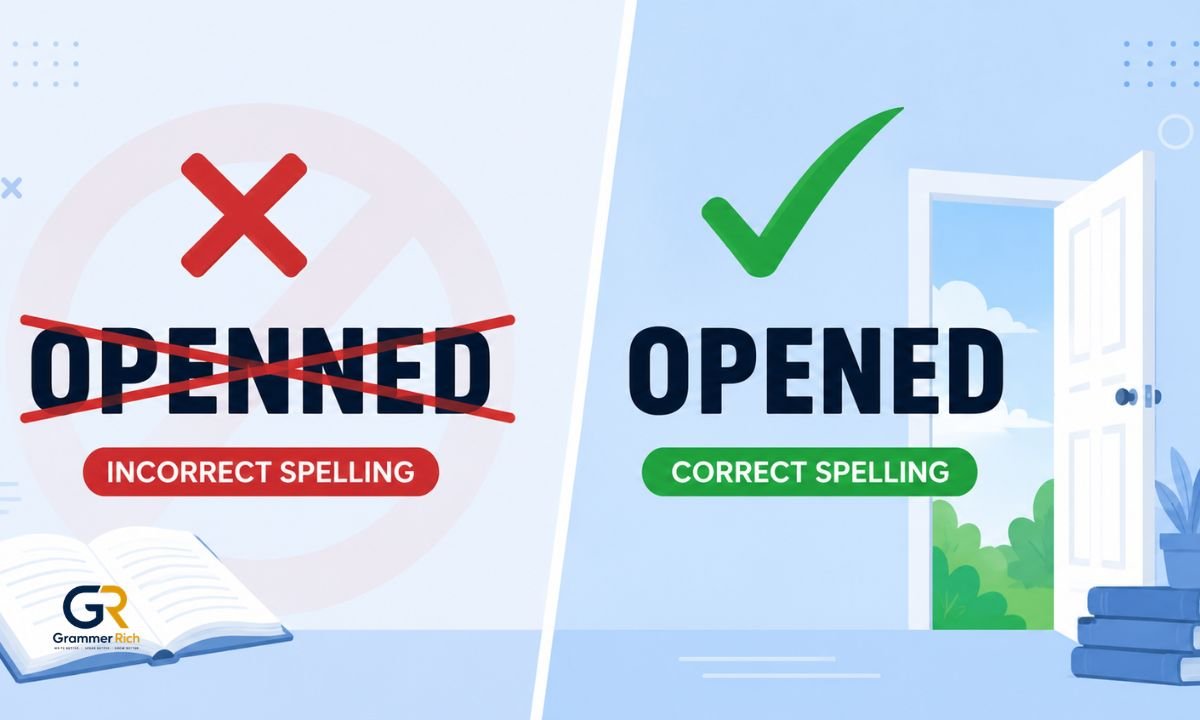
Opened” is the only correct spelling — it’s the standard past tense and past participle of “open.” “Openned” is simply a common misspelling, created by doubling the “n” where it doesn’t belong. Whether you’re writing “she opened the door” or “the store has opened,” always stick with one “n.”
Still second-guessing yourself every time you type it? You’re not alone. This confusion trips up even confident writers, and autocorrect doesn’t always catch it. In this guide, we’ll break down exactly why people mix up Openned or Opened, share memory tricks to lock in the right spelling, and walk through real examples so you never pause mid-sentence again.
Quick Answer
If you’re in a hurry, here’s the short version of the Openned or Opened debate: “Opened” is correct. “Openned” is not a word.
The verb “open” follows a regular spelling pattern in English. You simply add “-ed” to form the past tense and past participle. No consonant doubling is involved, because the stress in “open” falls on the first syllable, not the last. That single rule settles the entire Openned or Opened question in one sentence.
Meaning of “Opened”
“Opened” means that something was made to no longer be closed, sealed, or shut. It’s the past tense form of the verb “open,” and it’s also used as the past participle in perfect tenses.
A few quick examples:
- She opened the window before breakfast.
- The package has already been opened.
- He opened an email from his manager.
In every one of these cases, “opened” is doing regular verb work — describing an action that already happened, or one that’s connected to a present result. This is the correct spelling to use in every context, whether you’re texting a friend or writing a formal report. There’s no version of the Openned or Opened debate where the double-n spelling wins.
According to Merriam-Webster, the standard past tense and past participle of “open” is listed simply as “opened,” with a single “n.” No major dictionary — American or British — recognizes “openned” as an alternate or informal spelling.
Why People Mistakenly Write “Openned”
If “opened” is so clearly correct, why does “openned” show up so often? A few reasons explain the mix-up:
- Consonant-doubling confusion. English does double the final consonant in some verbs before adding “-ed” (like “stopped” or “planned”). People sometimes apply that pattern to “open” without realizing it doesn’t qualify.
- Muscle memory from similar words. Words like “planned,” “banned,” and “spanned” all end in a doubled “n.” Typing “open” quickly can trigger the same habit.
- Typing speed and autocorrect gaps. Fast typing on phones or keyboards often adds an extra letter, and not every autocorrect tool flags “openned” as wrong.
- Lack of clarity on the rule. Many English learners were never taught why some verbs double their final consonant and others don’t, so they guess.
Once you understand the actual rule, the Openned or Opened mistake becomes much easier to avoid for good.
Which Spelling Is Correct, Openning or Opening?
The same logic applies to the “-ing” form. “Opening” is correct; “openning” is not. Just like with the past tense, you don’t double the “n” because the stress doesn’t fall on the final syllable of “open.”
So whether you’re forming the past tense or the present participle, the rule stays consistent: one “n,” always. This is a helpful shortcut to remember whenever the Openned or Opened question pops back into your head.
Simple Rule to Remember
Here’s the easiest way to settle Openned or Opened for good: English doubles a final consonant before adding “-ed” only when all three of these are true:
- The word ends in a single consonant, after a single vowel.
- The word has one syllable, or the stress falls on the last syllable.
- Adding “-ed” would otherwise change the vowel sound.
“Open” fails the second test. The stress falls on the first syllable — OH-pen, not oh-PEN. That’s why you don’t double the “n.” Compare it to “prefer” (stress on the last syllable), which becomes “preferred” with two r’s.
A quick memory trick: think of “open” like “listen” or “happen.” Nobody writes “listenned” or “happenned,” and the same logic protects “opened” from the extra letter.
Comparison Table: Openned vs Opened
| Feature | Opened (Correct) | Openned (Incorrect) |
| Spelling status | Standard English spelling | Common misspelling |
| Dictionary listed | Yes — Merriam-Webster, Cambridge, Oxford | No |
| Consonant doubling rule | Does not apply (stress on first syllable) | Rule misapplied |
| Used in professional writing | Yes | No |
| Used in academic writing | Yes | No |
| Grammar checkers flag it | Not flagged (it’s correct) | Usually flagged as an error |
This table sums up the entire Openned or Opened comparison in one glance: one form is standard, the other simply isn’t recognized anywhere.
Examples in Sentences
Seeing “opened” in different contexts makes the correct spelling easier to remember for good.
Daily Conversation
- I opened the fridge and found nothing to eat.
- They opened the gate for the delivery truck.
- She finally opened up about her day.
Professional Writing
- The company opened a new branch in Karachi last quarter.
- Our team has opened three new client accounts this month.
- The meeting opened with a review of last week’s targets.
Academic Writing
- The study opened with a review of existing research.
- Researchers opened the discussion by defining key terms.
- The thesis opened new questions about climate policy.
Digital Communication
- I opened your message but haven’t replied yet.
- The app opened without any lag this time.
- She opened the shared document and left comments.
Across every single style of writing, the answer to Openned or Opened stays the same — it’s always “opened.”
Common Mistakes to Avoid
- Doubling the “n” out of habit from words like “planned” or “banned.”
- Trusting autocorrect blindly instead of proofreading.
- Assuming British and American English spell it differently (they don’t).
- Applying the consonant-doubling rule without checking where the stress falls.
- Mixing up “opened” with “opening” when the tense calls for the past form.
Avoiding these habits is the fastest way to stop second-guessing Openned or Opened every time you write.
Openned or Opened Grammar

Grammatically, “opened” can serve two roles:
- Simple past tense — describing a completed action. “He opened the store at 9 a.m.”
- Past participle — used with helping verbs like “has,” “have,” or “had,” or in passive voice. “The store has opened for the season.” / “The box was opened carefully.”
“Openned” never fits either role because it isn’t a recognized word in English grammar. Understanding this dual function of “opened” clears up most remaining confusion around Openned or Opened in everyday writing.
American vs British English Differences

Good news: this is one spelling debate where American and British English fully agree. Unlike words such as “colour/color” or “travelling/traveling,” there’s no regional variation for this verb. Both American and British dictionaries list “opened” with a single “n,” and neither recognizes “openned” as a valid regional spelling. So no matter which side of the Atlantic your audience is on, the Openned or Opened answer doesn’t change.
Related Forms of “Open”
Knowing the full verb family helps reinforce correct spelling across every tense:
- Open (base form) — Please open the door.
- Opens (present, third person) — She opens the shop at 8.
- Opening (present participle / gerund) — We’re opening a new store.
- Opened (past tense / past participle) — They opened early today.
Notice the pattern: none of these forms double the “n.” That consistency is your best defense against the Openned or Opened mix-up in the future.
Synonyms for “Opened”
Depending on context, you can sometimes swap “opened” for a synonym to add variety to your writing:
- Unlocked
- Unsealed
- Launched (for a business or event)
- Revealed
- Began (for a meeting, ceremony, or event)
- Unveiled
These alternatives can help when you want to avoid repeating “opened” too often — but remember, none of them affect how you spell “opened” itself when you do use it.
Mini Spelling Test (Try Yourself)
Test what you’ve learned. Choose the correct spelling in each sentence:
- She ________ the box carefully. (opened / openned)
- The meeting ________ with introductions. (opened / openned)
- He has already ________ the account. (opened / openned)
- They ________ a new restaurant downtown. (opened / openned)
Answer: Every single blank should be filled with “opened.” If you got all four right, you’ve fully mastered the Openned or Opened rule.
Why Correct Spelling Matters
Spelling errors like “openned” might seem small, but they add up. In professional emails, resumes, and academic papers, a misspelled word can quietly undermine your credibility, even if your ideas are strong. In digital content, incorrect spelling can also hurt readability and trust with your audience.
Getting Openned or Opened right isn’t just a grammar technicality — it’s part of writing that reads as polished, careful, and professional. A little spelling accuracy goes a long way in academic writing, professional writing, and everyday digital communication alike.
Conclusion
The rule behind Openned or Opened comes down to one simple fact: “opened” is correct, and “openned” isn’t a real word. Because the stress in “open” sits on the first syllable, English never doubles that final “n” — not in the past tense, not in the past participle, and not across British or American English. Keep that stress pattern in mind, compare it to words like “listened” or “happened,” and you’ll never trip over Openned or Opened again.

Welcome to Grammarrich.com, your trusted source for grammar tips, writing guides, and language learning. With 5 years of experience in the grammar niche, our goal is to provide clear, accurate, and easy-to-understand content that helps everyone write with confidence.