

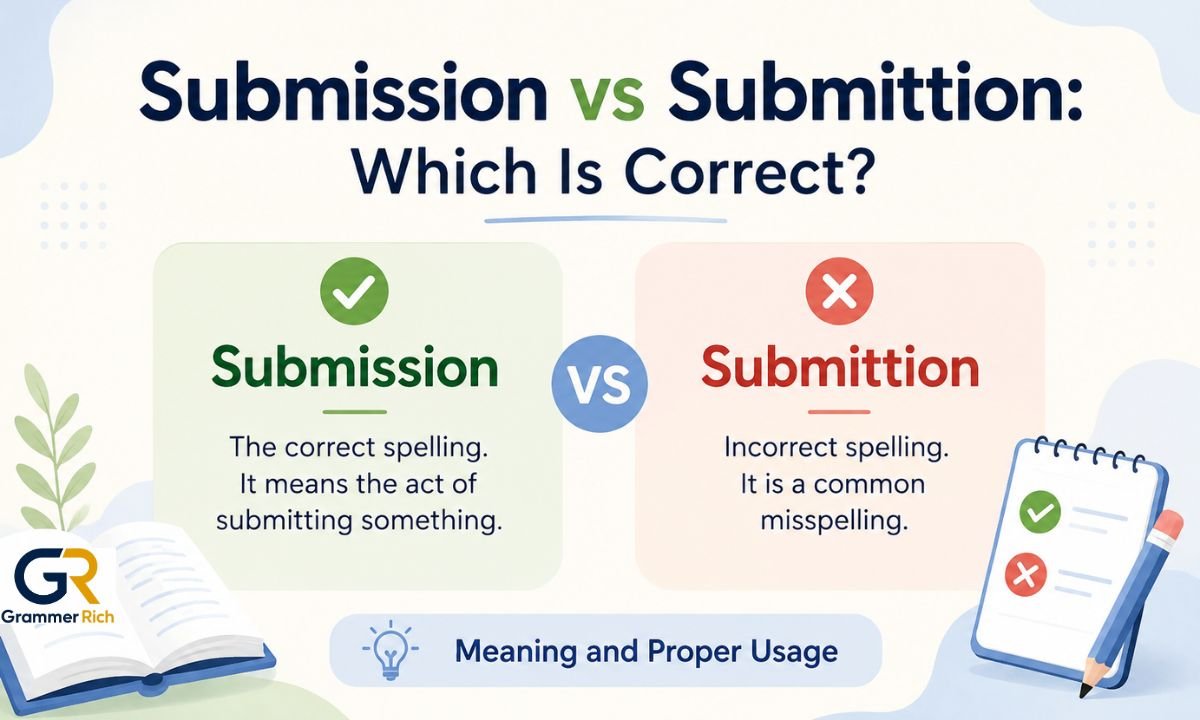
Submission is the correct spelling; Submittion is not a real word, just a common misspelling caused by an extra “t.” Submission refers to the act of presenting something for review, like a job application or research paper, or the act of yielding to authority. Always use “submission” in writing, emails, and formal documents.
Ever typed “submittion” and paused, wondering if it looked right? You’re not alone. This mix-up trips up even careful writers, especially non-native English speakers. Below, we’ll break down why the error happens, where “submission” comes from, and how to nail it every single time.
What Is the Correct Spelling: Submission or Submittion?
Let’s settle this fast. Only one of these words exists in the English language.
Correct Word
“Submission” is the correct spelling. It’s a standard English noun listed in every major dictionary, including Merriam-Webster and Cambridge Dictionary. It comes from the verb “submit” plus the suffix “-sion,” a common pattern in English word formation.
Incorrect Word
“Submittion” is not a word. It doesn’t appear in any recognized dictionary. People write it because they double the “t” from “submit” and then guess at the ending, landing on something that looks plausible but isn’t standard English.
Example Sentences
- Correct: “Please complete your submission before the deadline.”
- Incorrect: “Please complete your submittion before the deadline.”
- Correct: “The report’s submission was delayed by two days.”
- Incorrect: “The report’s submittion was delayed by two days.”
Why People Confuse Submission and Submittion
This isn’t a random typo. There are real patterns behind why writers make this mistake so often.
Double “T” Confusion in English
English has plenty of words where a consonant doubles before a suffix is added — think “submitted” or “submitting.” Writers sometimes assume the same doubling rule applies when forming the noun, but it doesn’t. The noun form drops back to a single “t” and adds “-sion” instead.
Pronunciation Makes It Harder
When people say “submission” out loud, the middle sound can blur, making it easy to mishear the spelling and assume there’s a double “t” followed by “-ion.” Pronunciation-based guessing is one of the biggest sources of English spelling mistakes.
Typing and Autocorrect Errors
Fast typing and inconsistent autocorrect settings also play a role. On some devices, “submittion” doesn’t get flagged immediately, especially in casual apps with weaker spell-check, letting the error slip through into emails and documents.
Understanding the Word Submission
“Submission” carries a few related meanings depending on context, but they all trace back to the verb “submit.”
Submission in Education
Students use “submission” constantly — assignment submission, essay submission, or final project submission. It refers to handing in work for evaluation, often through an online portal with a strict deadline.
Submission in Business
In professional settings, “submission” might refer to a proposal submission, report submission, or application submission. Business communication relies on precise language, so getting this word right matters for credibility.
Submission in Legal or Formal Contexts
In legal writing, “submission” can also mean a formal argument or statement presented to a court or authority. It’s also used more broadly to describe yielding or deferring to someone else’s authority or decision.
Submission vs Submittion: Key Differences Explained
| Feature | Submission | Submittion |
| Correct spelling | Yes | No |
| Found in dictionaries | Yes (Merriam-Webster, Cambridge) | No |
| Word type | Noun | Not a recognized word |
| Common usage | Academic, business, legal, formal writing | None — always an error |
| Root word | Submit | Misapplied form of “submit” |
Why “Submission” Uses “-sion”
English often converts verbs ending in “-mit” into nouns using “-ssion” or “-sion.” Look at similar pairs: “permit” becomes “permission,” and “transmit” becomes “transmission.” “Submit” follows the exact same pattern, becoming “submission.” Once you spot this rule, the correct spelling becomes much easier to remember.
Common Situations Where People Use Submission

You’ll encounter this word constantly across different types of writing.
Academic Writing
Research papers, theses, and course assignments almost always reference a “submission” deadline or process, making correct spelling essential for credibility.
Online Forms and Websites
Contest entries, job applications, and content platforms frequently use phrases like “form submission” or “successful submission” in confirmation messages.
Also, read this: Really vs Realy
Workplace Communication
Emails discussing reports, proposals, or documents often include lines like “final submission attached” or “submission requirements,” where a spelling slip can look unprofessional.
Real-Life Example: How a Simple Spelling Mistake Affected a Job Application

A recent graduate once submitted a cover letter that read, “Thank you for reviewing my submittion.” The hiring manager noticed immediately. It wasn’t a dealbreaker on its own, but paired with a couple of other small errors, it created an impression of carelessness. The candidate later said fixing recurring spelling mistakes, including this one, noticeably improved how their applications were received.
Data and Statistics About Spelling Errors in 2025–2026
Spelling accuracy remains a measurable factor in how writing is perceived online and professionally.
Key Insights
- Commonly misspelled words tied to suffix confusion, like “submittion” for “submission,” remain among the top search queries in online grammar tools.
- Studies on hiring practices consistently show that recruiters associate frequent spelling errors with reduced attention to detail.
- Search engines increasingly favor content with clean, error-free language, since readability signals contribute to how content performs in results.
Easy Tricks to Remember the Correct Spelling
A few simple habits can make this mistake disappear for good.
Remember the Root Word
Start with “submit,” then just add “-sion.” No extra “t” needed. Picture the word breaking cleanly into two parts: “submi” + “ssion.”
Compare With Similar Words
Line it up with familiar words that follow the same pattern:
- Permit → Permission
- Transmit → Transmission
- Submit → Submission
Use Spell-Checking Tools
Most spell-checkers catch “submittion” instantly, but it’s worth double-checking manually in apps with weaker grammar support, like some messaging tools or basic text editors.
How to Avoid Spelling Mistakes in Professional Writing
Small habits go a long way toward polished, professional writing.
Step-by-Step Checklist
- Read your document once specifically scanning for spelling, not just content.
- Run a spell-checker, but don’t rely on it completely.
- Compare tricky words against a dictionary if you’re unsure.
- Keep a personal list of words you frequently misspell.
Focus on Frequently Misspelled Words
Words formed with “-mit” verbs are a known trouble spot. Keeping a mental list of these — permission, transmission, submission — helps prevent repeat mistakes.
Avoid Relying Fully on Autocorrect
Autocorrect isn’t foolproof, especially with less common phrasing or on apps with limited dictionaries. A quick manual review still matters, particularly for formal or academic writing.
Why Correct Spelling Matters for SEO and Online Writing
Spelling accuracy isn’t just about looking polished. It affects how content performs online too.
Better User Experience
Clean, error-free writing is easier to read and builds trust with visitors almost instantly.
Improved Trust and Authority
Content full of spelling mistakes can undermine a brand’s credibility, even when the underlying information is accurate.
Stronger Search Visibility
Search engines reward well-written, grammatically sound content, which tends to correlate with better rankings and lower bounce rates.
Mini Quiz: Submission vs Submittion

Test what you’ve learned with these quick challenges.
Quiz 1: Pick the Correct Spelling
Which is correct: “submission” or “submittion”? (Answer: submission)
Quiz 2: True or False Challenge
True or False: “Submittion” appears in Merriam-Webster. (Answer: False)
Quiz 3: Fill in the Blank
“Please confirm your ___ before Friday.” (Answer: submission)
Quiz 4: Grammar Check Time
Spot the error: “The submittion deadline is tomorrow.” (Answer: should be “submission”)
Quiz 5: Fast Spelling Test
Type the correct noun form of “submit” in five seconds. (Answer: submission)
Quiz 6: Vocabulary Quiz
Which suffix pattern matches “submit”? -sion or -ttion? (Answer: -sion)
Quiz 7: Office Writing Challenge
Rewrite: “Attached is my submittion for review.” (Answer: “Attached is my submission for review.”)
Quiz 8: Student Quiz Time
Is “submittion” acceptable in a college essay? (Answer: No)
Quiz 9: Spot the Mistake
“Final submittion required by 5 PM” — what’s wrong? (Answer: “submittion” should be “submission”)
Quiz 10: Easy English Quiz
Which word matches this pattern: permit → permission, submit → ___? (Answer: submission)
Quiz 11: SEO Writing Quiz
Which spelling helps content rank better for readability? (Answer: submission)
Quiz 12: Quick Learning Test
True or False: Doubling the “t” is required before adding “-ion” to “submit.” (Answer: False)
Quiz 13: Final Smart Quiz
Choose the correct sentence: “Your submission has been received” or “Your submittion has been received.” (Answer: The first one)
Conclusion
The rule here is simple: submission is correct, submittion is not. Whenever you’re writing an email, essay, or report, remember that “submit” becomes “submission,” not “submittion.” Keep the similar words — permission, transmission — in mind as a quick memory trick. Now you’ll never mix them up again.

Welcome to Grammarrich.com, your trusted source for grammar tips, writing guides, and language learning. With 5 years of experience in the grammar niche, our goal is to provide clear, accurate, and easy-to-understand content that helps everyone write with confidence.