

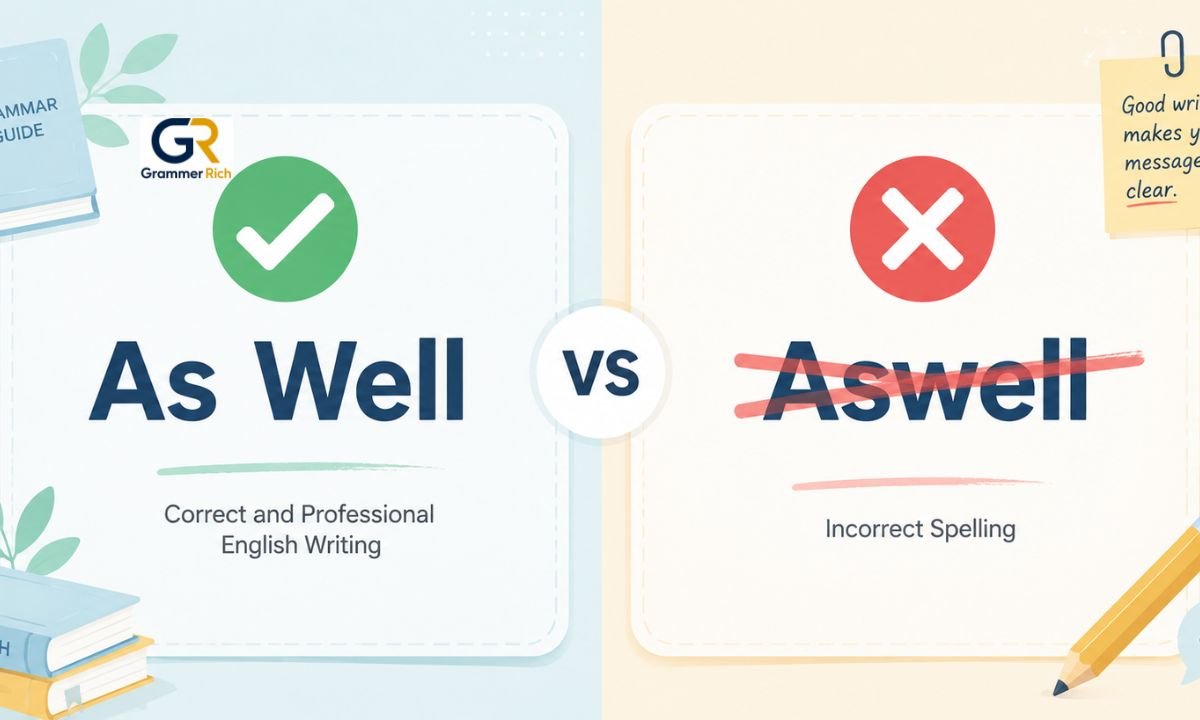
As well is the correct spelling — it’s a two-word phrase meaning “too” or “in addition.” Aswell is a common misspelling and isn’t recognized in standard English dictionaries. Always use “as well” whether you’re writing casually or formally, as in “She brought snacks as well” — never as a single fused word.
Confused about as well or aswell? You’re not alone — this mix-up trips up even confident writers. The good news is the fix is simple. In this guide, we’ll break down why “as well” wins every time, show real examples, and clear up any lingering doubt so you never second-guess it again.
What Does “As Well” Mean?
“As well” is an adverbial phrase that means “too,” “also,” or “in addition to something already mentioned.” When you’re deciding between as well or aswell, it helps to remember that the phrase is doing a small but useful job in a sentence: adding extra information without repeating what came before.
You’ll usually find it tacked onto the end of a sentence or clause. It’s flexible, natural-sounding, and works in both spoken and written English. Dictionaries such as Merriam-Webster and Cambridge Dictionary list “as well” as a standard two-word phrase — there’s no alternate one-word entry, which settles the as well vs aswell debate before it even starts.
Examples of “As Well”
- I ordered coffee, and I’ll have a croissant as well.
- She’s a great singer, and she plays the piano as well.
- We need to update the website as well as the app.
- He apologized to his manager as well as his teammates.
Each example shows the phrase adding something extra — that’s the core of the as well meaning you need to remember.
Is “Aswell” a Real Word?
No. “Aswell” is not a recognized word in any major English dictionary. If you’ve ever typed it and wondered “is aswell a word,” the honest answer is no — it’s simply a spelling mistake that has become common because of how quickly people type.
When people search as well or aswell, they’re often trying to confirm something they already suspect: that the fused version looks wrong. Trust that instinct. Standard English treats this as as well two words, full stop.
Why People Write “Aswell”
- Typing speed and autocorrect habits merge the words accidentally.
- Some compound words in English (like “however” or “nonetheless”) condition writers to assume merging is normal.
- Regional dialects and informal texting culture blur the line between formal and casual spelling.
- Visual memory — people “remember” seeing it as one word, even though they haven’t.
As Well vs Aswell: The Main Difference
The as well vs aswell comparison isn’t really a debate among grammarians — it’s a settled matter. “As well” is standard English; “aswell” is a spelling error. The confusion usually comes from habit, not from any real grammatical ambiguity.
Why “As Well” Stays Separate
English does merge some words over time — “cannot” became one word, and “alright” is creeping into casual use. But “as well” hasn’t followed that pattern. It functions as two distinct units: “as” (a linking word) and “well” (meaning “also” in this context). Because each word still carries its own grammatical role, style guides keep them apart.
Common Sentence Comparison
| Sentence Using “As Well” (Correct) | Sentence Using “Aswell” (Incorrect) |
| I’ll come to the party as well. | I’ll come to the party aswell. |
| They studied hard, and they practiced as well. | They studied hard, and they practiced aswell. |
| Please send the invoice as well as the receipt. | Please send the invoice aswell as the receipt. |
| He’s funny as well as smart. | He’s funny aswell as smart. |
This table makes the as well vs aswell distinction easy to see at a glance — the left column is publication-ready; the right column isn’t.
How to Use “As Well” Correctly in Sentences

Once you’ve settled the spelling question, the next step is sentence placement. Getting the as well correct usage right makes your writing sound more polished and professional.
Use “As Well” at the End
The most natural position for “as well” is at the end of a clause or sentence:
- “I’m attending the conference as well.”
- “She enjoys hiking, and she loves photography as well.”
Use “As Well” in Formal Writing
In as well formal writing, the phrase works well in reports, emails, essays, and professional correspondence:
- “The proposal addresses cost savings as well as long-term scalability.”
- “Our team has reviewed the contract as well as the appendix.”
Avoid Overusing It
Even correct phrases lose their punch when repeated too often. If you’ve already used “as well” twice in a paragraph, consider swapping in “also” or “too” for variety.
Common Grammar Mistakes Related to “As Well”
Even careful writers slip up here. Understanding these patterns helps you avoid the same grammatical error in your own writing.
Writing It as One Word
This is the single biggest and most common mistake tied to the as well or aswell question — fusing the two words into “aswell.” Spell-check tools sometimes miss it because “aswell” doesn’t trigger every autocorrect system.
Wrong Placement in Sentences
Placing “as well” awkwardly in the middle of a sentence, rather than at the end of a clause, can make writing sound clunky:
- Awkward: “I as well went to the store.”
- Better: “I went to the store as well.”
Confusing It With “Also” and “Too”
“As well,” “also,” and “too” share similar meanings, but they aren’t always interchangeable in terms of tone and sentence position. “Also” often starts a sentence; “too” and “as well” typically end one.
“As Well” in British vs American English
Whether you’re writing in as well British English or as well American English, the spelling never changes — only the frequency and tone of use shifts slightly.
British English
British writers and speakers use “as well” frequently in both spoken and written contexts, often favoring it over “too” in everyday conversation.
American English
American English tends to favor “too” and “also” in casual speech, but “as well” remains common in professional and academic writing across the U.S. as well.
Also, read this; Submission vs Submittion
Real-Life Example: How One Small Grammar Mistake Affected Professional Writing

A marketing coordinator once submitted a client-facing proposal that repeatedly used “aswell” instead of “as well.” The client didn’t mention the content strategy — they mentioned the typo. That single spelling slip became the takeaway from an otherwise strong pitch.
This is a small but real illustration of why the as well or aswell distinction matters beyond grammar class. Reader trust is fragile, and inconsistent spelling chips away at it, even when the ideas behind the writing are solid.
Why Correct Grammar Still Matters in 2026
With AI writing tools, grammar checkers, and autocorrect everywhere, some people assume spelling mistakes matter less than they used to. The opposite is true. As more content gets generated quickly, small, human-level accuracy — like knowing as well or aswell — has become a signal of care and credibility.
Why Search Engines Care About Readability
Search engines increasingly reward content that reads clearly and correctly. Consistent grammar, including correct spelling of “as well,” supports readability scores, keeps bounce rates lower, and builds the kind of reader trust that keeps people on the page.
Easy Trick to Remember the Correct Form
Here’s a simple shortcut for anyone who keeps second-guessing as well or aswell.
If “well” means “also,” keep it separate.
Whenever “well” is standing in for “also” or “too,” it stays as its own word, paired with “as.” That’s the whole rule.
Quick Memory Formula
Think of it like “as much” or “as often.” You wouldn’t write “asmuch” or “asoften” — so don’t write “aswell” either.
As Well vs Also vs Too
These three words are close cousins, but they behave a little differently.
| Word | Typical Position | Example |
| As well | End of sentence | “She came to the meeting as well.” |
| Also | Start or middle of sentence | “Also, she brought the report.” |
| Too | End of sentence | “She came to the meeting too.” |
Which One Should You Use?
Use “as well” in slightly more formal or polished writing, “too” in casual speech, and “also” when you want to introduce a new point at the start of a sentence.
Best Writing Tips to Avoid Grammar Mistakes

Beyond the as well or aswell issue, a few habits will sharpen your overall writing accuracy.
Proofread Slowly
Reading your work aloud, slowly, catches mistakes your eyes tend to skip over when reading silently.
Use Grammar Tools
Grammar checkers can flag “aswell” as an error, but don’t rely on them entirely — tools miss context-dependent mistakes.
Read Professional Content
Regularly reading well-edited books, articles, and publications trains your eye to notice correct patterns naturally, including the standard as well two words form.
Mini Quiz: As Well or Aswell
Test what you’ve learned about as well or aswell with this quick quiz.
Quiz 1: Which One Is Correct?
“I’ll bring dessert ___ (as well / aswell).”
Quiz 2: Spot the Mistake
“He plays guitar aswell as drums.” — What’s wrong here?
Quiz 3: What Does “As Well” Mean?
Choose the closest meaning: (a) instead of, (b) also, (c) never.
Quiz 4: Formal or Informal?
Is “as well” appropriate in a formal business email? (Yes/No)
Quiz 5: Fill in the Blank
“She’s kind, and she’s generous ___.”
Quiz 6: Grammar Check
True or False: “Aswell” appears in Merriam-Webster.
Quiz 7: Quick Choice
Pick the correct sentence: “We’ll go aswell.” or “We’ll go as well.”
Quiz 8: Similar Meaning
Which word means the same as “as well”: also, never, instead?
Quiz 9: Sentence Position
Where does “as well” usually go in a sentence?
Quiz 10: True or False
“As well” and “aswell” are interchangeable spellings.
Quiz 11: Final Challenge
Rewrite this correctly: “I like tea aswell as coffee.”
Conclusion
The rule behind as well or aswell is refreshingly simple: “as well” is always two words, and “aswell” is always a mistake. Whether you’re writing a casual text or a formal report, that one rule holds steady across British and American English alike.
Keep this guide handy the next time you pause mid-sentence, unsure whether to type “as well” or “aswell.” Now you’ll never mix them up again.

Welcome to Grammarrich.com, your trusted source for grammar tips, writing guides, and language learning. With 5 years of experience in the grammar niche, our goal is to provide clear, accurate, and easy-to-understand content that helps everyone write with confidence.