

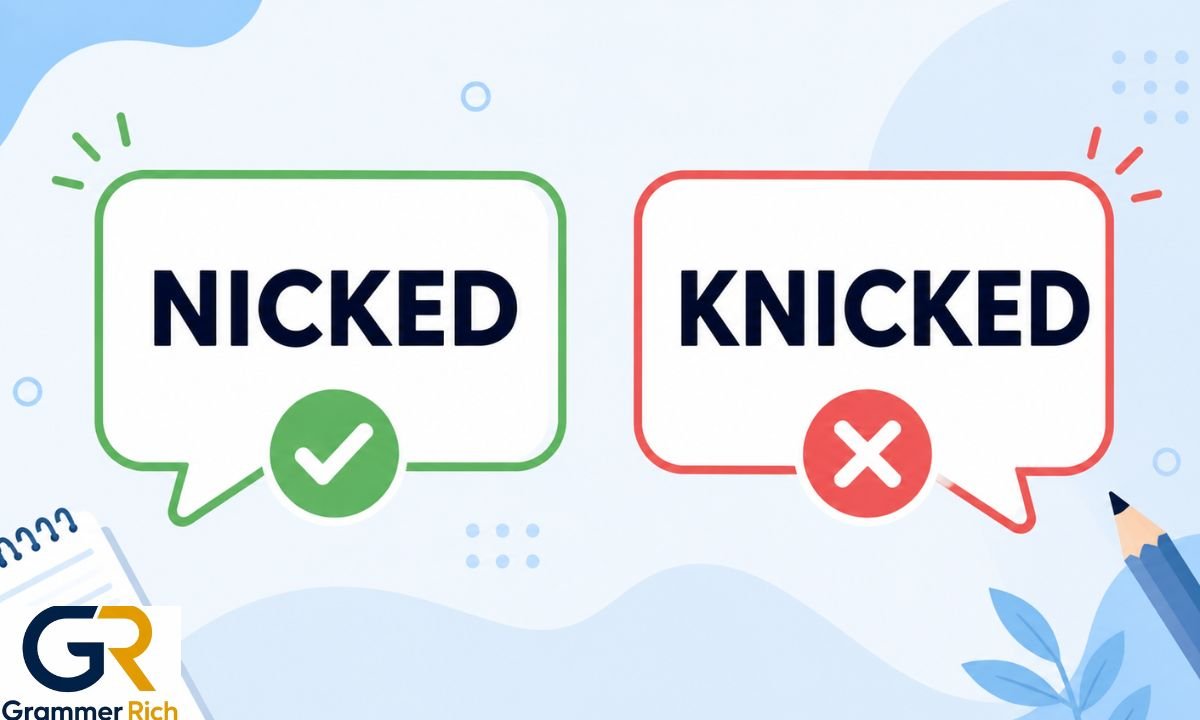
“Nicked or knicked — which one is correct? “Nicked” is the correct spelling. “Knicked” is not a real word — it’s simply a misspelling caused by the silent K sound in words like “knife” and “knee.” If you’re writing about a small cut, a minor bit of damage, a theft, or an arrest, always spell it nicked.”
Example: Correct: “He nicked his finger while chopping onions.” Incorrect: “He knicked his finger while chopping onions.”
Nicked vs. Knicked: Quick Answer
The Simple Rule
There is no “k” in “nicked.” The word comes from the verb nick, which simply means to cut, chip, steal, or catch someone. Add “-ed” for the past tense, and you get nicked — no extra letter needed.
People add the extra “k” because English has several words that start with a silent “kn” sound, such as “knife,” “knee,” “knock,” and “know.” Since these words sound like they could start with “n,” writers sometimes assume “nicked” should follow the same pattern. It doesn’t.
Quick Comparison Table
| Spelling | Correct? | Notes |
| Nicked | ✅ Yes | Standard English spelling, past tense of “nick” |
| Knicked | ❌ No | Common misspelling, not found in any dictionary |
What Does “Nicked” Mean?
Definition of Nicked
“Nicked” is the past tense and past participle of the verb nick. Depending on context, it can mean to cut something slightly, to damage something, to steal something, or (mainly in British English) to arrest someone.
Nicked as a Small Cut or Scratch
The oldest and most literal meaning of “nicked” is a small cut or notch made in a surface.
Example: “I nicked myself shaving this morning.”
This usage is common across both British and American English.
Nicked as Minor Damage
“Nicked” also describes small, superficial damage to an object — a chip, dent, or scrape.
Example: “The moving company nicked the corner of my table.”
Nicked as Stolen
In British slang, “nicked” is a casual way of saying something was stolen.
Example: “Someone nicked my bike outside the station.”
Nicked as Arrested
Also in British slang, “nicked” can mean arrested or caught by police.
Example: “He got nicked for speeding.”
What Does “Knicked” Mean?
Is Knicked a Real Word?
No. “Knicked” does not appear in any major dictionary — not Merriam-Webster, not Cambridge, not Oxford. It has no accepted definition and is treated purely as a spelling error.
Why People Write Knicked
Writers usually add the extra “k” because of pattern confusion with silent-K words like “knife,” “knit,” “knock,” and “knee.” Since “nicked” and these words share a similar sound, it’s an easy — and common — mistake.
Why Knicked Is Usually a Misspelling
Spellcheckers and dictionaries consistently reject “knicked.” In formal writing, using it will look like a typo rather than an intentional word choice, so it’s best avoided entirely.
Is a Cut a Nick or Knick?

A small cut is called a nick, never a “knick.” If you cut yourself slightly while shaving, cooking, or trimming something, you got a nick — spelled with no “k” at the start.
Correct: “I have a small nick on my chin.” Incorrect: “I have a small knick on my chin.”
Nicked vs. Knicked: Side-by-Side Comparison
| Feature | Nicked | Knicked |
| Dictionary status | Standard word | Not a word |
| Spelling | N-I-C-K-E-D | K-N-I-C-K-E-D |
| Used in formal writing | Yes | No |
| Used in casual speech | Yes | Only as a typo |
| Meaning | Cut, damage, steal, arrest | None |
The History and Origin of Nicked
Etymology of Nick
The word “nick” has an uncertain origin, and even the Oxford English Dictionary lists its beginnings as unclear. It first appeared in English in the 1500s, referring to a notch or small cut made in a surface — for example, marks cut into a wooden tally stick to keep count of something.
How Nicked Entered Modern English
By the 1600s, “nick” had extended beyond physical notches to mean catching someone unexpectedly or “nicking” them in a figurative sense — catching them at the right or wrong moment.
Development of British Slang Usage
From that idea of “catching” someone, the word gradually took on criminal associations in British English. By the 1800s, “nicked” was being used to mean stealing something, and soon after, being caught and arrested by police. The word “nick” even became slang for a police station or jail cell — as in “spending a night in the nick.”
Evolution of Meaning
Today, “nicked” carries several related meanings that all connect back to the same root idea: a small, sudden action — whether it’s a cut, a theft, or an arrest.
Why People Misspell Nicked as Knicked
The Silent K Problem
English has a group of words where “kn” is pronounced simply as “n”: knife, knee, knock, know, knit, and knight. Because these words are common, many writers assume any “n” word that starts with a similar sound should also carry a silent K.
Pronunciation Creates Confusion
Since “nicked” and “knicked” would be pronounced identically if “knicked” were real, there’s no auditory clue telling a writer they’ve made a mistake. The error only becomes visible in writing, not speech.
Similar-Looking Words Influence Memory
Brand names and proper nouns like “Knicks” (the basketball team) can also cause confusion, since the double letters look visually similar to “nicked” with an extra “k” inserted.
British English vs. American English Usage
Is Nicked Used in British English?
Yes, and quite frequently. In British English, “nicked” is common slang for both stealing and getting arrested, in addition to its literal meaning of a small cut.
Is Nicked Used in American English?
American English generally uses “nicked” only in its literal sense — a small cut or minor damage. The slang meanings of “stolen” and “arrested” are far less common in the US and may sound unfamiliar to American readers.
Also, read this: As Well or Aswell
Regional Differences
| Meaning | British English | American English |
| Small cut/scratch | Common | Common |
| Minor damage | Common | Common |
| Stolen | Common slang | Rare |
| Arrested | Common slang | Rare |
How to Use Nicked Correctly
Nicked for a Small Injury
Correct: “She nicked her knee climbing over the fence.”
Nicked for Minor Damage
Correct: “The delivery driver nicked the door frame with the box.”
Nicked for Theft
Correct: “Somebody nicked the parcel from the porch.”
Nicked for Arrest
Correct: “The suspect was nicked near the train station.”
Common Phrases and Expressions with Nicked
Got Nicked
Means “got arrested.” Example: “He got nicked for shoplifting.”
Nicked by the Police
Means to be caught and arrested. Example: “They were nicked by the police after the chase.”
Nicked from Someone
Means stolen from a person or place. Example: “My phone was nicked from my bag.”
Nicked a Little Off the Edge
Means a small piece was cut or chipped off. Example: “The knife nicked a little off the edge of the table.”
Nicked in Everyday Writing
Nicked in Conversation
In everyday spoken English, especially in the UK, “nicked” is used casually and doesn’t sound harsh or overly formal.
Nicked in Emails
In professional emails, “nicked” is best kept to its literal meaning (a small scratch or minor damage), since slang meanings can feel too casual for business writing.
Nicked in News Articles
British news outlets frequently use “nicked” in headlines and quotes, especially in crime reporting, to reflect informal or conversational tone.
Nicked in Social Media Posts
On social media, “nicked” appears often in casual, humorous, or informal posts — “lol someone nicked my parking spot.”
Nicked in Fiction Writing
Fiction writers, especially those writing British characters or dialogue, use “nicked” to add authenticity and regional voice.
Real-World Case Study: One Word, Multiple Meanings

British news headlines show how flexible “nicked” can be, depending on context.
Headline One
A headline about a theft might read: “Thief Nicked Bike From Outside Station.” Here, “nicked” means “stole.”
Headline Two
A headline about an arrest might read: “Man Nicked After High-Speed Chase.” Here, “nicked” means “arrested.”
Headline Three
A headline about minor damage might read: “Statue Nicked During Renovation Work.” Here, “nicked” means “chipped” or “slightly damaged.”
This single word carries very different meanings depending on the surrounding context — which is exactly why understanding it matters for readers and writers alike.
Common Mistakes with Nicked and Knicked

Using Knicked in Formal Writing
Incorrect: “The package was knicked from the doorstep.” Correct: “The package was nicked from the doorstep.” Why: “Knicked” isn’t a recognized English word.
Assuming Both Spellings Are Equal
Some writers assume “knicked” is simply an alternate British spelling. It isn’t — it’s a spelling error, not a regional variant.
Misunderstanding British Slang
American readers sometimes misread “nicked” (meaning arrested or stolen) as only referring to a small cut, missing the intended meaning in British content.
Nicked vs. Similar English Words
Nicked vs. Cut
“Cut” is a general term for slicing or dividing something. “Nicked” specifically implies a small, shallow cut, not a deep or deliberate one.
Nicked vs. Scratched
“Scratched” usually describes a surface mark made by dragging something sharp across it. “Nicked” implies a small chip or notch, often from a single quick action.
Nicked vs. Stolen
“Stolen” is the neutral, standard term for theft. “Nicked” is the informal, British slang equivalent.
Nicked vs. Arrested
“Arrested” is the formal, standard term used in legal and official contexts. “Nicked” is the casual British equivalent, used in speech and informal writing.
Comparison Table
| Word | Formality | Common Region |
| Nicked | Informal | UK |
| Cut | Neutral | Both |
| Scratched | Neutral | Both |
| Stolen | Neutral/Formal | Both |
| Arrested | Formal | Both |
How to Remember the Correct Spelling
Memory Trick
Think of the phrase “No Knife needed” — “nick” starts with N, not K, just like the action itself doesn’t need an extra step.
Visual Association
Picture a small notch cut into wood. “Notch” and “nick” both start with N — no K in either word.
Proofreading Tip
If you’re unsure, run a quick search for “knicked” in your document. Since it’s not a real word, most spellcheckers will flag it immediately — a fast way to catch the mistake before publishing.
Conclusion
“When comparing nicked or knicked, “nicked” is the only correct spelling — “knicked” is a common misspelling with no dictionary standing. Whether you’re describing a small cut, minor damage, a theft, or a British-style arrest, the rule stays the same: no K, just “nicked.” Keep this simple spelling rule in mind, and you’ll never second-guess the word again.”

Welcome to Grammarrich.com, your trusted source for grammar tips, writing guides, and language learning. With 5 years of experience in the grammar niche, our goal is to provide clear, accurate, and easy-to-understand content that helps everyone write with confidence.