

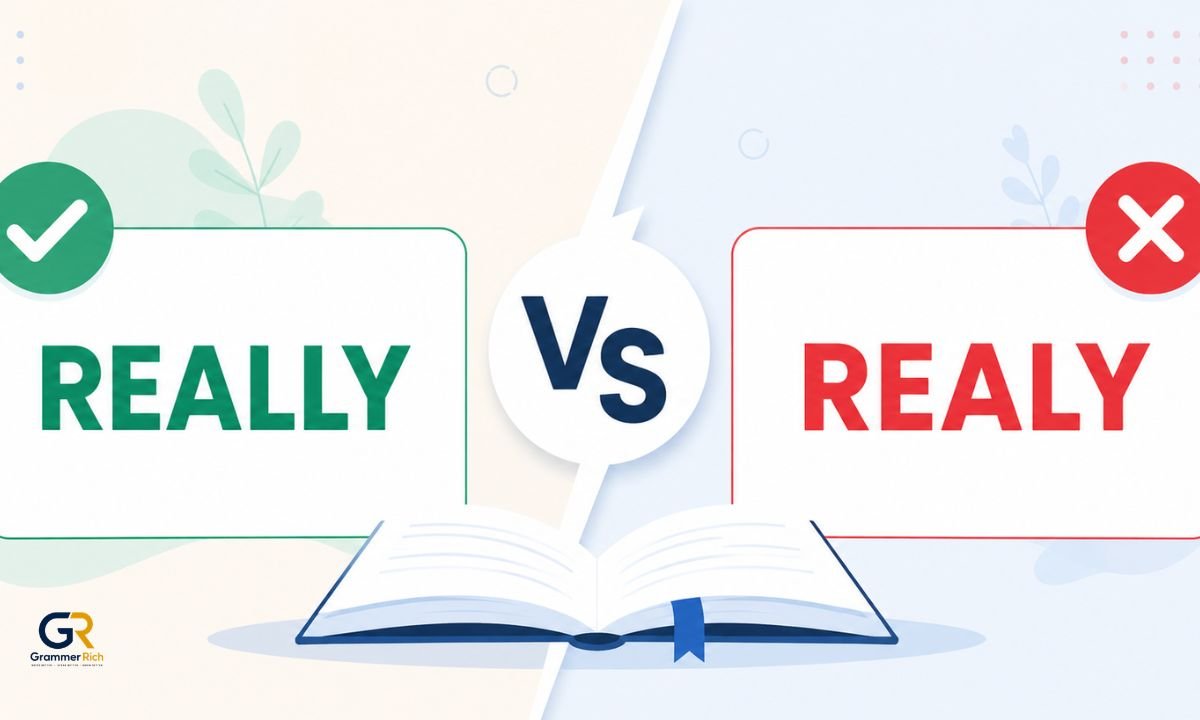
Really is the correct spelling in every context—it’s the only accepted form of this adverb, used to add emphasis or confirm truth (“I really like it”). Realy is simply a common misspelling with no valid use in standard English, whether in casual writing, essays, or professional documents. Stick with “really,” always.
So why does this mix-up keep happening? Simple: our brains sometimes drop letters when typing fast, and “realy” just slips through. This guide breaks down the Really vs Realy debate for good—covering common mistakes, memory tricks, and real examples so you’ll never second-guess your spelling again.
Really vs Realy: The Clear and Final Answer
Let’s settle it right away. In the Really vs Realy debate, only one spelling exists in standard English: really. “Realy” is not recognized by any major dictionary, including Merriam-Webster or Cambridge Dictionary.
If you’ve typed “realy” in an email, a text, or an essay, you’re not alone. It’s one of the most common spelling errors in English, right up there with “definately” and “recieve.” But knowing the Really vs Realy answer once means you’ll never repeat the mistake.
Here’s the quick breakdown:
- Really — correct in all contexts (formal, informal, spoken, written)
- Realy — incorrect; treat it as a typo, not a variant spelling
The Meaning of “Really”
What does really mean in English?
“Really” is an adverb of degree, also called an intensifier. It strengthens the word or phrase it modifies, adding emphasis, confirming truth, or expressing genuine surprise.
For example:
- “That movie was really good.” (emphasis)
- “Did you really finish the project already?” (surprise)
- “I really appreciate your help.” (sincerity)
Understanding this meaning is the foundation of the Really vs Realy conversation, because once you know what the word does, its correct spelling becomes much easier to remember.
Is Realy a Word? A Direct and Honest Explanation
Is realy a word?
No. “Realy” is not a word in standard English. It doesn’t appear in Merriam-Webster, Oxford, or Cambridge Dictionary as an accepted spelling or alternate form.
Why is realy incorrect in English?
The error usually comes from dropping one “l” when adding the suffix “-ly” to “real.” English spelling rules for this suffix are inconsistent, so people guess wrong. That guess produces “realy” instead of “really.”
Realy meaning in English (incorrect usage)
Because “realy” isn’t a recognized word, it has no independent meaning. It’s simply read as a misspelling of “really” by anyone who encounters it, including spell-checkers and grammar tools.
Grammar Rules for Really

How to use really in grammar
“Really” functions as an adverb, so it typically modifies adjectives, verbs, or entire sentences. It can appear:
- Before an adjective: “That’s a really useful tip.”
- Before a verb: “I really need coffee.”
- At the start of a sentence for emphasis: “Really, I had no idea.”
Why placement matters
Where you place “really” changes the emphasis of a sentence, even though the spelling never changes. This is another reason the Really vs Realy question matters for clear communication — a misspelling can distract readers from your actual meaning.
Why Is “Really” Spelled with Two Ls?
How to spell really correctly
“Really” comes from combining “real” + “-ly.” Because “real” already ends in “l,” adding “-ly” naturally creates a double “l”: r-e-a-l-l-y.
The double consonant pattern
This double-letter pattern isn’t unique to “really.” English has similar cases, like “full” becoming “fully.” Recognizing this pattern is one of the simplest tricks for winning the Really vs Realy battle for good.
Why do we drop the “e” in truly?
Interestingly, “true” drops its “e” before adding “-ly” to form “truly,” while “real” keeps both L’s. English spelling doesn’t always follow one universal rule, which is exactly why so many people search for “Really vs Realy” clarification online.
Also, read this: Encode vs Incode
What Is the Difference Between Really vs Realy?

| Feature | Really | Realy |
| Standard English word | Yes | No |
| Found in dictionaries | Yes (Merriam-Webster, Cambridge) | No |
| Correct in formal writing | Yes | Never |
| Correct in casual writing | Yes | Never |
| Common cause | N/A | Missing one “l” |
This table makes the Really vs Realy comparison simple: one is a legitimate English word, and the other is an error every time it appears.
Really vs Realy in Sentences
Seeing both spellings side by side highlights the difference clearly.
- ✅ “I really want to visit Japan someday.”
- ❌ “I realy want to visit Japan someday.”
- ✅ “She was really tired after the flight.”
- ❌ “She was realy tired after the flight.”
Every “realy” example above should be corrected to “really” without exception.
A Common Source of Confusion

Really vs actually difference
While both words add emphasis, “really” intensifies a feeling or degree, while “actually” corrects or clarifies information. For instance, “I actually finished early” corrects an assumption, while “I really finished early” simply emphasizes the achievement. This distinction is separate from the Really vs Realy spelling issue but often gets tangled up with it.
Pronunciation of Really (US vs UK)
How do Americans pronounce really?
American English typically pronounces “really” as “REE-uh-lee” or a quicker “REE-lee” in casual speech.
Realy vs really British vs American English
British English often pronounces it closer to “REE-lee” as well, though regional accents vary widely. Regardless of pronunciation differences, spelling never changes — “realy” remains incorrect in both American and British English.
Can You Use Really in Formal Writing?
Yes. “Really” is fully acceptable in formal writing, academic essays, and professional communication. Some style guides recommend using it sparingly to avoid overusing intensifiers, but the word itself is never inappropriate. What’s always inappropriate is the misspelled “realy,” which signals a lack of proofreading in professional documents.
Common Spelling Mistakes and How to Avoid Them
People misspell “really” for a few predictable reasons:
- Typing too quickly and dropping a letter
- Confusing it with words like “real” or “rarely”
- Never learning the double-L rule for “-ly” suffixes
- Relying on autocorrect instead of understanding the rule
To avoid the Really vs Realy mistake permanently, try this memory trick: think of “real” plus “ly,” said slowly, so you naturally hear both L’s.
A Example Why This Mistake Matters
Imagine sending a cover letter that reads, “I am realy excited about this opportunity.” A hiring manager may see that single typo and question your attention to detail. Getting the Really vs Realy spelling right isn’t just about grammar pedantry — it’s about credibility.
How “Really” Fits into English Grammar
“Really” belongs to a broader category of adverbs of degree, alongside words like “very,” “extremely,” and “quite.” These words don’t carry meaning on their own; instead, they adjust the intensity of the word next to them. Mastering this category helps writers avoid not just the Really vs Realy error, but also overuse of intensifiers in general.
Really vs Very vs Truly
These three intensifiers are often used interchangeably, but subtle differences exist:
- Really — general emphasis or confirmation (“really happy”)
- Very — strengthens a quality without implying surprise (“very happy”)
- Truly — emphasizes sincerity or genuineness (“truly grateful”)
None of these alternatives change the underlying Really vs Realy rule — “really” is still the only correct spelling among them.
Practice Exercises
Fill in the Blank
- I am ______ tired today. (really/realy)
- That was a ______ good movie. (really/realy)
Correct the Mistakes
- “She was realy happy about the news.”
- “This is realy important.”
Rewriting for Precision
Rewrite this sentence to fix the error: “I realy think we should leave now.”
Identify Misuse in Context
Find and correct the misspelling: “He said it was realy the best decision he’d ever made.”
Tips for Practice
- Read sentences aloud and listen for the double “l” sound.
- Use spell-check as a backup, not a replacement for learning the rule.
- Write “real + ly = really” a few times until it becomes automatic..
Conclusion
The Really vs Realy question has one simple, permanent answer: always use “really.” It’s the only spelling recognized in standard English, appropriate for formal writing, casual conversation, and everything in between. “Realy” is a typo, not an alternative — and now that you know the rule behind the double “l,” you have no reason to mix them up again.
Next time you type this word, picture “real” plus “ly,” and let those two L’s fall into place naturally. Now you’ll never mix them up again.

Welcome to Grammarrich.com, your trusted source for grammar tips, writing guides, and language learning. With 5 years of experience in the grammar niche, our goal is to provide clear, accurate, and easy-to-understand content that helps everyone write with confidence.