

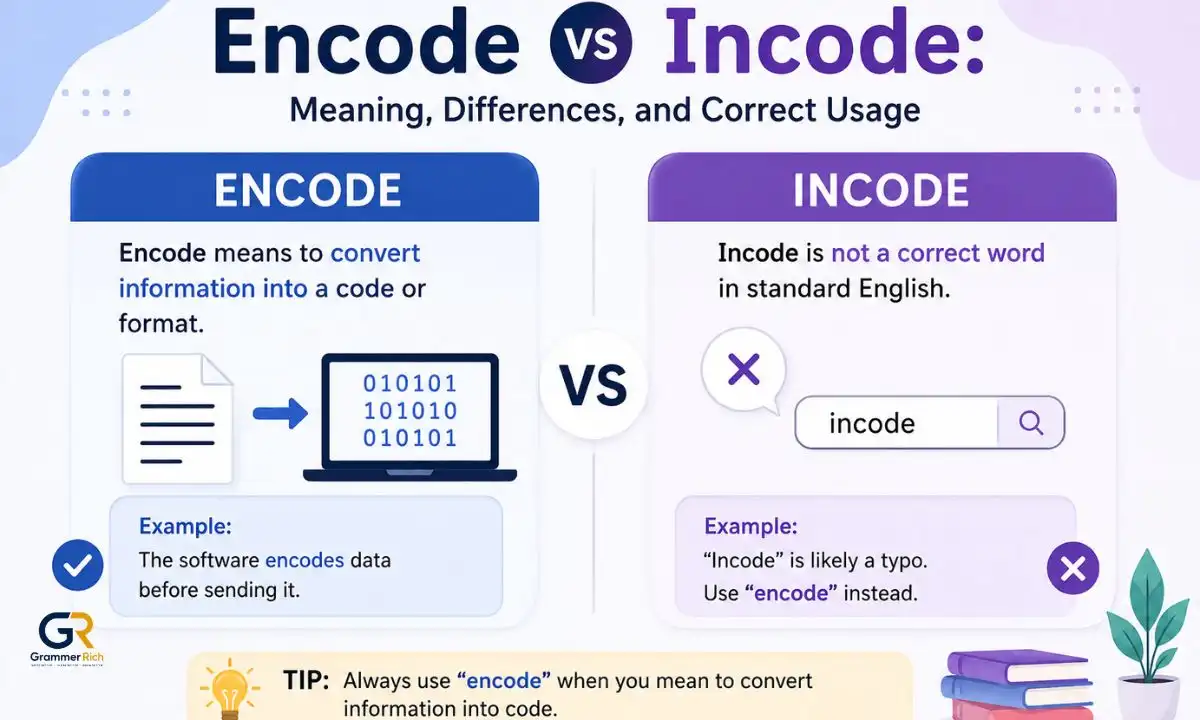
Encode vs Incode — despite how similar they look, only one is a real word. “Encode” is the standard English verb meaning to convert information into a code or format, correct in every grammatical context (encode, encoded, encoding). “Incode” isn’t a recognized English word; it’s a common misspelling, so encode is always the correct choice.
Confused by encode vs incode every time you type it? You’re not alone. This mix-up trips up writers, students, and even native speakers constantly. Below, we’ll break down where the confusion comes from, why “incode” keeps showing up in searches, and exactly how to use “encode” correctly in real sentences.
Quick Answer (No Confusion)
If you only remember one thing from this encode vs incode guide, remember this: “encode” is correct, “incode” is not. There’s no debate here, and there’s no context where “incode” becomes the right choice. Dictionaries like Merriam-Webster and Cambridge Dictionary list “encode” as a standard verb. Neither lists “incode” at all. That silence tells you everything about the encode vs incode question.
People usually search “encode vs incode” because the word “incode” sounds plausible. It has that same rhythm as “encode,” “decode,” and “decoder.” But sounding right isn’t the same as being right, and that’s really the whole story behind the encode vs incode confusion.
What Does Encode Mean? (Clear Definition + Core Idea)
At its core, “encode” means to convert information from one form into another format, usually so it can be stored, transmitted, or processed more efficiently. Whenever you’re comparing encode vs incode, remember that only “encode” carries this meaning — “incode” carries no meaning at all because it isn’t a word.
Encode Definition in Computer Science
In computer science, encoding means transforming data into a specific format so machines can read, store, or transmit it. This covers everything from converting text into binary to compressing a video file. When developers discuss data formats, they’re always discussing encode, never incode.
Meaning in English (Simple Explanation)
In everyday English, “encode” simply means to put something into code form. You might encode a secret message, encode feelings into a poem, or encode data into a spreadsheet. The word works as a regular verb: encode (present), encoded (past), encoding (present participle).
What Does Encode Mean in Real Life?
Encoding isn’t just a tech term — it shows up constantly in daily life, often without you noticing.
Everyday Encoding Examples
- A QR code encodes a web link into a scannable pattern.
- Morse code encodes letters into dots and dashes.
- Sheet music encodes sound into written notation.
- Barcodes encode product information into scannable stripes.
Example Sentences
- “The app will encode your password before saving it.”
- “She encoded the file to reduce its size.”
- “Please encode this data in UTF-8 format.”
Notice something? None of these sentences work with “incode.” That’s the clearest way to settle the encode vs incode question — try swapping the words, and “incode” simply breaks the sentence.
Types of Encoding (Essential Knowledge)
Understanding the types of encoding makes the encode vs incode conversation easier, because it shows how broadly the correct word applies.
Main Types of Encoding
Character Encoding
Character encoding maps letters, numbers, and symbols to numeric codes so computers can display and process text correctly.
Binary Encoding
Binary encoding converts data into sequences of 0s and 1s — the foundational language of computers.
URL Encoding
URL encoding converts special characters in a web address into a format browsers can safely transmit (like turning a space into “%20”).
Audio/Video Encoding
Audio and video encoding compresses media files into formats that are easier to store and stream, such as MP4 or MP3.
What Is Incode? (Honest Reality Check)
Let’s be direct: “incode” has no accepted definition in English. It’s not a technical term, not a regional variant, and not an old or archaic form of “encode.” When people type “incode,” they almost always mean “encode.”
Incode Meaning
There is no meaning to assign here. “Incode” is a spelling error, likely caused by mixing up the prefixes “en-” and “in-,” which sound alike but function differently in English word formation.
Is Incode a Real Word?
No. Is incode a real word in any recognized dictionary? No major dictionary — not Merriam-Webster, not Cambridge, not Oxford — includes “incode” as a standard entry. This is the simplest way to settle encode vs incode: check a dictionary, and only one term appears.
Why Do People Confuse Encode vs Incode?

The encode vs incode mix-up isn’t random. It happens for a few predictable reasons.
Common Causes
- Prefix confusion: “En-” and “in-” both mean “into,” so the brain sometimes swaps them.
- Autocorrect and typos: Fast typing on mobile keyboards often drops or swaps letters.
- Sound-alike patterns: Words like “decode” and “incode” share a similar rhythm, tricking the ear.
- Non-native English influence: ESL learners sometimes apply prefix rules from other languages.
Encode vs Incode Difference (Side-by-Side Breakdown)
Here’s a quick comparison table to make the encode vs incode difference crystal clear.
| Feature | Encode | Incode |
| Real word? | Yes | No |
| Dictionary listed? | Yes (Merriam-Webster, Cambridge) | No |
| Grammar role | Verb (base form) | None |
| Common use | Data, computer science, communication | N/A — misspelling only |
| Correct in writing? | Always | Never |
Encode vs Incode Grammar (Why Only One Works)
From a grammar standpoint, the encode vs incode question isn’t close at all. “Encode” follows standard English verb conjugation rules, while “incode” doesn’t exist as a recognized part of speech.
Grammar Role
“Encode” is a transitive verb, meaning it needs an object: you encode something. It conjugates normally — encode, encodes, encoded, encoding — just like any regular verb.
Examples
- Correct: “The system will encode the message.”
- Incorrect: “The system will incode the message.”
- Correct: “Data was encoded before transmission.”
- Incorrect: “Data was incoded before transmission.”
Also, read this; Its Called vs It Called
How to Use Encode Correctly in Writing
Once you’ve settled encode vs incode in your head, using the word correctly becomes automatic.
Basic Patterns
- Encode + noun (“encode the file”)
- Be + encoded (“the file was encoded”)
- Encoding + noun (“the encoding process”)
Examples
- “Developers encode user data for security.”
- “This tool encodes video into smaller files.”
- “The message was encoded using Base64.”
Can You Use Incode in Any Context?
No. There is no formal, technical, regional, or historical context where “incode” is accurate. This is worth repeating because people sometimes assume niche fields have their own exception — they don’t.
Incorrect Usage
“Please incode this file before uploading.”
Correct Version
“Please encode this file before uploading.”
Encoding in Programming (Deep Explanation)
In programming, encoding is essential because computers only understand raw data — encoding gives that data structure and meaning.
Why Encoding Is Necessary
Without encoding, computers couldn’t reliably interpret text, images, audio, or video across different systems. Encoding standards ensure that a file created on one device displays correctly on another.
Data Encoding Techniques (Technical Detail)

There are several widely used data encoding techniques, each suited to different tasks.
Common Methods
Binary Encoding
Converts any data type into binary digits (0s and 1s) for machine-level processing.
Base64 Encoding
Converts binary data into readable text characters, often used for embedding images or attachments in emails.
UTF-8 Encoding
The most common character encoding standard for the web, supporting virtually every language and symbol.
Character Encoding Examples
- ASCII encodes basic English letters and symbols into numeric values.
- UTF-8 encodes global characters, including emojis and non-Latin scripts.
- Unicode provides a universal encoding standard across platforms.
Binary Encoding Explained Simply
Think of binary encoding like a light switch that’s either on or off. Every letter, number, or image on your screen ultimately breaks down into long strings of these on/off signals — 1s and 0s — that computers read incredibly fast.
Encode vs Encrypt vs Decode (Important Distinction)
It’s easy to blur encode vs incode with a totally different pair: encode vs encrypt. These are separate concepts, even though both involve transforming data.
Clear Comparison
- Encode: Changes data format for compatibility (not for secrecy).
- Encrypt: Changes data specifically to hide it from unauthorized users.
- Decode: Reverses encoding to restore the original format.
Text Encoding vs Encryption
Encoding
Encoding is about format and compatibility — turning text into a form a system can process, like UTF-8.
Encryption
Encryption is about security — scrambling data so only someone with the right key can read it.
Impact of the Mistake
Using “incode” instead of “encode” might seem minor, but in professional writing, getting encode vs incode wrong can hurt credibility fast.
Scenario
A developer writes technical documentation and repeatedly uses “incode” instead of “encode.”
What Happens
Readers — especially technical reviewers — may question the writer’s expertise, even if the underlying explanation is accurate.
Correct Version
Replacing every instance of “incode” with “encode” instantly fixes the issue and restores professionalism.
Result
Clean, accurate terminology builds trust, particularly in technical or academic writing where precision matters.
Common Mistakes to Avoid
Using “Incode” Instead of Encode
Always double-check spelling, especially in technical documents where this error is common.
Confusing Encode with Encrypt
Remember: encoding is about format, encryption is about security. They’re not interchangeable.
Ignoring Context
Even correct spelling can be misused — make sure “encode” fits the sentence’s meaning (formatting data, not hiding it).
Why Encode Is the Correct Word

“Encode” is correct because it’s built from recognized English morphology: the prefix “en-” (meaning “to put into”) plus “code.” This structure matches similar words like “enclose,” “enable,” and “encase.” “Incode” simply doesn’t follow any recognized word-formation pattern in English.
Context Matters: Where Encode Is Used
Computer Science
Encoding underpins how computers store, process, and transmit information across systems.
Web Development
Developers encode URLs, forms, and data payloads to ensure websites function correctly across browsers.
Digital Communication
Messaging apps, emails, and file-sharing tools all rely on encoding standards to deliver content accurately.
Encoding Examples in Real Life
- Streaming platforms encode video for smooth playback on different devices.
- Banking apps encode sensitive information before processing transactions.
- Social media platforms encode images for faster loading times.
Quick Practice (Lock It In)
Fill in the Blank
- “The developer will _____ the data before sending it.” (encode/incode)
- “This tool automatically _____ files into Base64.” (encodes/incodes)
Fix the Sentence
- “The file was incoded yesterday.” → “The file was encoded yesterday.”
- “We need to incode this message.” → “We need to encode this message.”
Key Takeaways (Simple and Clear)
Here’s a fast recap of everything this encode vs incode guide has covered:
- In the encode vs incode debate, only “encode” is a real, dictionary-recognized word.
- “Incode” is a common misspelling with no accepted meaning.
- Encoding relates to format and compatibility, not secrecy.
- Encryption, not encoding, is used to protect data from unauthorized access.
- When in doubt, “encode” is always the safe, correct choice.
Encode vs Incode: A Final Sanity Check
If you’ve made it this far, the encode vs incode question should feel almost too easy now. Still, it’s worth running through a mental checklist before you hit publish or submit on any piece of writing. Ask yourself: does this word appear in a dictionary? Does it follow standard English prefix rules? Does swapping in “encode” still make sense? If yes, yes, and yes, you’re safe.
This kind of quick self-check is especially useful for non-native English speakers, students writing academic papers, and content writers producing technical material at scale. The encode vs incode mistake is easy to make once, but it’s just as easy to eliminate permanently with a little repetition. Bookmark this page, reread the comparison table above, and you’ll stop second-guessing yourself within a week or two.
Conclusion
The rule is simple: whenever you’re weighing encode vs incode, “encode” wins every time. It’s the dictionary-recognized, grammatically correct verb for converting information into code, while “incode” remains nothing more than a common typo. Keep this distinction in mind, double-check your spelling in technical writing, and you’ll never second-guess encode vs incode again.

Welcome to Grammarrich.com, your trusted source for grammar tips, writing guides, and language learning. With 5 years of experience in the grammar niche, our goal is to provide clear, accurate, and easy-to-understand content that helps everyone write with confidence.