

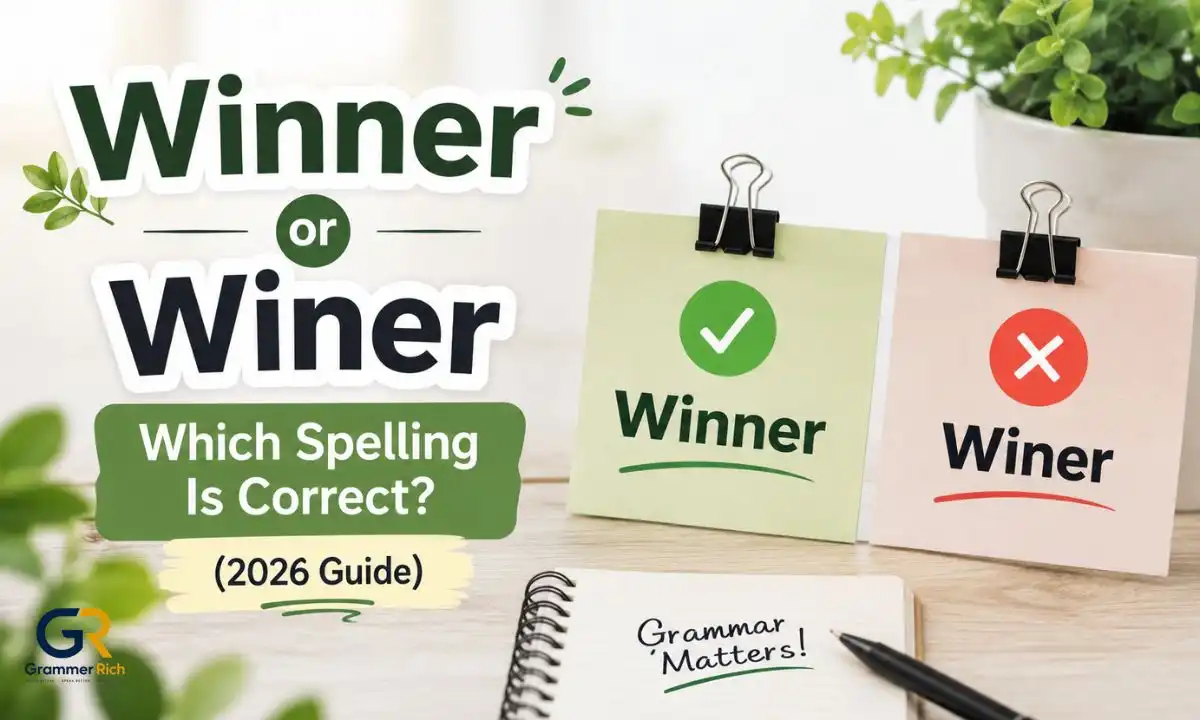
Winner” is the correct spelling. It means a person or thing that wins a game, contest, or competition. “Winer” is not a real word in standard English. People often misspell “winner” as “winer” by mistake, especially when typing fast. This small typo can change how your writing looks to readers and search engines alike.
Ever typed “winer” instead of “winner” and wondered which one is right? You’re not alone. Many people search for Winner or Winer every day, unsure of the correct form. In this guide, we’ll clear up the confusion once and for all. By the end, you’ll never mix up Winner or Winer again.
Winner or Winer – Quick Answer
Winner is the only correct spelling in standard English. It’s the word you use when talking about a person, team, or entity that wins a game, contest, race, or prize.
Winer is not a recognized word in standard dictionaries. It almost always shows up as a typing slip, where the second “n” gets dropped by mistake. In rare, informal cases, some writers use “winer” loosely to describe someone connected to the wine trade, but the correct term for that is winemaker or vintner, not winer.
So, whenever you’re stuck between winner or winer, the safe and grammatically correct choice is always winner.
| Word | Correct? | Meaning |
| Winner | ✅ Yes | A person, team, or thing that wins |
| Winer | ❌ No (mostly) | Common misspelling of “winner”; rarely used for wine-related work |
Winner or Winer Meaning
The word winner is a noun formed from the verb “win” plus the suffix “-er.” It describes:
- A person who finishes first in a competition, sport, or game
- A team that achieves victory over opponents
- A product, idea, or strategy that turns out to be successful
Example sentences:
- She was declared the winner of the marathon.
- Our proposal was a clear winner with the client.
- The lottery winner claimed the prize within a week.
Winer, on the other hand, has no accepted meaning in modern dictionaries. If you search for it, most results simply redirect you back to “winner,” confirming that it’s a spelling mistake rather than a genuine word choice.
Simple Rule
Here’s an easy rule to lock this in permanently:
- Start with the base verb win.
- Add the suffix -er to show “one who wins.”
- Because “win” ends in a single vowel followed by a single consonant (a CVC pattern), English doubles the final consonant before adding a vowel suffix.
- That doubling gives you winner, not winer.
A simple memory trick: A winner works twice as hard, so the word gets an extra “n.” Or link it to similar words that follow the same doubling pattern, such as runner, swimmer, and planner.
The Origin of Winner or Winer
The confusion between winner or winer isn’t random — it comes down to how English spelling handles short verbs.
The word winner traces back to the Old English verb winnan, meaning to strive, fight, or gain victory through effort. Over time, English speakers added the agent suffix “-er” to describe the person doing the action, following the same pattern used in words like teacher, runner, and singer.
Winer has no such history as a standalone English word. It occasionally surfaces in casual or regional writing as shorthand related to wine, but it has never been standardized. Style guides, dictionaries, and grammar authorities do not list it as an accepted term. This is why nearly every reputable language resource agrees: when it comes to winner or winer, only one form belongs in formal writing.
British English vs American English Spelling
One question people often ask is whether the winner or winer debate changes between British and American English, the way “color” and “colour” do. The answer is simple: it doesn’t.
- American English: Winner
- British English: Winner
- Australian and Canadian English: Winner
Unlike words that shift with regional spelling conventions, winner stays exactly the same across every major English-speaking country. There is no British variant, no American variant, and no accepted alternative spelling. This makes the winner or winer question easier than many other spelling debates, because you don’t need to adjust based on your audience’s location — winner is correct everywhere.
Which Spelling Should You Use?
If you’re still weighing winner or winer, here’s a simple checklist to guide your writing:
- Use “winner” when referring to someone or something that succeeds in a competition, contest, game, or challenge.
- Avoid “winer” in all formal writing, including emails, resumes, essays, and business communication.
- Double-check fast typing. Most instances of “winer” happen when people type quickly on phones or type without proofreading.
- Run a spell-check. Tools like Grammarly or your word processor’s built-in checker will usually flag “winer” automatically.
In short: whenever you’re describing success, achievement, or victory, “winner” is the spelling to use — no exceptions.
Common Mistakes with Winner or Winer

Even careful writers slip up occasionally. Here are the most frequent mistakes people make with winner or winer:
- Dropping a letter while typing fast – “He is the winer of the match” instead of “winner.”
- Trusting autocorrect blindly – Autocorrect doesn’t always catch a missing consonant, especially in casual apps or messaging.
- Confusing it with wine-related words – Some assume “winer” relates to wine production, when the correct term is winemaker or vintner.
- Pronunciation-based spelling – Saying the word quickly can make it sound like a single “n,” leading to the incorrect spelling.
- Skipping proofreading – Rushed writing, especially on social media or in captions, is where “winer” appears most often.
Being aware of these patterns makes it much easier to avoid the mistake going forward.
Winner or Winer in Everyday Examples
Seeing correct usage in context helps cement the spelling. Here are some real-world style examples:
- Sports: The tennis winner celebrated with the trophy held high.
- Academics: The scholarship winner was announced during the ceremony.
- Business: The startup became the winner in a highly competitive market.
- Everyday life: She felt like a winner after finishing her first 5K race.
- Games: The board game winner earned bragging rights for the night.
Notice how every one of these examples uses “winner,” never “winer.” That consistency reflects how the word is actually used across sports writing, journalism, and academic contexts.
Winer or Winner – Google Trends & Usage Data

Search behavior around winner or winer shows a clear and consistent pattern. People frequently type “winer” into search engines, but almost always because they’re unsure of the spelling — not because they intend to use a different word.
Key observations from usage patterns:
- Searches for “winner” vastly outnumber “winer” across search engines.
- Most searches for “winer” are spelling-confusion queries, not searches for wine-related content.
- The confusion spikes in casual writing environments: texting, social captions, and quick emails.
- Formal publications, news outlets, and academic sources use “winner” almost exclusively.
This usage data reinforces the same conclusion found throughout this guide: “winner” is the standard, expected spelling, while “winer” is a recognized but uncommon error.
Winner vs Winer: Comparison Table
| Feature | Winner | Winer |
| Standard English word | Yes | No |
| Found in major dictionaries | Yes | Rarely, if at all |
| Used in formal writing | Yes | No |
| Common meaning | Person/team that wins | Misspelling of “winner” |
| Spelling rule | Doubles “n” after short vowel | Not a recognized rule-based form |
| Regional spelling difference (US/UK) | None | None |
| Recommended usage | Always | Avoid |
Conclusion
The debate between winner or winer really comes down to one simple fact: winner is correct, and winer is not a standard English word. The mix-up usually happens because of fast typing, autocorrect gaps, or the way the word sounds when spoken quickly. By remembering the doubled “n” rule and reviewing the examples in this guide, you can confidently use “winner” in every sentence, whether you’re writing a school essay, a business email, or a quick social media post. The next time you second-guess yourself, remember: when it’s about success and victory, winner is always the winner.

Welcome to Grammarrich.com, your trusted source for grammar tips, writing guides, and language learning. With 5 years of experience in the grammar niche, our goal is to provide clear, accurate, and easy-to-understand content that helps everyone write with confidence.