

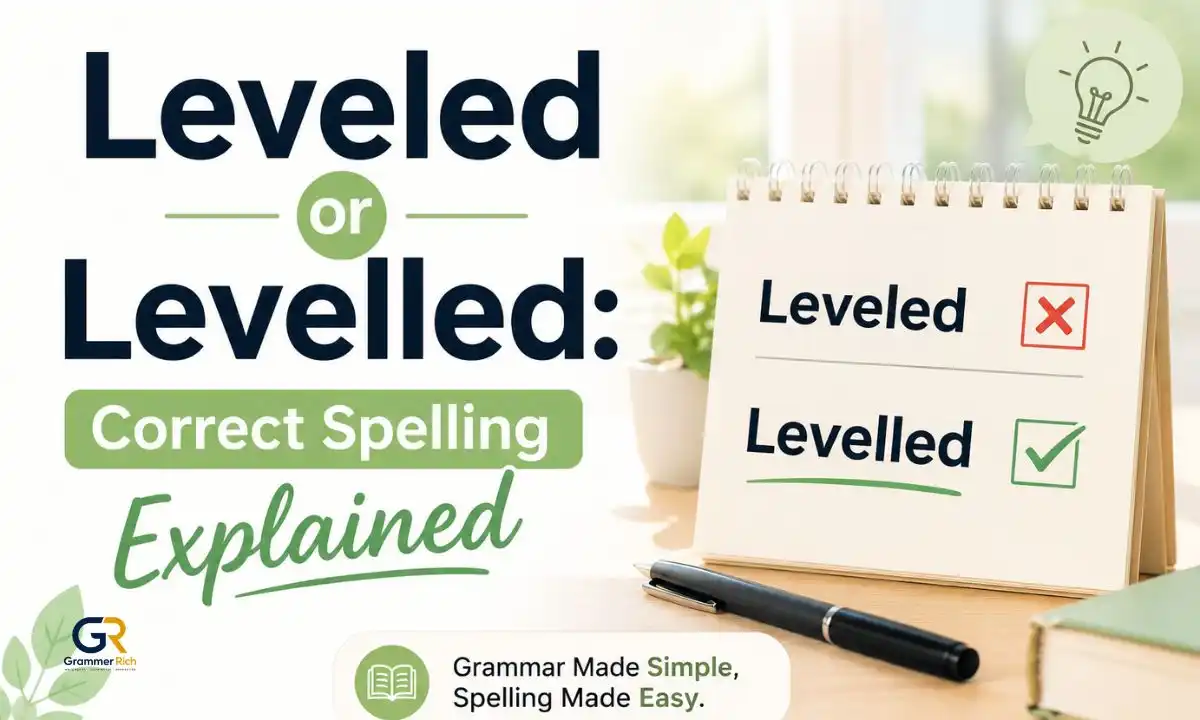
Many people get confused when they see two spellings for the same word: “leveled” and “levelled.” Both words come from the verb “level,” which means to make something flat or equal. The difference is not about meaning, but about which type of English you are using. American English uses one form, while British English uses the other. Once you know this simple rule, you will never be confused again.
Have you ever paused while typing and asked yourself, “Leveled or levelled, which one is correct?” You are not alone. This small spelling difference confuses students, writers, and even native speakers every day. The good news is that both spellings are correct, just used in different places. In this guide, we will clear up the confusion around leveled or levelled once and for all, so you can write with confidence.
Leveled or Levelled – Quick Answer
Here’s the short version if you’re in a hurry:
- Leveled (one “L”) is the standard spelling in American English.
- Levelled (two “L’s”) is the standard spelling in British, Australian, and Canadian English.
Both words come from the same root verb, “level,” and both mean exactly the same thing: to make something flat, even, or equal. The difference between leveled or levelled is purely regional — it has nothing to do with meaning, tense, or grammar rules beyond spelling convention.
Quick examples:
- The workers leveled the ground before pouring concrete. (US)
- The workers levelled the ground before pouring concrete. (UK)
If you remember nothing else, remember this: one L for the US, two L’s for the UK.
The Origin of Leveled or Levelled
To understand why leveled or levelled even became a debate, it helps to look at where the word “level” comes from.
The word traces back to the Latin term libella, meaning a small balance or measuring tool, which passed through Old French as livel before entering English in the 1300s. Over time, English speakers turned “level” into a verb, and like most verbs, it needed a past-tense form.
Here’s where things get interesting. English spelling wasn’t standardized in the way we think of it today until dictionaries — particularly Samuel Johnson’s in Britain and Noah Webster’s in America — began setting formal rules in the 18th and 19th centuries. Webster deliberately simplified many spellings to make American English more phonetic and consistent, while British English largely kept older, traditional conventions.
This single decision is the reason we now argue over leveled or levelled, along with dozens of similar word pairs like “traveled/travelled” and “canceled/cancelled.”
British English vs American English Spelling

The rules governing leveled or levelled come down to how each dialect treats consonant doubling when adding a suffix like “-ed” or “-ing.”
British English Rules
In British English, there’s a well-known convention: when a verb ends in a single vowel followed by a single “L,” that final “L” is doubled before adding “-ed” or “-ing” — regardless of where the stress falls in the word. This is why British writers use:
- Levelled
- Levelling
- Traveled → Travelled
- Cancelled
This rule applies even though the stress in “level” falls on the first syllable, which is technically an exception to the general English doubling rule (which usually only doubles consonants in stressed syllables).
American English Rules
American English follows a stricter, more phonetic-based rule. The final consonant is only doubled if the last syllable is stressed. Since the stress in “level” falls on “LEV,” not “-el,” American English does not double the L. This gives us:
- Leveled
- Leveling
- Traveled
- Canceled
Noah Webster’s 19th-century spelling reforms are largely responsible for this pattern across American English.
Comparison Table
| Feature | British English | American English |
| Past tense | Levelled | Leveled |
| Present participle | Levelling | Leveling |
| Doubling rule | Doubles final L regardless of stress | Doubles only if final syllable is stressed |
| Common in | UK, Australia, New Zealand, most of Canada | United States |
| Example sentence | The team levelled the site. | The team leveled the site. |
Which Spelling Should You Use?
Choosing between leveled or levelled really comes down to your audience and the style guide you’re following. Use these quick guidelines:
- Writing for a US audience? Use “leveled.” This includes American businesses, US-based publications, and most American academic institutions.
- Writing for a UK, Australian, or New Zealand audience? Use “levelled.” These regions consistently follow British spelling conventions.
- Writing for Canada? Canadian English typically leans toward “levelled,” though American influence means “leveled” is also widely understood and sometimes accepted.
- Following a specific style guide? Check it first. The Associated Press (AP) and Chicago Manual of Style favor American spelling, while Oxford style guides favor British spelling.
- Writing for a global or mixed audience? Pick one spelling and stay consistent throughout the entire document.
The biggest rule of thumb: consistency matters more than which version you choose. Switching between leveled or levelled within the same piece of writing looks like a mistake, even if both spellings are individually correct.
Common Mistakes with Leveled or Levelled

Even experienced writers slip up here. Watch out for these common errors:
- Mixing spellings in one document. For example, writing “She leveled the shelf, then levelled the table” is inconsistent and unprofessional.
- Forgetting the “-ing” form follows the same rule. If you use “leveled,” you should also use “leveling” — not “levelling.”
- Assuming spellcheck is always right. Spellcheck settings are based on your selected language/region, not on what’s actually correct for your audience.
- Ignoring company or publication style guides. Many organizations have a preferred spelling regardless of regional norms — always defer to it.
- Confusing “level” with unrelated homophones. Some writers also mix up related terms like “leveled” with “levelheaded,” which is a separate compound word and always written with two L’s in both dialects.
Leveled or Levelled in Everyday Examples
Seeing leveled or levelled in real contexts makes the distinction easier to remember.
Emails
- US: “We leveled up our onboarding process last quarter.”
- UK: “We levelled up our onboarding process last quarter.”
News & Media
- US outlets: “Officials say the storm leveled several homes overnight.”
- UK outlets: “Officials say the storm levelled several homes overnight.”
Social Media
- US: “Just leveled up my gaming setup! 🎮”
- UK: “Just levelled up my gaming setup! 🎮”
Interestingly, in gaming culture worldwide, “leveled up” and “levelled up” both appear frequently, since online gaming communities blend American and British audiences constantly.
Formal Writing
- US: “The committee leveled criticism at the proposed policy.”
- UK: “The committee levelled criticism at the proposed policy.”
In formal or academic writing, sticking to one regional standard throughout your entire document is essential for professionalism and credibility.
Leveled or Levelled – Google Trends & Usage
Search interest data consistently shows a regional pattern for leveled or levelled searches. “Leveled” tends to dominate search volume in the United States, while “levelled” is far more common in search queries originating from the UK, Australia, Canada, and India.
This pattern also shows up in published content. American newspapers, US government websites, and US-based blogs almost exclusively use “leveled,” while UK newspapers, Australian publications, and Commonwealth government sites use “levelled.” Global brands writing for international audiences often lean toward British spelling, simply because more English-speaking countries around the world use it as their standard.
Comparison Table: Leveled vs Levelled
| Aspect | Leveled | Levelled |
| Region | American English | British/Commonwealth English |
| Number of L’s | One | Two |
| Related “-ing” form | Leveling | Levelling |
| Used in | US, some of Canada | UK, Australia, NZ, most of Canada |
| Style guides favoring it | AP, Chicago Manual of Style | Oxford, Cambridge |
| Example | The field was leveled. | The field was levelled. |
Conclusion
At the end of the day, the debate over leveled or levelled isn’t really a debate at all — it’s a matter of regional spelling convention. Americans write “leveled,” while British, Australian, and most Canadian writers use “levelled.” Both are grammatically correct, both mean the same thing, and both trace back to the same Latin root.
The real key to using leveled or levelled correctly is consistency. Identify your audience, choose the spelling that matches their regional standard or your style guide, and stick with it throughout your writing. Do that, and you’ll never second-guess this word again.

Welcome to Grammarrich.com, your trusted source for grammar tips, writing guides, and language learning. With 5 years of experience in the grammar niche, our goal is to provide clear, accurate, and easy-to-understand content that helps everyone write with confidence.