

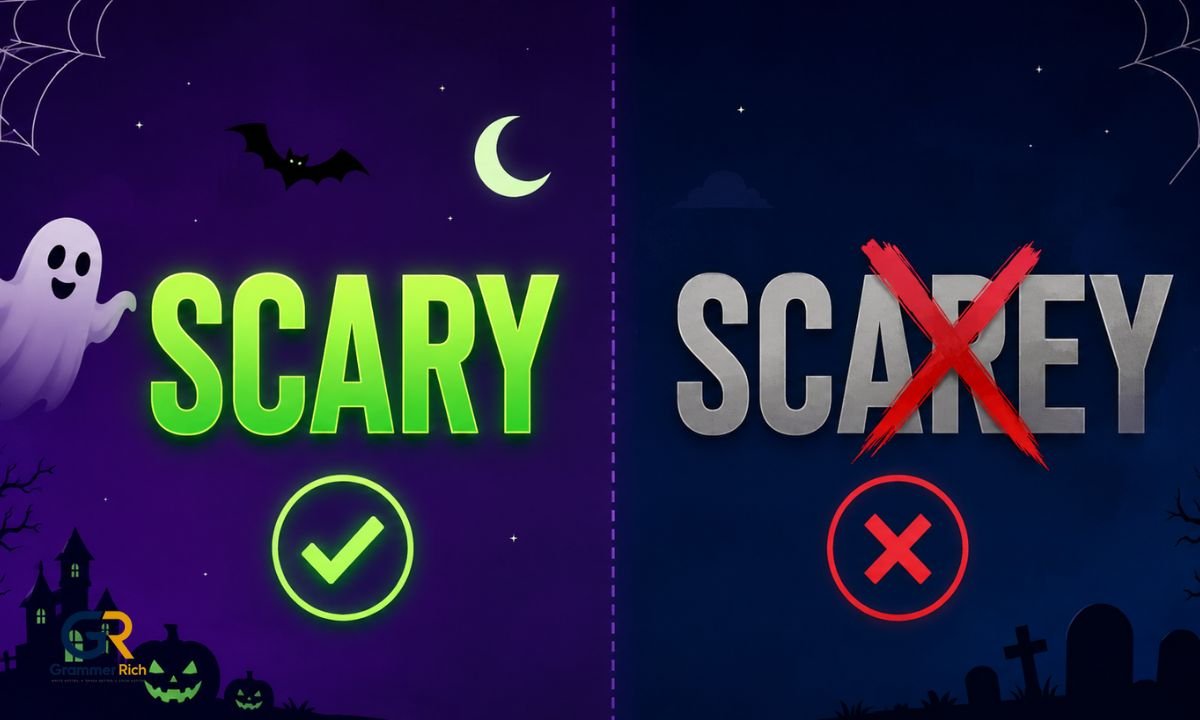
“Scarey” and “scary” are two spellings of the same adjective, but only one is standard. “Scary” is the correct, widely accepted spelling in both American and British English, used in dictionaries, books, and formal writing. “Scarey” is a common variant spelling that occasionally appears in casual or older texts, but it’s considered nonstandard today. When in doubt, go with “scary.”
So why does this mix-up keep happening? Simple: the two words sound identical, and that extra “e” just feels right to some writers. This guide breaks down the Scarey vs Scary debate for good, showing you where each spelling came from, when (if ever) “scarey” shows up in real usage, and how to keep your writing sharp, correct, and typo-free every single time.
Scarey vs Scary Meaning in Plain English
Let’s clear this up fast. Both “scarey” and “scary” describe something that causes fear. A spider on your pillow? Scary. A stranger following you home? Scary. The meaning never changes between the two spellings — only the spelling itself is in question.
Here’s the short version: “scary” is correct. “Scarey” is a misspelling. That’s really the whole Scarey vs Scary debate in one sentence. But because so many people type “scarey” without a second thought, it’s worth understanding exactly why one version won and the other didn’t.
Dictionaries like Merriam-Webster and Cambridge Dictionary list only “scary” as the standard form. “Scarey” doesn’t appear as an accepted headword in either. If you’re writing an essay, a resume, a blog post, or anything meant for a wide audience, “scary” is the safe, professional choice every time.
What Does Scary Mean? Definition, Context, and Usage

“Scary” is an adjective that means causing fear, alarm, or nervousness. It describes people, places, events, or feelings that trigger a fear response. The scary meaning stays consistent whether you’re talking about a horror movie, a health scare, or a nerve-wracking job interview.
A few quick facts about the word:
- Part of speech: Adjective
- Base word: Scare (verb/noun)
- Common suffix pattern: Drop the silent “e” in “scare,” then add “-y”
- Pronunciation: SKAIR-ee (two syllables)
Here’s how “scary” typically shows up in real sentences:
- The abandoned house at the end of the street looks scary at night.
- That was a scary movie — I couldn’t sleep afterward.
- Public speaking is scary for a lot of people, even confident ones.
- Her scary story kept the whole campfire group silent.
Notice the pattern? “Scary” almost always sits right before a noun (scary movie, scary story) or after a linking verb (looks scary, was scary). That’s standard adjective behavior in English, and it’s one more reason “scary” — not “scarey” — is the form that fits naturally into sentences.
Also read this Blog: Ladel vs Ladle: Which Spelling Is Correct?
Is Scarey a Word? Breaking the Myth

Technically, “scarey” isn’t recognized as standard English. It won’t show up as a primary entry in Merriam-Webster, Cambridge Dictionary, or Oxford Dictionary. So if you’ve ever typed “is scarey a word” into Google at 1 a.m. while double-checking an email, the honest answer is: not really, not in formal English.
That said, “scarey” isn’t some rare typo invented yesterday. It’s an old variant spelling that occasionally pops up in older texts, casual writing, and even some regional or informal usage. Spellcheck tools will usually flag it, and most style guides quietly correct it without comment. It’s similar to seeing “grey” and “gray” — except in this case, only one spelling is actually accepted.
So is “scarey” correct English? No. Is it understandable? Yes, mostly because it looks and sounds so close to “scary” that readers barely notice. But “close enough” isn’t the same as “correct,” especially in professional or academic writing where small errors chip away at credibility.
The Real Difference Explained
Here’s where a lot of people get tripped up. The Scarey vs Scary question isn’t about past tense versus past participle, or two words with different meanings — it’s purely a spelling issue. Both forms are pronounced the same and mean the same thing. There’s no grammatical rule that makes “scarey” appropriate in one context and “scary” appropriate in another.
Compare that to genuinely different word pairs, like “affect” and “effect,” which have distinct meanings and uses. Scarey vs Scary doesn’t work that way. There’s one correct spelling, and one common mistake. That’s it.
It also helps to know that this isn’t a debate the way “grey vs gray” is a debate. Nobody argues both spellings are equally valid depending on where you live, and no dictionary lists “scarey” as a secondary or regional accepted form. That puts the Scarey vs Scary question in a different category entirely — it’s not a style choice, it’s simply an error that’s easy to make and easy to fix once you know the rule.
Writers sometimes assume that because a spelling “looks right” or shows up in casual text messages, it must be an acceptable alternative. But frequency of use doesn’t equal correctness. Plenty of common typos appear often online without ever becoming standard English. “Scarey” falls into that same bucket: familiar, understandable, but not correct.
| Feature | Scary | Scarey |
| Standard spelling | Yes | No |
| Found in major dictionaries | Yes | No |
| Used in formal writing | Yes | Rarely, and incorrectly |
| Passes spellcheck | Yes | Usually flagged |
| Meaning | Causing fear | Same meaning, nonstandard spelling |
| Recommended usage | Always | Avoid |
The Grammar Behind the Correct Spelling of Scary
English has a fairly consistent rule for turning short words ending in a silent “e” into adjectives: drop the “e,” then add “-y.” “Scare” becomes “scary,” the same way “ice” becomes “icy” and “shine” becomes “shiny.”
That’s the whole trick behind how to spell scary correctly. You’re not adding an extra letter — you’re removing one before attaching the suffix. Writers who default to “scarey” are usually just keeping the “e” out of habit, the way it appears in the base word “scare.”
A few more examples of this same spelling rule in action:
- Nose → Nosy
- Grime → Grimy
- Fame → Famous (irregular, but same silent-e-drop idea)
- Scare → Scary
Once you see the pattern, it’s hard to unsee it. This is also why “scarey” feels intuitive to so many people — it’s not illogical, it’s just not how English adjective formation actually works in this case.
This silent-e-drop rule shows up across huge portions of English vocabulary, which is exactly why it’s worth memorizing rather than treating “scary” as an isolated exception. Think about words like “bone” becoming “bony,” “haze” becoming “hazy,” or “smoke” becoming “smoky.” In every case, the final “e” disappears the moment “-y” joins the word. Native speakers usually absorb this rule without ever studying it formally, simply from years of reading. ESL learners, on the other hand, often benefit from seeing the rule spelled out explicitly, since it isn’t always taught directly in early grammar lessons. Once the pattern is visible, applying it to “scare” becomes second nature.
How to Spell Scary Correctly Without Hesitation
If you want a foolproof way to never second-guess yourself again, try this trick: think of the word “scare,” remove the final “e,” and tack on “y.” Say it slowly if you have to. Scare. Scar. Scary.
A few more memory tricks that writers, editors, and ESL learners find helpful:
- Compare it to “scarce.” They look similar but mean completely different things — “scarce” means limited in supply, not frightening. Keep them separate in your mind.
- Picture the movie genre. “Scary movies” is a phrase you’ve likely seen a thousand times in print, on posters, and in reviews. That repeated visual exposure reinforces the correct spelling.
- Use spellcheck as backup, not a crutch. Most tools catch “scarey,” but understanding the rule means you won’t need to rely on autocorrect every time.
- Read it out loud. If you’re unsure, saying the word rarely helps with spelling, but pairing it with the “scare + y” logic will.
Once this clicks, the correct English usage becomes automatic, and you’ll stop pausing mid-sentence to double-check.
Using Scary in Real Sentences and Everyday Language

Seeing scary example sentences in different contexts makes the correct usage stick faster than any rule alone. Here are a variety of ways “scary” fits naturally into everyday language, from casual chats to more formal writing.
Informal/conversational:
- That roller coaster was way scarier than I expected.
- Ugh, spiders are the scariest thing to me, honestly.
Descriptive/narrative:
- The forest grew darker and scarier with every step they took.
- A scary silence fell over the room the moment the lights flickered.
Professional/formal:
- Economic uncertainty can be a scary prospect for small business owners.
- The report highlighted some genuinely scary statistics about data breaches.
For kids (scary meaning for kids):
- When explaining the scary meaning to children, keep it simple: scary means something that makes you feel a little afraid, like a loud thunderstorm or a spooky costume. It’s a normal feeling, and it usually passes quickly.
Across every one of these examples, “scary” — never “scarey” — is the spelling that belongs.
Scary vs Creepy vs Spooky
These three words all live in the same fear-related neighborhood, but they carry slightly different shades of meaning. Understanding scary vs creepy vs spooky helps you pick the most precise word for the feeling you’re describing.
- Scary — Causes real fear or alarm; can range from mild to intense. Example: A scary near-miss car accident.
- Creepy — Causes unease, discomfort, or a sense of being watched, often without full-blown fear. Example: That empty doll factory felt creepy.
- Spooky — Lighter, often playful or seasonal; associated with ghosts, Halloween, and eerie fun rather than genuine danger. Example: The spooky decorations went up for Halloween.
None of these words are interchangeable in tone, even though they’re all cousins in the horror-and-fear vocabulary family.
Expanding Vocabulary with a Scary Synonym List
If “scary” starts to feel repetitive in your writing, plenty of synonyms carry a similar punch, each with its own intensity level.
| Synonym | Intensity | Example Use |
| Frightening | Medium-high | A frightening thunderstorm rattled the windows. |
| Terrifying | Very high | A terrifying scream echoed through the hallway. |
| Horrifying | Very high | The horrifying news spread quickly. |
| Eerie | Medium | An eerie silence settled over the town. |
| Chilling | Medium-high | A chilling account of survival. |
| Alarming | Medium | Alarming numbers in the latest report. |
Mixing in these words that cause fear keeps your writing varied while still hitting the same emotional target as “scary.”
It’s worth noting that not every synonym fits every context. “Terrifying” and “horrifying” work well for genuinely intense situations — a horror movie, a near-death experience, a disturbing news story. But using them to describe something mildly unsettling, like a dark hallway, can come across as exaggerated. “Eerie” and “chilling,” on the other hand, are better suited to atmosphere and tone rather than sudden shock. Choosing the right synonym isn’t just about avoiding repetition; it’s about matching intensity to the actual situation you’re describing.
Scary vs Frightened Difference
Here’s a subtle but important distinction: “scary” describes the source of fear, while “frightened” describes the person experiencing it. The scary vs frightened difference comes down to who — or what — the word is attached to.
- The movie is scary. (The movie causes fear.)
- She was frightened by the movie. (She experienced the fear.)
Mixing these up is a common issue for ESL learners, since both words relate to fear but serve completely different grammatical roles — one describes a cause, the other describes an emotional state.
Related Word Confusions You Should Avoid
Scarey vs Scary isn’t the only spelling pair that trips people up. English is full of near-identical word confusions, and getting familiar with a few others sharpens your overall language accuracy.
- Grey vs Gray — Both are technically correct, but regional (British vs American English).
- Scardy vs Scaredy — “Scaredy” (as in “scaredy-cat”) is the correct informal spelling; “scardy” is a common typo.
- Scarce vs Scary — Completely different meanings; “scarce” means rare or limited, not frightening.
- Affect vs Effect — A classic grammar mix-up involving a verb versus a noun.
Bookmarking a short list like this can save you from repeating the same small mistakes across different pieces of writing.
Why “Scarey” Still Appears in Searches and Content
If “scarey” is technically wrong, why do so many people still search for it? A few reasons explain the pattern. First, phonetic spelling is a huge factor — English learners and native speakers alike sometimes spell words the way they sound rather than the way they’re officially written. Second, older texts and regional dialects occasionally used “scarey” before spelling conventions became more standardized through widespread dictionaries and digital spellcheck tools.
There’s also the simple reality of muscle memory. Writers see “scare” constantly, and dropping that silent “e” before adding a suffix isn’t always intuitive. Add in fast typing, autocorrect inconsistencies, and casual social media writing, and “scarey” keeps resurfacing generation after generation, even though “scary” has remained the standard English spelling all along.
Search engines see this confusion play out every day. Thousands of people type “scarey” into Google, then land on pages that gently correct them and point them toward “scary” instead. That’s actually a healthy sign for the language — it means most readers double-check themselves rather than assuming their first instinct is automatically right. If you’ve ever paused mid-sentence wondering which spelling to use, you’re in good company, and now you have a rule that settles it for good.
English Practice Session
Ready to test what you’ve learned? Try the questions below, then check your answers against the key at the end.
Multiple Choice Questions
- Which spelling is correct in formal writing? a) Scarey b) Scary
- What part of speech is “scary”? a) Noun b) Adjective c) Verb
- Which sentence uses the word correctly? a) The house looked scarey at midnight. b) The house looked scary at midnight.
- What does “frightened” describe? a) The source of fear b) The person experiencing fear
- Which word means “limited in supply,” not frightening? a) Scarce b) Scary
Fill in the Blanks
- The old movie theater felt genuinely _______ after closing hours.
- She was _______ by the sudden loud noise outside her window.
- Halloween decorations are often described as _______ rather than truly terrifying.
- The correct spelling rule is: drop the silent “e” in “scare” and add _______.
- Water became _______ during the drought, forcing strict rationing.
Answers
Multiple Choice Answers
- b) Scary
- b) Adjective
- b) The house looked scary at midnight.
- b) The person experiencing fear
- a) Scarce
Fill in the Blanks Answers
- scary
- frightened
- spooky
- “y”
- scarce
Conclusion
The Scarey vs Scary debate really comes down to one simple rule: drop the silent “e” in “scare,” add a “y,” and you’ve got the only correct spelling — scary. “Scarey” might still show up occasionally in casual writing or old texts, but it has no place in formal English, resumes, essays, or professional content. Keep the rule in mind, lean on the examples above when you’re unsure, and you’ll spell it right every time. Now you’ll never mix them up again.

Welcome to Grammarrich.com, your trusted source for grammar tips, writing guides, and language learning. With 5 years of experience in the grammar niche, our goal is to provide clear, accurate, and easy-to-understand content that helps everyone write with confidence.