

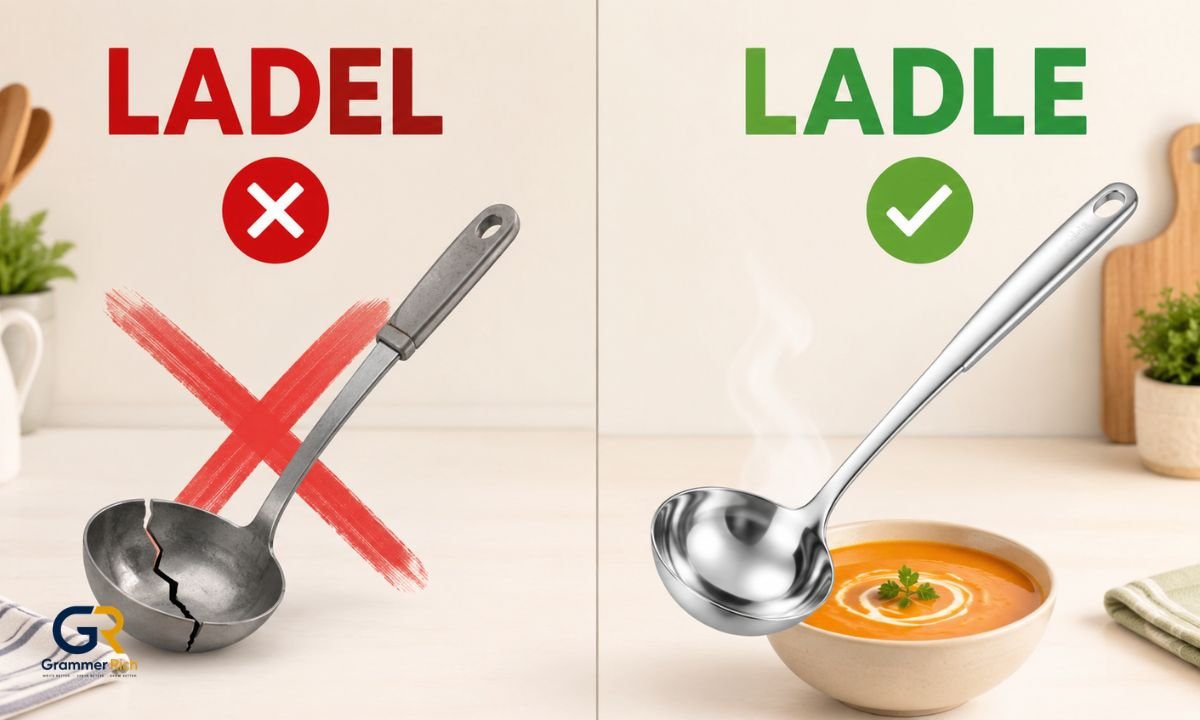
Ladle is the correct spelling, whether you mean the kitchen tool used to serve soup or the verb for scooping liquid. Ladel is simply a common misspelling, often caused by mixing up the vowel order. There’s no grammatical distinction between the two forms — one is right, and one is wrong.
So why does this mix-up happen so often? Ladel vs Ladle trips up even confident writers because the words sound identical when spoken. In this guide, we’ll break down where the confusion started, show you memory tricks to never misspell it again, and cover real examples so Ladel vs Ladle never slows down your writing.
Correct Spelling Explained in Depth: Ladel vs Ladle
Let’s settle this quickly. “Ladle” is the only spelling recognized by Merriam-Webster, Cambridge Dictionary, and every other major English dictionary. “Ladel” doesn’t exist as a word in standard English — it’s a spelling error, not a regional variant or an informal alternative.
This confusion isn’t really about grammar rules. It’s about how our brains process sound versus spelling. English speakers hear the “-le” ending pronounced the same way it would sound if written “-el,” so writers guess wrong when typing quickly.
Linguistic Accuracy Table
| Spelling | Status | Notes |
| Ladle | ✅ Correct | Standard English noun and verb |
| Ladel | ❌ Incorrect | Common phonetic misspelling |
Key Linguistic Truth
The “-dle” ending is common in English words describing tools and actions: candle, handle, saddle, paddle. “Ladle” follows this exact same pattern. Once you notice that pattern, the correct spelling becomes much easier to remember.
Meaning of Ladle: Definition and Conceptual Overview

At its core, a ladle is a deep-bowled kitchen utensil with a long handle, designed to scoop and serve liquids like soup, gravy, or punch. It also works as a verb, meaning to scoop or pour liquid using this tool.
Structural Definition of Ladle
Physically, a ladle typically features a rounded, cup-like bowl attached to a handle long enough to reach into a pot without burning your hand. Some versions include a spout for controlled pouring, while others have flat bases for stability.
Functional Definition
Functionally, a ladle exists to move liquid from one container to another with minimal spillage. It gives the user control over portion size, which matters a great deal in both home kitchens and professional food service.
Expanded Meaning Table
| Form | Meaning | Example |
| Noun | A kitchen utensil for serving liquids | “Pass me the ladle.” |
| Verb | To scoop or serve liquid | “She ladled the soup into bowls.” |
Ladle in Cooking: Real Culinary Function and Importance
In cooking, a ladle isn’t just handy — it’s essential. A soup ladle helps portion broth evenly. A gravy ladle keeps sauce from dripping across the table. A punch ladle lets you serve drinks without dunking your hand into the bowl.
Core Kitchen Functions Table
| Ladle Type | Primary Use |
| Soup ladle | Serving broths and stews |
| Gravy ladle | Pouring sauces and gravies |
| Slotted ladle | Draining liquid while serving solids |
| Punch ladle | Serving beverages from a bowl |
Practical Culinary Insights
Professional kitchens often standardize ladle sizes in ounces, so chefs can portion soup consistently across dozens of servings. This is portion control in action — a small tool solving a real operational problem.
Pronunciation Breakdown: Ladle Pronunciation Explained Clearly
Ladle is pronounced “LAY-dl,” with the stress on the first syllable. The “a” sounds like the “ay” in “day,” and the ending glides softly into an “-l” sound rather than a hard “-el.”
Phonetic Structure
Breaking it into two beats — LAY + dl — makes the pronunciation stick. There’s no separate vowel sound in the second syllable, which is exactly why so many people misspell it as “ladel.”
Pronunciation Comparison Table
| Word | Phonetic Spelling | Common Mispronunciation |
| Ladle | LAY-dl | LAY-del (incorrect stress) |
Key Linguistic Insight
Because the ending sound is so quick and soft, writers unconsciously “correct” it to match how other words look, like “label” or “novel.” That instinct is understandable, but it’s still wrong here.
Why “Ladel” Happens: Cognitive and Language Error Analysis
Spelling mistakes like this usually come from what linguists call phonetic spelling — writing a word the way it sounds rather than the way it’s actually spelled. English is full of these silent-letter traps.
Error Source Table
| Cause | Explanation |
| Phonetic guessing | Writer spells based on sound, not memory |
| Pattern confusion | Mixing “-le” endings with “-el” endings |
| Autocorrect gaps | Some spell-checkers miss less common words |
Important Insight
This is a mistake pattern, not a knowledge gap. Even strong writers slip on words like this simply because English spelling doesn’t always match pronunciation.
Historical Origin and Evolution of Ladle
The word “ladle” traces back to Old English “hlædel,” related to “hladan,” meaning “to load” or “to heap.” Over centuries, the spelling simplified, but the “-dle” ending held steady.
Historical Timeline Table
| Era | Form | Notes |
| Old English | hlædel | Root meaning “to load” |
| Middle English | ladel/ladle | Spelling gradually standardized |
| Modern English | ladle | Fixed, dictionary-confirmed spelling |
Cultural Development Insight
Kitchen tool names often evolve slowly because they’re used constantly across generations. That everyday repetition is part of why “ladle” locked into its current spelling so firmly.
Grammar Usage: Noun and Verb Function of Ladle
“Ladle” works as both a noun and a verb. As a noun, it names the object. As a verb, it describes the action of scooping or serving liquid with that object.
Grammar Structure Table
| Usage | Example Sentence |
| Noun | “The ladle hung beside the stove.” |
| Verb | “He ladled stew into each bowl.” |
Linguistic Importance
Recognizing both functions matters for writing clearly. Confusing the noun and verb forms is rare, but confusing the spelling itself is common — which is exactly why this guide exists.
Types of Ladles in Culinary Practice
Not all ladles are built the same. Different shapes and materials suit different kitchen tasks, from everyday home cooking to high-volume restaurant service.
Types Classification Table
| Type | Best For |
| Stainless steel ladle | Everyday home and professional use |
| Slotted ladle | Serving solids while draining liquid |
| Silicone ladle | Nonstick cookware |
| Miniature ladle | Sauces, dressings, condiments |
Key Culinary Insight
Choosing the right ladle affects portion accuracy and presentation, especially in restaurant settings where consistency matters as much as flavor.
Also, read this Blog : Sponser vs Sponsor
Vocabulary Expansion: Synonyms and Related Terms
While “ladle” is specific, a few related terms show up in similar contexts. Knowing them helps you describe kitchen tools more precisely.
Vocabulary Comparison Table
| Term | Relation to Ladle |
| Scoop | Broader term, not liquid-specific |
| Dipper | Informal synonym in some regions |
| Server | General term for serving utensils |
Key Insight
None of these words are interchangeable with “ladle” in formal writing. Precision matters, especially in culinary or professional content.
Common Mistakes in Real Usage
Beyond the ladel vs ladle spelling error, a few related mistakes show up often in casual writing and even published content.
Mistake Pattern Table
| Mistake | Correction |
| “Ladel” | “Ladle” |
| “Laddle” | “Ladle” |
| “Ladle’d” | “Ladled” |
Key Insight
Double letters and extra vowels are the two most common ways this word gets misspelled. Watching for both fixes most errors instantly.
Real-World Application of Ladle
You’ll encounter “ladle” constantly — in recipes, restaurant menus, product listings, and cooking shows. Getting the spelling right matters for credibility, especially in published or professional writing.
Usage Environment Table
| Setting | Example Use |
| Home cooking | “Ladle the soup into bowls.” |
| Recipe writing | “Use a ladle to portion the batter.” |
| Retail listings | “Stainless steel soup ladle, 12 oz.” |
Practical Insight
Search engines and readers both notice consistent spelling. A misspelled product title, for instance, can hurt visibility in online listings.
Global Translation and Cultural Usage
Ladles exist in nearly every culinary tradition, even if the word changes. Understanding this helps writers working across international audiences or translated content.
Language Equivalents Table
| Language | Word for Ladle |
| French | louche |
| Spanish | cucharón |
| German | Schöpfkelle |
Key Insight
While the object is universal, only the English spelling “ladle” is relevant to this guide’s core question.
How to Pronounce Ladle in American English

In American English, “ladle” is pronounced the same way as in British English: LAY-dl, with a soft, quick ending. There’s no regional variation that changes the spelling or stress pattern.
Operational Efficiency in Professional Kitchens

In commercial kitchens, standardized ladle sizes speed up service and reduce waste. Staff are often trained to use specific ladle sizes for specific dishes, ensuring consistent portions across every order.
Outcome Analysis Table
| Practice | Result |
| Standardized ladle sizes | Consistent portions |
| Color-coded ladles | Faster staff training |
| Proper ladle maintenance | Longer tool lifespan |
Key Insight
Small tools like ladles quietly support big operational goals — consistency, speed, and cost control.
Complete Clarity on Ladel vs Ladle
Summary Table
| Question | Answer |
| Correct spelling? | Ladle |
| Is “ladel” a word? | No |
| Parts of speech? | Noun and verb |
| Pronunciation? | LAY-dl |
Practice Session: Ladel vs Ladle
Fill in the Blanks
- She used a ______ to serve the soup. (ladle)
- He ______ the sauce over the pasta. (ladled)
Multiple Choice
Which spelling is correct in English? A) Ladel B) Ladle Answer: B
What is a ladle used for? A) Cutting vegetables B) Serving liquids Answer: B
Correct or Incorrect: “Pass the ladel, please.” Answer: Incorrect — should be “ladle.”
Conclusion
The rule is simple: it’s always “ladle,” never “ladel.” Whether you’re writing a recipe, a menu, or a casual text, remembering the “-dle” pattern — just like candle, handle, and paddle — will keep you spelling it correctly every time. Now you’ll never mix up ladel vs ladle again.

Welcome to Grammarrich.com, your trusted source for grammar tips, writing guides, and language learning. With 5 years of experience in the grammar niche, our goal is to provide clear, accurate, and easy-to-understand content that helps everyone write with confidence.