

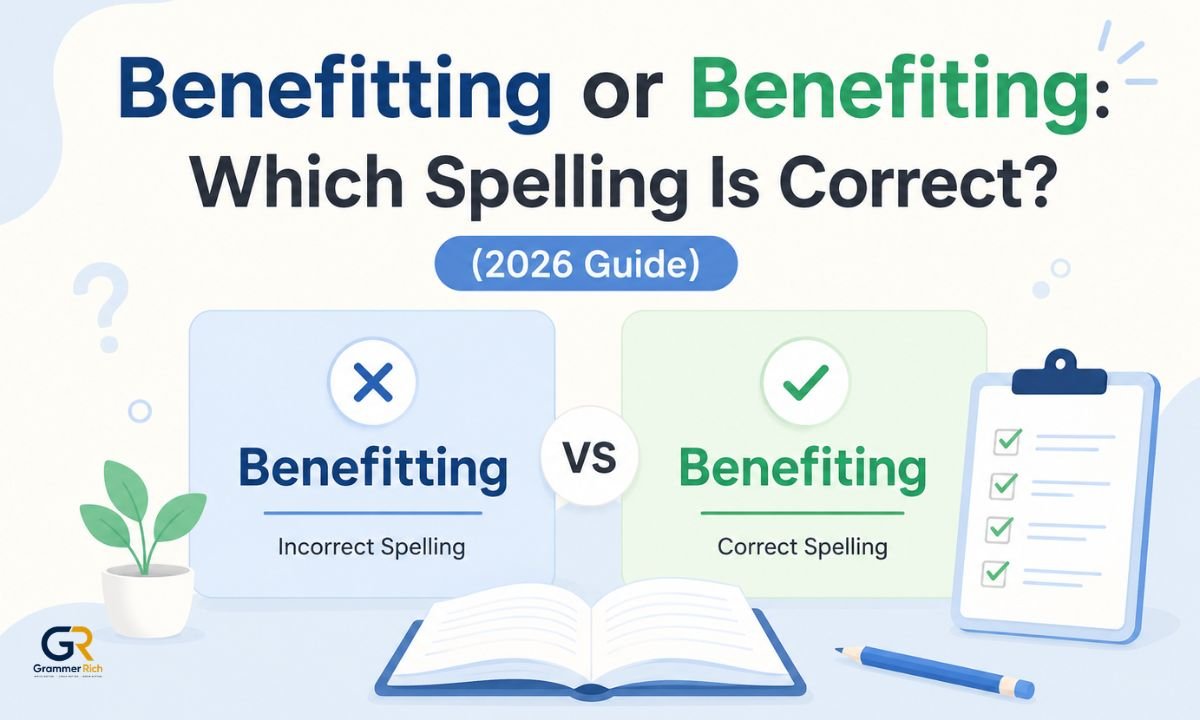
“Benefiting” is the standard spelling in American English, while “benefitting” shows up mostly in British and Australian writing, though even there “benefiting” is now more common. If you’re writing for a global audience or unsure which style guide applies, “benefiting” is the safer choice.
Here’s the good news: this mix-up trips up even experienced writers, and the fix is simpler than it looks. Whether you’re drafting an essay, a business email, or a blog post, getting benefitting or benefiting right comes down to one small grammar rule. Stick around, and you’ll never second-guess this spelling again.
Quick Answer: Benefitting or Benefiting
- Benefiting — correct in American English, and increasingly standard everywhere else.
- Benefitting — traditionally accepted in British and Australian English, though less common today.
- When in doubt, choose benefiting. It’s the safer, more widely accepted spelling across style guides and dictionaries.
What Does “Benefit” Mean?
“Benefit” can work as both a noun and a verb. As a noun, it means an advantage or gain. As a verb, it means to receive an advantage from something.
Examples:
- Noun: “The new policy has many benefits for employees.”
- Verb: “Small businesses benefit from lower tax rates.”
Benefitting or Benefiting Spelling Explained
The confusion comes from a simple grammar rule: whether to double the final consonant before adding “-ing.” Some verbs double it, others don’t, and “benefit” sits in a gray zone because of how its stress pattern works.
Because the stress falls on the first syllable (“BEN-e-fit”), not the last, most modern style guides say the final “t” should not be doubled. That gives us “benefiting” as the preferred form.
Benefited or Benefitted Oxford Dictionary

The Oxford English Dictionary lists both “benefited” and “benefitted” as acceptable past-tense forms, but notes that “benefited” is far more frequent in current usage. This mirrors the benefiting vs. benefitting pattern exactly — the single-T version is the modern standard.
Why “Benefiting” Is the Preferred Spelling
Key facts:
- Major dictionaries, including Merriam-Webster and Cambridge Dictionary, list “benefiting” as the primary spelling.
- Style guides used in journalism and academic writing favor the single-T form.
- Search data consistently shows “benefiting” used more often than “benefitting” worldwide.
Real-world usage insight:
News outlets, academic journals, and most professional publications default to “benefiting.” If you’re writing for a business audience or publishing online, this is the form that will look correct to the widest readership.
Is “Benefitting” Ever Correct?
Yes, in certain contexts. “Benefitting” is not wrong — it’s a recognized variant, especially in British and Australian English, where doubling the consonant is sometimes preferred regardless of stress position. It’s simply less common today than it once was.
If you’re writing for a UK-based publication with a specific style guide requiring it, “benefitting” is acceptable. Otherwise, “benefiting” is the safer default.
Benefitting or Benefiting Synonym
If you want to avoid the spelling question altogether, consider synonyms like “gaining from,” “profiting from,” or “advantaging.” These carry a similar meaning without the spelling ambiguity.
Grammar Rule: Doubling Consonants Before “-ing”

The rule:
English doubles a final consonant before adding “-ing” when:
- The word ends in a single consonant preceded by a single vowel (a CVC pattern).
- The stress falls on the last syllable.
If the stress falls earlier in the word, the consonant usually stays single.
Examples:
- “Run” → “running” (one syllable, stress on it, consonant doubles)
- “Refer” → “referring” (stress on last syllable, doubles)
- “Benefit” → “benefiting” (stress on first syllable, no doubling)
- “Offer” → “offering” (stress on first syllable, no doubling)
Why “Benefit” Does NOT Double the “T”
Since the stress in “benefit” lands on the first syllable, the standard rule says skip the doubling. This is the same reason “offering” and “targeting” don’t double their final consonants either.
Comparison Table:
| Word | Stress Position | Doubles Consonant? | -ing Form |
| Benefit | First syllable | No | Benefiting |
| Refer | Last syllable | Yes | Referring |
| Target | First syllable | No | Targeting |
| Occur | Last syllable | Yes | Occurring |
| Offer | First syllable | No | Offering |
Exceptions to the Consonant Doubling Rule
English grammar loves exceptions, and this rule is no different. A handful of words break the pattern due to regional convention rather than stress.
Examples:
- “Travel” → “traveling” (US) vs. “travelling” (UK) — both accepted, despite first-syllable stress.
- “Cancel” → “canceling” (US) vs. “cancelling” (UK) — same pattern.
- “Benefit” follows this same UK/US split, which is why “benefitting” persists in some regions.
British vs American vs Australian Usage
Benefitting or Benefiting UK
British English has traditionally leaned toward doubling consonants more liberally than American English, similar to “travelling” or “cancelling.” However, current British dictionaries increasingly list “benefiting” as the primary spelling too.
Benefitting or Benefiting US
American English strictly follows the stress-based doubling rule, making “benefiting” the clear standard. Style guides like AP and Chicago consistently use the single-T spelling.
Benefitting or Benefiting Australia
Australian English generally follows British conventions, so “benefitting” was historically more common. Modern Australian style guides, though, now favor “benefiting” in line with global trends.
Benefiting vs Benefitting: Side-by-Side Comparison
| Feature | Benefiting | Benefitting |
| Region | Global standard, US preferred | Traditional UK/Australian variant |
| Dictionary preference | Primary spelling | Secondary/variant spelling |
| Formal writing | Recommended | Acceptable but less common |
| SEO performance | Higher search volume | Lower search volume |
Examples of Benefiting and Benefitting in Sentences
Correct Usage:
- “Thousands of students are benefiting from the new scholarship program.”
- “Local farmers have been benefiting from improved irrigation systems.”
Rare Usage:
- “The charity is benefitting from increased donations this year.” (Acceptable in British/Australian contexts, though “benefiting” is still more widely recommended.)
Common Mistakes to Avoid
- Doubling the “t” automatically because it “looks right” — check the stress rule first.
- Assuming British English always requires the double-T form; it doesn’t anymore.
- Mixing spellings within the same document — pick one and stay consistent.
- Ignoring your organization’s style guide, which may specify a preferred form.
Similar Spelling Confusions
Several other verbs follow the same first-syllable-stress rule and cause similar confusion.
Examples:
- “Target” → “targeting” (not “targetting”)
- “Focus” → “focusing” (not “focussing,” in American English)
- “Format” → “formatting” (doubles here because it’s a special case in most style guides)
Does Spelling Choice Affect SEO?
Yes, spelling choice can influence search visibility, especially for content-heavy websites.
Important SEO facts:
- “Benefiting” has a higher average search volume across most English-speaking regions.
- Using the more searched spelling in headings and body text can improve keyword matching.
- Google’s algorithms generally recognize both spellings as related, but consistency helps readability and trust signals.
Case Insight:
Sites that standardize on “benefiting” throughout their content tend to align better with dictionary-based grammar checkers and reader expectations, which can reduce bounce rates from perceived errors.
When Should You Use “Benefiting” in Writing?
Use “benefiting” in nearly all formal, academic, business, and web content, unless you’re following a specific British style guide that explicitly calls for “benefitting.”
Example:
“Employees benefiting from the new health plan should submit paperwork by Friday.”
Quick Memory Tip to Remember the Correct Spelling
Think of the phrase: “Benefit stays lean, not doubled and mean.” Since the stress sits on “BEN,” not the final syllable, the “t” stays single. If you can say the word without stressing the last syllable, skip the double consonant.
Conclusion
The rule is simple once you see it: because “benefit” is stressed on its first syllable, the correct modern spelling is “benefiting,” not “benefitting.” The double-T version still appears in some British and Australian writing, but it’s increasingly the exception rather than the norm. Stick with “benefiting” for consistency, credibility, and SEO performance. Now you’ll never mix them up again.
Meta Description: Confused between benefitting and benefiting? Get the clear answer, grammar rule, and examples so you never misspell it again.

Welcome to Grammarrich.com, your trusted source for grammar tips, writing guides, and language learning. With 5 years of experience in the grammar niche, our goal is to provide clear, accurate, and easy-to-understand content that helps everyone write with confidence.