

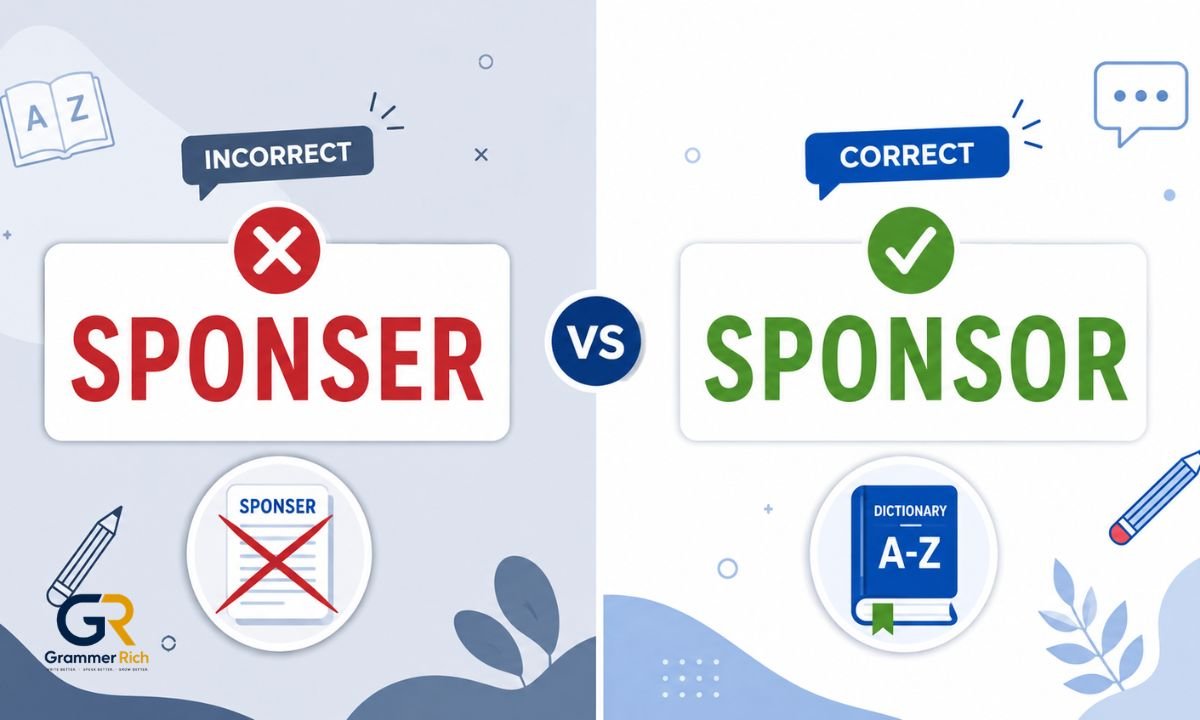
“Sponser” is simply a common misspelling — it has no meaning in English and shouldn’t appear in any context. “Sponsor” is the only correct spelling, whether you’re using it as a noun (a person or company that funds an event) or a verb (to financially support someone or something). If your spell-checker flags “sponser,” trust it: swap in “sponsor” every time.
So why does this mix-up trip up so many writers, students, and even marketers? The confusion around Sponser vs Sponsor usually comes down to how the word sounds when we say it out loud. This guide breaks down the correct spelling, common mistakes, real usage examples, and simple tricks to help you remember it for good.
What the Word Actually Represents

At its core, a sponsor is someone or something that provides support — usually financial — in exchange for recognition, goodwill, or a working relationship. When you hear the word in a business meeting, a sports broadcast, or a support group, it carries the same basic idea: backing someone else’s effort.
The debate over Sponser vs Sponsor isn’t really a debate about meaning. It’s about spelling. Only one version exists in standard dictionaries, and that’s “sponsor.” “Sponser” isn’t an alternate spelling, a regional variant, or an informal shorthand — it’s simply incorrect.
How the Word Actually Works: Sponser vs Sponsor
Here’s where the Sponser vs Sponsor question gets interesting. The word “sponsor” functions as both a noun and a verb, and that dual role is part of why people get uncertain about the spelling.
- As a noun: “The company became the event’s main sponsor.”
- As a verb: “They agreed to sponsor the marathon this year.”
Notice that “sponser” doesn’t appear in either form. English speakers sometimes assume an “-er” ending because it feels familiar (like “helper” or “worker”), but “sponsor” keeps its “-or” ending in every grammatical role.
Which Is Correct, Sponser or Sponsor?

Let’s settle the Sponser vs Sponsor question once and for all: “sponsor” is correct, always. “Sponser” is never correct — not in casual writing, not in formal documents, not in any English-speaking region.
This isn’t a US-versus-UK spelling difference either, like “color” and “colour.” Both American and British dictionaries, including Merriam-Webster and Cambridge Dictionary, list only “sponsor.” There’s no accepted version of “sponser” anywhere in standard English.
Read this Blog: Sugar or Suger: Which Spelling Is Correct?
Why the Confusion Happens
If “sponser” isn’t even a real word, why do so many people write it that way? A few reasons explain the pattern:
- Phonetic spelling — the word sounds like it could end in “-er,” especially when spoken quickly.
- Pattern matching — English has many “-er” ending nouns for people who do something (teacher, worker, sponsor… wait, no).
- Autocorrect gaps — some basic spell-checkers miss it if the surrounding grammar looks fine.
- Non-native speaker influence — ESL learners often default to the more common “-er” pattern.
Understanding this helps explain why the Sponser vs Sponsor mix-up is so widespread, even among experienced writers.
Correct Spelling Sponsor: Clear Visual Comparison
| Feature | Sponsor (Correct) | Sponser (Incorrect) |
| Dictionary status | Listed in Merriam-Webster, Cambridge, Oxford | Not listed anywhere |
| Part of speech | Noun and verb | Not applicable |
| Example sentence | “The bank sponsors the charity gala.” | Not valid in any sentence |
| Formal writing use | Always acceptable | Always incorrect |
| Regional variation | None — same in US/UK English | None — simply a misspelling |
This table makes the Sponser vs Sponsor comparison easy to reference whenever you’re double-checking your writing.
Why “Sponser” Is Always Incorrect in English
There’s no scenario — academic, professional, casual, or technical — where “sponser” is the accepted spelling. It doesn’t appear in style guides, it isn’t a recognized variant, and no major dictionary lists it as an alternate form.
When people search for Sponser vs Sponsor, they’re usually hoping there’s some nuance or exception buried somewhere. There isn’t. The rule is refreshingly simple: one spelling exists, and it ends in “-or.”
How to Spell Sponsor Correctly (Practical Memory Approach)
If you want a foolproof way to remember the correct spelling, try one of these tricks:
- Think of “sponsor” and “supervisor” — both end in “-or” and both describe someone overseeing or supporting something.
- Break it into syllables: spon-sor, not spon-ser.
- Associate it with “donor” — another support-related word ending in “-or.”
Once the pattern clicks, the Sponser vs Sponsor confusion tends to disappear for good.
How to Use Sponsor in English (Real Contexts and Examples)

Seeing the word in action helps cement the correct spelling. Here are a few natural examples:
- “Our university found a corporate sponsor for the robotics team.”
- “She agreed to sponsor her nephew’s visa application.”
- “The marathon’s title sponsor logo appeared on every runner’s bib.”
- “He’s been my sponsor in recovery for over a year.”
Each sentence uses “sponsor” the same way — never “sponser” — regardless of the context.
Sponsor Definition With Real Examples Across Industries
The word shows up across many fields, and the meaning shifts slightly depending on the setting:
- Marketing: A brand pays to be associated with an event for visibility.
- Sports: Companies fund teams or athletes in exchange for logo placement.
- Education: Organizations or individuals fund scholarships or programs.
- Immigration/Legal: A person vouches for and supports another’s application.
- Recovery programs: A mentor supports someone through a recovery process.
No matter the industry, the underlying idea of support and backing stays consistent — and so does the spelling.
How Business Relationships Actually Work: Sponser vs Sponsor
In professional settings, sponsorship is a two-way relationship. One party offers funding, resources, or endorsement; the other offers visibility, access, or a platform. Contracts, press releases, and marketing materials will always use “sponsor,” never “sponser” — which is another reason the Sponser vs Sponsor mistake stands out so clearly in professional writing. A misspelling in a sponsorship agreement can undercut the credibility of an otherwise polished document.
Types of Sponsors and Their Roles
Not all sponsors serve the same function. Common types include:
- Financial sponsor — provides direct monetary support.
- Media sponsor — offers advertising space or airtime instead of cash.
- Title sponsor — gets top billing, often in the event’s name itself.
- In-kind sponsor — donates goods or services rather than money.
- Business sponsor — supports a company initiative or internal project.
Recognizing these categories makes it easier to talk about sponsorship accurately, especially in marketing and event planning.
Sponsor Synonyms and Related Vocabulary
Depending on context, related words include backer, patron, benefactor, supporter, promoter, and underwriter. None of these substitute perfectly for “sponsor,” but they’re useful when you want to vary your writing without repeating the same word.
Sponsor Forms and Variations in Usage
The base word branches into several related forms:
- Sponsored (past tense/adjective): “The event was sponsored by three local businesses.”
- Sponsoring (present participle): “They’re sponsoring a new scholarship this fall.”
- Sponsorship (noun): “The sponsorship deal lasts three years.”
- Sponsors (plural): “Several sponsors backed the festival.”
Every variation keeps the “-or” spelling intact — “sponser” doesn’t appear in any form, tense, or derivative.
What Is a Sponsor in Recovery Contexts
Outside business and marketing, “sponsor” has a deeply personal meaning in recovery communities. A recovery sponsor is someone further along in their journey who mentors and supports another person through the process. This usage still follows the same spelling rule — the Sponser vs Sponsor question doesn’t change based on emotional or personal context.
Common Mistakes People Make With Sponsor
Beyond the spelling itself, a few related errors show up often:
- Confusing “sponsor” with “sponsee” (the person being sponsored).
- Using “sponsorer” instead of “sponsor.”
- Dropping the “-ship” suffix incorrectly when forming “sponsorship.”
- Assuming “sponser” is a casual or shortened spelling — it isn’t.
Avoiding these keeps your writing polished, whether it’s a marketing pitch or a school assignment.
Practice Exercises: Sponser vs Sponsor
Fill in the Blank
- The company decided to ______ the youth soccer league.
- Every runner’s bib displayed the marathon’s title ______.
Error Identification
Find the mistake: “Our sponser agreed to fund the entire event.”
Sentence Correction
Rewrite correctly: “She has been my sponser for six months.”
Application
Write two original sentences using “sponsor” as a noun and as a verb.
Marketing Context
Draft a one-line pitch to a potential brand sponsor for a local festival.
Education Context
Write a sentence describing a scholarship sponsor.
Sports Context
Describe how a title sponsor’s logo might appear during a broadcast.
Quick Recall Assessment
True or False: “Sponser” is an accepted British English spelling. (Answer: False)
Conclusion
The Sponser vs Sponsor debate really comes down to one simple rule: only “sponsor” is correct, in every context, tense, and industry. “Sponser” isn’t a shortcut or a variant — it’s just a mistake. Once you lock in the “-or” ending, whether you’re writing a sponsorship proposal, a school essay, or a quick text message, you’ll spell it right every time. Now you’ll never mix them up again.

Welcome to Grammarrich.com, your trusted source for grammar tips, writing guides, and language learning. With 5 years of experience in the grammar niche, our goal is to provide clear, accurate, and easy-to-understand content that helps everyone write with confidence.