

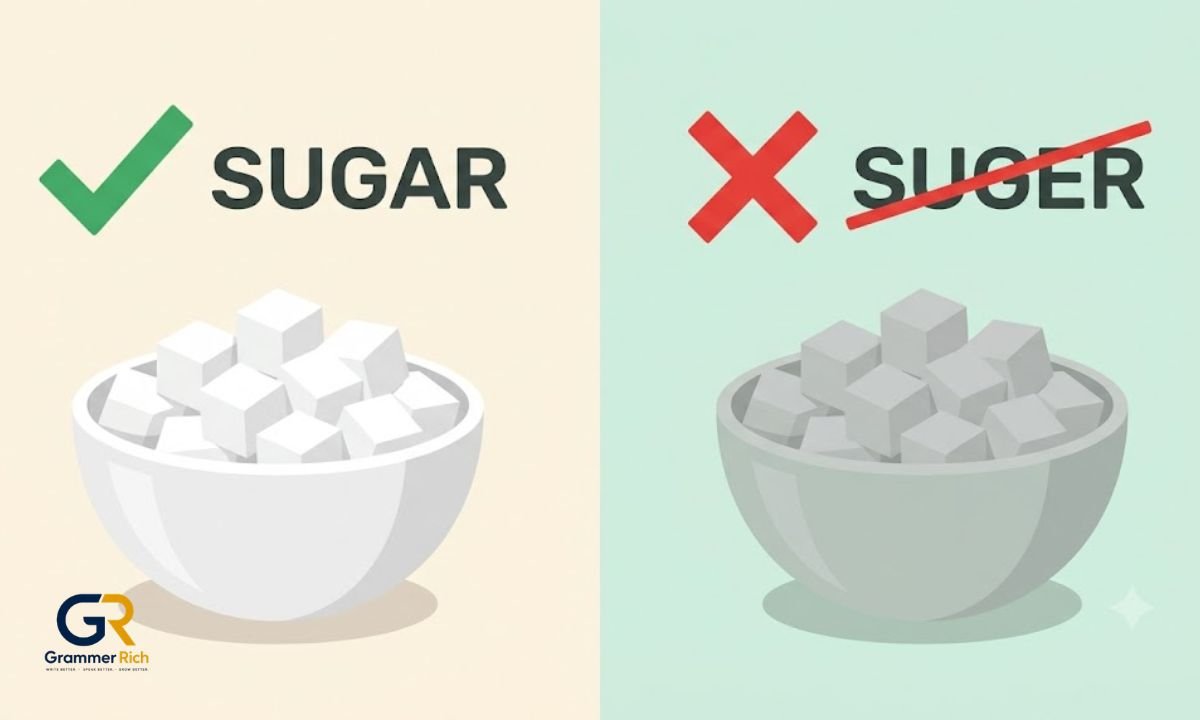
Sugar is the correct spelling, referring to the sweet crystalline substance used in food and drinks. Suger is a common misspelling, not a recognized English word, though it sometimes appears as a surname or in unrelated foreign terms. There’s no grammatical rule separating them, unlike true past-tense pairs. If you’re writing about the sweetener, sugar is always the right choice.
So why do so many people type suger instead? Simple: it just sounds right when you’re typing fast or trusting autocorrect a little too much. This guide breaks down where the confusion comes from, how to remember the correct spelling for good, and why “sugar or suger” trips up even confident writers.
Sugar or Suger — What Is the Correct Spelling?

Let’s settle this right away. When people search “sugar or suger,” they’re almost always trying to confirm one thing: which version is real English. The answer is sugar. Every major dictionary, including Merriam-Webster and the Cambridge Dictionary, lists sugar as the standard spelling. Suger doesn’t appear in any of them as a valid word.
This isn’t a case like “ridden” versus “rode,” where both spellings are correct depending on grammar. Sugar or suger isn’t a tense issue at all — it’s purely a spelling issue. One version is right, and one version is a typo that happened to stick around because it sounds so close to the real word.
Here’s a quick comparison to make it crystal clear:
| Spelling | Correct? | Why |
| Sugar | Yes | Standard, dictionary-recognized spelling |
| Suger | No | Common misspelling; not found in standard dictionaries |
If you remember nothing else from this article, remember this: sugar has a “a” after the “g,” not an “e.” That single letter is the whole debate.
Read more: Thank You Both vs Thanks to Both of You: What’s the Difference?
Why Do People Write “Suger” Instead of “Sugar”?
If sugar is so clearly correct, why does suger show up so often in emails, texts, and even published content? There are a few honest reasons, and none of them make you a bad writer.
1. Pronunciation Confusion
English spelling doesn’t always match pronunciation, and sugar is a great example. The word starts with a “sh” sound, not a hard “s” sound, which throws people off. When your brain hears “shug-er,” it’s easy to type what sounds right instead of what’s spelled right.
2. Phonetic Typing
Many people type the way they think words sound. Since the “a” in sugar is barely pronounced, some writers assume it’s an “e” instead. This phonetic guesswork is one of the biggest reasons sugar or suger keeps confusing people.
3. Fast Typing Errors
Typos happen. When you’re typing quickly on a phone keyboard, your thumb can easily land on “e” instead of “a.” It’s a small slip, but it’s common enough that “suger” has become one of the most searched sugar-related typos online.
4. Lack of Awareness
Some people simply haven’t seen the word written out often enough to memorize it. If you learned English mostly through speaking rather than reading, sugar or suger can genuinely feel like a coin flip.
What Does “Sugar” Mean?
Now that the spelling question is settled, let’s look at what sugar actually means — because understanding the word makes it much easier to remember how to spell it.
Simple Meaning
In everyday language, sugar refers to a sweet-tasting substance used to flavor food and drinks. It’s the white or brown granulated ingredient you scoop into your coffee, bake into cookies, or find already added to sodas and candy.
Scientific Meaning
Scientifically, sugar is a type of simple carbohydrate. It’s made up of molecules like glucose, fructose, and sucrose, which the body breaks down for energy. Table sugar, specifically, is sucrose — a combination of glucose and fructose bonded together.
Both meanings point to the same core idea: sugar is a sweet, energy-providing substance, whether you’re talking about the spoonful in your tea or the molecules your body processes after a meal.
What Is Sugar Made Of?
Sugar isn’t manufactured from nothing — it comes from natural plant sources that are processed and refined.
Natural Sources of Sugar
- Sugarcane – a tall grass crop that’s crushed and processed to extract sugar
- Sugar beet – a root vegetable that’s another major source of table sugar
- Fruits – contain natural fructose
- Milk – contains a natural sugar called lactose
Whether it comes from a cane field or a beet farm, the end product goes through refining before it reaches your kitchen table. This is worth knowing because it explains why “natural sugar” and “added sugar” aren’t quite the same thing — a distinction we’ll cover shortly.
Types of Sugar You Should Know
Not all sugar is the same, and understanding the categories helps you make sense of nutrition labels and health advice.
1. Natural Sugar
This is sugar that occurs naturally in whole foods, like the fructose in an apple or the lactose in milk. It comes packaged with fiber, vitamins, and other nutrients.
2. Added Sugar
Added sugar is sugar (or syrup) that manufacturers mix into food during processing — think sodas, candy, and packaged snacks. It’s the type nutritionists usually recommend limiting.
3. Simple Sugars
These are basic sugar molecules like glucose and fructose. They’re quickly absorbed by the body, which is why sugary snacks can give a fast energy spike.
4. Complex Sugars
Complex sugars, or complex carbohydrates, are made of longer chains of sugar molecules. They take longer to digest and provide steadier energy — found in foods like whole grains and legumes.
Is Sugar a Carbohydrate?

Yes. Sugar is technically a type of carbohydrate — specifically, a simple carbohydrate. Carbohydrates are one of the three main macronutrients (alongside protein and fat), and sugar sits at the simplest end of that spectrum.
Quick Breakdown
- Carbohydrates = broad category of energy-providing nutrients
- Sugar = a simple carbohydrate within that category
- Starches and fiber = other types of carbohydrates, but more complex
So while all sugar is a carbohydrate, not all carbohydrates are sugar. That distinction matters if you’re reading food labels or tracking your diet.
How to Use “Sugar” in Sentences (Examples)
Seeing the correct word in context is one of the best ways to lock it into memory.
Examples:
- I take one spoonful of sugar in my coffee.
- The recipe calls for two cups of sugar.
- Too much sugar in soft drinks can affect your health.
- She avoids added sugar whenever possible.
- Sugarcane is harvested and processed into table sugar.
Formal vs Informal Use
In formal writing — reports, articles, academic papers — always use “sugar.” There’s no informal or shortened version of the word that’s considered acceptable. Unlike slang terms that get abbreviated in casual texting, sugar stays the same across every context. If you ever see “suger” in professional writing, it’s simply an error, not a stylistic choice.
Sugar Pronunciation: Why It Confuses People
Sugar is pronounced /ˈʃʊɡər/ — starting with a “sh” sound rather than a hard “s.” This mismatch between spelling and pronunciation is exactly why sugar or suger becomes a genuine point of confusion for so many English learners and native speakers alike.
Most words that start with “s” make a straightforward “s” sound (think “sun” or “sit”). Sugar breaks that pattern, and irregular pronunciation like this is a well-documented source of spelling mistakes in English. The written form doesn’t map neatly to how the word sounds, so people fill in the gaps with guesses — and “suger” is a common guess.
Common Misspellings of Sugar
Suger isn’t the only variation floating around. Here are other misspellings people occasionally search for:
- Shugar
- Suggar
- Sugor
- Sooger
All of these are incorrect. No matter which variation you’ve seen or typed, the only standard, dictionary-approved spelling is sugar.
Sugar in Food and Daily Life

Sugar shows up in far more places than most people realize — not just the sugar bowl on the table.
Common Sources
- Soft drinks and sodas
- Candy and desserts
- Breakfast cereals
- Flavored yogurts
- Sauces and condiments like ketchup
- Baked goods
Even foods that don’t taste overtly sweet, like bread or salad dressing, often contain added sugar. This is part of why health experts encourage people to check ingredient labels rather than relying on taste alone.
Is Sugar Bad for You? (Health Overview)
Sugar itself isn’t inherently dangerous — your body needs some glucose for energy. The concern comes from excess consumption, particularly of added sugar, which is easy to overdo in a modern diet full of processed foods.
Potential Effects of Too Much Sugar
- Weight gain from excess calorie intake
- Increased risk of tooth decay
- Higher risk of type 2 diabetes over time
- Energy crashes after sugar spikes
- Potential strain on heart health with long-term overconsumption
None of this means sugar needs to disappear from your diet entirely. It means moderation matters, especially with added sugar hiding in processed foods.
How Much Sugar Should You Consume Daily?
Health organizations, including the World Health Organization, generally recommend limiting added sugar intake to reduce health risks.
Recommended Intake
- WHO recommends keeping added sugar under 10% of total daily calories, with additional benefits if reduced to below 5%
- For a typical 2,000-calorie diet, that’s roughly 25–50 grams of added sugar per day
- Natural sugars found in whole fruits and dairy aren’t the primary concern in these guidelines
These numbers are general guidance, not medical prescriptions — individual needs can vary based on health conditions and activity levels.
Natural vs Added Sugar — What’s the Difference?
This distinction comes up constantly in nutrition conversations, so it’s worth spelling out clearly.
| Category | Natural Sugar | Added Sugar |
| Source | Occurs naturally in fruit, milk, vegetables | Added during food processing or cooking |
| Nutrients | Comes with fiber, vitamins, minerals | Provides calories with little nutritional value |
| Common Examples | Fructose in apples, lactose in milk | Sugar in soda, candy, baked goods |
| Health Impact | Generally less concerning in whole foods | Main focus of health guidelines to limit |
Understanding this difference helps you make smarter choices without needing to fear sugar as a whole.
How to Reduce Sugar Intake
If you’re looking to cut back, small, sustainable changes tend to work better than drastic ones.
- Read nutrition labels and watch for “added sugars”
- Swap sugary drinks for water or unsweetened tea
- Choose whole fruit instead of fruit juice or dried fruit with added sugar
- Cook more meals at home to control ingredients
- Gradually reduce sugar in coffee, tea, or recipes rather than cutting it all at once
Reducing sugar doesn’t mean eliminating flavor — it often just means being more intentional about where your sugar comes from.
Sugar Alternatives You Can Consider
For people looking to cut back without giving up sweetness entirely, several alternatives exist:
- Honey – a natural sweetener with trace nutrients
- Stevia – a plant-based, calorie-free sweetener
- Maple syrup – a natural alternative with a distinct flavor
- Monk fruit sweetener – calorie-free and increasingly popular
- Erythritol and other sugar alcohols – lower-calorie options used in many “sugar-free” products
Each alternative has its own taste profile and best-use cases, so it often comes down to personal preference and how you’re using it.
Quick Summary: Sugar vs Suger
- Sugar is the correct, dictionary-recognized spelling.
- Suger is a common misspelling with no standard meaning.
- The confusion mostly comes from pronunciation and fast typing, not a grammar rule.
- Sugar refers to a sweet substance and a simple carbohydrate used for energy.
- Moderating added sugar intake is the main health consideration, not sugar as a whole.
Conclusion
At the end of the day, the sugar or suger debate has a simple resolution: sugar is correct, and suger is just a spelling slip that pronunciation makes easy to fall into. Once you remember that sneaky “sh” sound at the start of the word, the correct spelling gets a lot easier to recall. Now you’ll never mix them up again.

Welcome to Grammarrich.com, your trusted source for grammar tips, writing guides, and language learning. With 5 years of experience in the grammar niche, our goal is to provide clear, accurate, and easy-to-understand content that helps everyone write with confidence.