

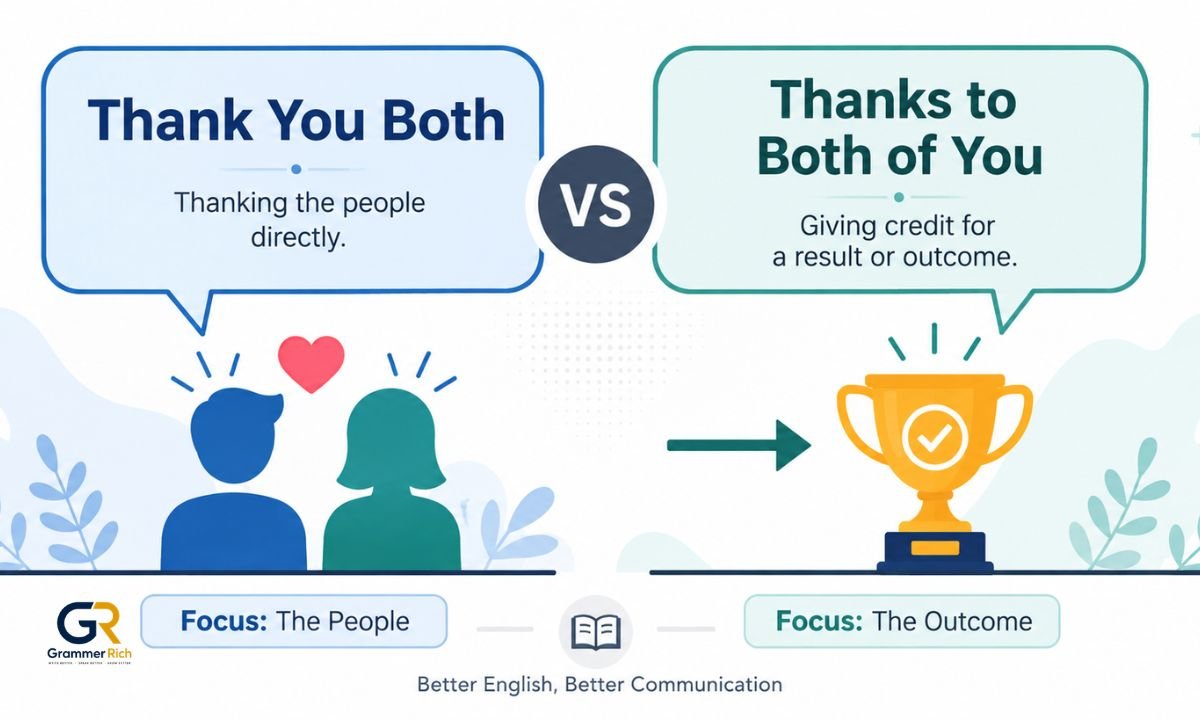
Both phrases are grammatically correct, but they work differently. “Thank you both” is a direct, spoken expression of gratitude aimed straight at two people, common in casual conversation. “Thanks to both of you” leans more formal or written, often used to credit two people for a specific outcome or effort. Choose based on tone and setting, not grammar rules.
Ever paused mid-message wondering which version sounds right? You’re not alone. Thank You Both vs Thanks to Both of You trips up even confident writers, especially in emails, speeches, and cards. This guide breaks down real examples, common mix-ups, and quick rules so you’ll never second-guess your wording again.
Quick Answer
If you want to say thanks directly to two people, use “thank you both.” If you want to explain that something happened because of two people, use “thanks to both of you.” The first is a direct expression of gratitude. The second leans on cause and effect. Neither phrase is wrong — they just answer different questions.
- “Thank you both” = a direct thank-you, said to two people.
- “Thanks to both of you” = a statement giving credit, usually followed by a result.
Meaning of “Thank You Both”
“Thank you both” is one of the simplest ways of thanking two people at once. It works the same way “thank you” does when you’re speaking to a single person — you’re just extending the same courtesy to two.
You’ll hear it constantly in daily speech. A host says it to guests as they leave. A manager says it to two employees who stayed late. It’s short, warm, and doesn’t need extra explanation.
Examples:
- “Thank you both for coming tonight.”
- “Thank you both for your support this year.”
- “Thank you both for your help — I couldn’t have done it alone.”
Notice the structure: “thank you” plus “both,” acting almost like a pronoun that stands in for “the two of you.” It’s informal-friendly but still perfectly acceptable in professional writing, especially business emails and thank-you notes.
Meaning of “Thanks to Both of You”
“Thanks to both of you” carries a slightly different job. Instead of just expressing gratitude, it usually points to a cause. Something happened, and these two people made it happen.
This is where the phrase leans on the idiom “thanks to,” which means “because of” or “as a result of.” So “thanks to both of you” really means “because of both of you.”
Examples:
- “Thanks to both of you, the project launched on time.”
- “Thanks to both of you, we hit our sales target.”
- “Many thanks to both of you for making this possible.”
You’ll often see this phrase followed by an outcome. That’s the giveaway. If a sentence explains a result, “thanks to both of you” usually fits better than a plain “thank you both.”
Thanks to Both of You: Meaning in Context
The phrase shifts slightly depending on where it sits in a sentence. At the start, it introduces a cause: “Thanks to both of you, everything ran smoothly.” Placed at the end, it reads more like a closing acknowledgment: “We finished early, thanks to both of you.” Either way, it’s doing double duty — expressing appreciation while also crediting a specific outcome to two people.
Key Difference Between the Two Phrases

Here’s a side-by-side comparison to make the distinction stick.
| Feature | Thank You Both | Thanks to Both of You |
| Function | Direct expression of gratitude | Cause-and-effect statement |
| Structure | “Thank you” + “both” | “Thanks to” (because of) + “both of you” |
| Typical use | Spoken thanks, short notes, casual and formal settings | Written recognition, crediting an outcome |
| Followed by | Often nothing, or a reason (“for your help”) | Often a result or achievement |
| Tone | Warm, direct, personal | Slightly more formal, explanatory |
| Example | “Thank you both for coming.” | “Thanks to both of you, we succeeded.” |
The core difference between “thank you both” and “thanks to both of you” comes down to intent. One is gratitude aimed at people. The other is gratitude tied to an outcome those people created.
When to Use “Thank You Both”
Use “thank you both” whenever you’re thanking two people directly, without needing to explain why or what resulted from their effort. It works well:
- At the end of a meeting or event, thanking attendees.
- In a text or email replying to two people who helped you.
- In speeches, when addressing two honorees or hosts.
- In cards and notes for birthdays, gifts, or favors.
It’s flexible enough for both informal and semi-formal English. You don’t need extra context — the phrase stands on its own.
When to Use “Thanks to Both of You”
Use “thanks to both of you” when you want to connect the thanks to a specific cause or result. It fits naturally in:
- Business emails summarizing a team win.
- Announcements crediting two contributors.
- Formal speeches recognizing collaborative effort.
- Written reports or recaps (“thanks to both of you, deadlines were met”).
If you can rephrase your sentence with “because of both of you” and it still makes sense, that’s your cue to use “thanks to both of you.”
Tone and Formality Differences
Neither phrase is strictly formal or informal — context decides that. But there are patterns worth knowing.
“Thank you both” feels personal and conversational. It’s the phrase you’d use face-to-face, in a quick reply, or in a friendly note. It doesn’t lose its warmth even in professional settings, which is why it shows up so often in workplace communication.
“Thanks to both of you” carries a touch more structure. Because it usually explains a result, it fits naturally into written communication — recaps, announcements, formal thank-you letters. It can still feel warm, but it reads slightly more composed than a quick verbal thanks.
Thank You Both for Your Help

This exact phrase — “thank you both for your help” — is one of the most common real-world uses of the pattern. It combines the direct gratitude of “thank you both” with a reason attached at the end. Unlike “thanks to both of you,” it doesn’t need to describe an outcome; it simply names what you’re grateful for. That makes it ideal for everyday emails, quick messages, and spoken thanks after someone lends a hand.
American vs British English Usage
Both phrases are used across American and British English without major differences in meaning. That said, a few subtle patterns show up in usage:
- American English tends to favor shorter, more direct phrasing like “thank you both,” especially in business emails.
- British English sometimes leans on “many thanks to both of you” in formal correspondence, adding a touch more politeness.
- Neither region treats one phrase as incorrect — the choice is stylistic, not regional grammar.
If you’re writing for an international audience, either phrase will read naturally. Just match the tone of the rest of your message.
Common Mistakes to Avoid
A few errors show up often enough to call out directly.
- Dropping “to” from “thanks to.” “Thanks both of you” isn’t standard English — the preposition “to” is required.
- Adding an unnecessary “you” after “thank.” “Thank you to both of you” is repetitive; pick one structure, not both.
- Using “thanks to both of you” without a result. If there’s no outcome being credited, “thank you both” usually fits better.
- Mixing formality levels. Pairing a very formal opener with a casual “thanks both!” can feel jarring in professional writing.
Avoiding these keeps your writing clean and confident, whether you’re drafting a quick text or a formal email.
Simple Memory Trick
Here’s an easy way to remember the difference for good: if you’re talking to people, say “thank you both.” If you’re talking because of people, say “thanks to both of you.” “To” signals direction — you’re speaking at someone. “Thanks to” signals cause — something happened as a result of them.
Thank You Both: Synonyms

If you want variety, several phrases carry a similar meaning to “thank you both”:
- “I appreciate you both.”
- “My thanks to both of you.”
- “I’m grateful to both of you.”
- “Much appreciated, both of you.”
Synonyms and Related Phrases
Beyond direct synonyms, related expressions can help you avoid repeating the same phrase across a document:
- “Thanks a lot, both of you.”
- “Sincere thanks to the two of you.”
- “I owe you both a huge thank you.”
- “With gratitude to both of you.”
Rotating these keeps writing — especially thank-you speeches or notes to multiple people — from sounding repetitive.
Real-Life Usage Examples
In an email: “Thank you both for jumping on the call this morning. Your input made the pitch stronger.”
In a speech: “Thanks to both of you, this event came together in record time. We’re grateful for everything you did behind the scenes.”
In a text message: “Just landed — thank you both for picking me up, means a lot!”
In a formal letter: “Thanks to both of you, our department exceeded its goals this quarter. Your leadership made the difference.”
Conclusion
The rule is simple once it clicks: “thank you both” is a direct thank-you, while “thanks to both of you” credits two people for a specific result. Keep that distinction in mind, match your phrase to your context, and you’ll write with more precision every time. Now you’ll never mix them up again.

Welcome to Grammarrich.com, your trusted source for grammar tips, writing guides, and language learning. With 5 years of experience in the grammar niche, our goal is to provide clear, accurate, and easy-to-understand content that helps everyone write with confidence.