

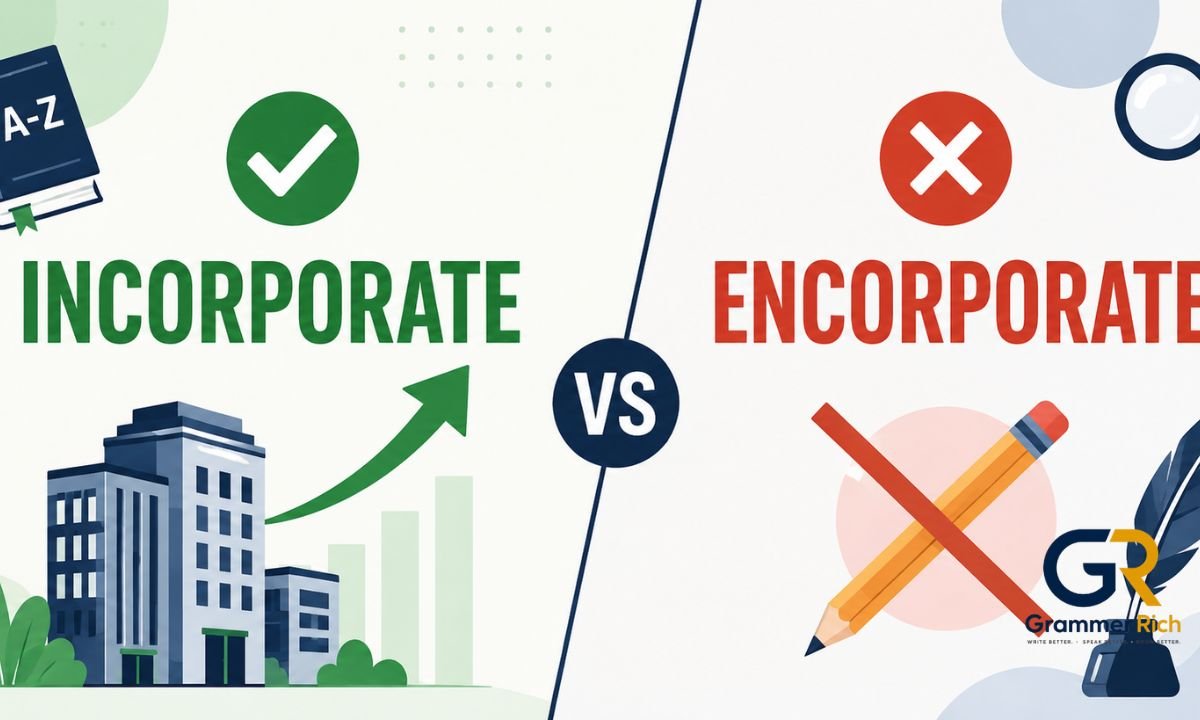
“Encorporate” isn’t a real word — it’s simply a common misspelling of “incorporate.” Only “incorporate” is correct, whether you mean forming a legal business entity or blending something into a larger whole. If you’ve typed “encorporate” into a search bar, autocorrect isn’t broken; you just made an easy mix-up.
So why does this mistake happen so often? The “en-” prefix trips people up because it sounds natural, even though it’s wrong here. In this guide, we’ll clear up the Encorporate vs Incorporate confusion for good, cover where the error comes from, and show you exactly how to use “incorporate” correctly in business and everyday writing.
The Quick Answer You Need First
If you only remember one thing from this article, remember this: “incorporate” is correct, “encorporate” is not. There’s no debate here, no regional variation, no exception. Every major dictionary — Merriam-Webster, Cambridge, and Oxford — lists “incorporate” as the standard spelling. None of them recognize “encorporate” as an alternate form.
The Encorporate vs Incorporate question isn’t really a comparison between two valid words. It’s a comparison between a correct word and a typo that happens to sound plausible. That’s an important distinction, and it’s why this mix-up shows up so often in business documents, essays, and even professional emails.
What Does “Incorporate” Really Mean?
Incorporate Definition
“Incorporate” is a verb with two main meanings. The first is general: to combine something as part of a whole. The second is more specific and legal: to form a company or organization into a legal corporation.
Both meanings share the same root idea — bringing separate parts together into one unified body. That’s actually where the word comes from historically; it traces back to Latin roots meaning “to form into a body.” Once you see that connection, the meaning becomes much easier to remember.
Incorporate Meaning in Simple Words
In plain English, “incorporate” means to include something so it becomes part of a bigger thing. That’s it. No legal jargon required for everyday use.
Quick Examples
- The teacher decided to incorporate group projects into her lesson plan.
- Please incorporate the feedback before your next draft.
- The recipe incorporates three different spices for extra flavor.
Notice how natural these sentences sound. That’s the everyday, non-legal use of the word — and it’s the version most people actually need in daily writing.
Incorporate Meaning in Business (Important Context)
Incorporate Definition (Business)
In a business context, “incorporate” means something more formal: to legally establish a company as a corporation, separate from its owners.
What Happens When a Business Is Incorporated
When a business incorporates, it becomes its own legal entity. That means:
- The company can own property, sign contracts, and be sued — independently of its owners.
- Owners typically gain limited liability protection.
- The business may face different tax rules than a sole proprietorship or partnership.
- Formal paperwork, called articles of incorporation, must be filed with the state or relevant authority.
Example
“After two years of running the shop informally, Sarah decided to incorporate her business to protect her personal assets.”
This is the meaning most people are actually searching for when they type “Encorporate vs Incorporate” — they’re usually drafting a business document and want to get the spelling right the first time.
What Is “Encorporate”? (The Honest Truth)
Encorporate Definition
There isn’t one. “Encorporate” has no dictionary definition because it isn’t a recognized English word. It’s a spelling error, plain and simple.
That might feel like an unsatisfying answer, but it’s the accurate one. Some misspellings eventually get folded into informal usage or slang. “Encorporate” hasn’t; it shows up almost exclusively as a mistake, not as an intentional variant.
Is Encorporate a Real Word? Let’s Settle It Clearly
No. “Encorporate” is not listed in Merriam-Webster, Cambridge Dictionary, or Oxford Dictionary. Spell-checkers flag it. Style guides don’t mention it, because there’s nothing to guide — it’s simply wrong.
If you’re wondering whether this might be a British vs. American spelling difference (like “colour” vs. “color”), it isn’t. Both British and American English use “incorporate.” There’s no regional exception hiding here.
Why Encorporate vs Incorporate Confuses So Many People
Main Reasons for Confusion
- The “en-” prefix feels familiar. English has plenty of real words that start with “en-,” like “enclose,” “enable,” and “encourage.” That pattern makes “encorporate” feel like it should exist.
- Auto-correct and typing speed. A quick typo of “in” as “en” is an easy slip, especially on mobile keyboards.
- Mishearing the word. Spoken aloud, “incorporate” can sound close enough to “encorporate” that people repeat the error without noticing.
- Non-native English learners sometimes apply prefix patterns from other languages, where “en-” carries a similar meaning to “in-.”
Key Insight
The confusion isn’t really about meaning — it’s about spelling and prefix pattern-matching. Once you understand that “in-” is the correct prefix here, the mistake becomes much easier to catch.
Encorporate vs Incorporate Synonym

Since “encorporate” isn’t valid, there’s no separate synonym list for it. Any synonym you’d look for actually belongs to “incorporate” — words like include, integrate, embody, or absorb, depending on context. We’ll cover a fuller synonym list further down.
Difference Between Encorporate and Incorporate (Clear Comparison)
| Feature | Incorporate | Encorporate |
| Recognized by dictionaries | Yes (Merriam-Webster, Cambridge, Oxford) | No |
| Correct spelling | Yes | No |
| Used in legal/business writing | Yes | Never appropriately |
| Used in everyday writing | Yes | Never appropriately |
| Passes spell-check | Yes | No |
| Origin | Latin-based, standard English verb | Common typo of “incorporate” |
This table sums up the entire Encorporate vs Incorporate debate in one glance: there isn’t really a debate, just a correct word and an incorrect one.
How to Spell Incorporate Correctly (And Never Forget It Again)
Correct Spelling
I-N-C-O-R-P-O-R-A-T-E. Ten letters, starting with “in,” not “en.”
Common Mistakes
- Encorporate (wrong prefix)
- Incorprate (missing letter)
- Incoporate (missing “r”)
Memory Trick
Think of the word “IN” as in “bring something IN to the group.” Incorporate literally means to bring something in, so if you remember that connection, the correct prefix should stick.
Examples of Incorporate in Sentences
- The design team wants to incorporate more sustainable materials.
- The startup plans to incorporate in Delaware next month.
- Her thesis incorporates research from three different fields.
- We should incorporate customer feedback into the next product update.
Incorporate Usage in English
Common Sentence Structures
“Incorporate” typically follows these patterns:
- Incorporate + [something] + into [something else]
- Incorporate + [something] + as [something]
- [Subject] + incorporates + [object]
Examples
- “The company incorporated the new logo into all its marketing materials.”
- “She incorporated her mother’s recipes into the new cookbook.”
Incorporate vs Include vs Integrate (Key Differences)

These three words often get grouped together because they overlap in meaning, but each has a slightly different shade.
Comparison Table
| Word | Core Meaning | Typical Use |
| Incorporate | To bring something in so it becomes part of a whole | Formal or structural blending |
| Include | To contain or add something as part of a group | General, everyday inclusion |
| Integrate | To combine so parts work together smoothly | Systems, processes, technology |
Include vs Integrate vs Incorporate (Simple Explanation)
Think of it this way: “include” is casual, “incorporate” is a bit more formal, and “integrate” implies the pieces now function as one connected system.
Example
“The app includes a calendar feature, incorporates user feedback into updates, and integrates smoothly with other tools.”
Incorporate vs Integrate: Practical Difference
“Incorporate” is about addition — bringing something into a whole. “Integrate” is about function — making sure separate parts work together seamlessly. A company might incorporate a new department, but it takes time to fully integrate that department’s workflow with the rest of the organization.
Incorporate Synonym List (Improve Writing Variety)
Incorporate Synonyms
- Include
- Integrate
- Embody
- Absorb
- Combine
- Blend
- Merge
- Embed
Example
Instead of repeating “incorporate” five times in one paragraph, swap in “blend,” “merge,” or “embed” for variety.
Encorporate vs Incorporate vs Incorporated
Here’s where another layer of confusion creeps in: “incorporated” is simply the past tense and adjective form of “incorporate.” “Encorporated” doesn’t exist, for the same reason “encorporate” doesn’t.
Incorporated Meaning (Business Context Explained)
Incorporated Meaning
“Incorporated” (often abbreviated “Inc.”) describes a company that has completed the legal process of incorporation. You’ll see it attached to company names, like “Acme Inc.”
Example
“Acme Toys, Incorporated, filed its paperwork with the state last spring.”
Common Mistakes Writers Make
Mistake 1: Using “Encorporate”
The most obvious mistake is simply typing the wrong prefix. Spell-check usually catches this, but not always, especially if autocorrect assumes you meant a different word entirely.
Mistake 2: Confusing With “Include”
Some writers use “incorporate” when a simpler word like “include” would read more naturally, especially in casual writing.
Mistake 3: Misusing the Business Meaning
Using “incorporate” to describe informal partnerships or unofficial business arrangements, when no legal incorporation has actually taken place, can create real confusion in business writing.
Writing Mistake: A Closer Look
Scenario
A student writes: “We should encorporate more sources into our essay.”
Problem
The spelling error undermines the writer’s credibility, even though the sentence structure is otherwise fine.
Correct Version
“We should incorporate more sources into our essay.”
Impact
A single misspelled word like this can distract a reader — or worse, a grading algorithm or an editor — from otherwise strong writing.
Grammar Rules for Verbs: Why “Incorporate” Works
Verb Forms
- Base form: incorporate
- Past tense: incorporated
- Past participle: incorporated
- Present participle: incorporating
- Third person singular: incorporates
All forms keep the same correct “in-” prefix throughout. There’s no version of this word, in any tense, that uses “en-.”
Where “Incorporate” Fits Best
Writing
Academic and creative writing use “incorporate” to describe blending ideas, sources, or themes into a piece.
Business
Legal and business documents use “incorporate” specifically for forming a corporation.
Technical Fields
Engineering, design, and software documentation often use “incorporate” when describing how new features or components fit into an existing system.
Why “Encorporate” Is Always Incorrect
There’s no context — formal, informal, technical, or creative — where “encorporate” is the right choice. It isn’t a stylistic variant, a regional spelling, or an accepted alternative. It’s a spelling error every time it appears.
Quick Practice (Make It Stick)
Fill in the Blank
- The company plans to ______ (incorporate/encorporate) next quarter.
- Please ______ (incorporate/encorporate) my edits into the final draft.
Fix the Sentence
“We need to encorporate more diverse voices into the panel.” → Corrected: “We need to incorporate more diverse voices into the panel.”
Key Takeaways (Simple and Clear With Deeper Insight)
Incorporate Is Correct and Widely Used
It appears in dictionaries, business filings, and everyday writing across both British and American English.
Encorporate Is a Spelling Mistake
It has no dictionary entry and no accepted use anywhere in standard English.
What Happens If You Use It
Using “encorporate” in professional or academic writing can make a document look careless, even if the rest of the content is strong.
Incorporate Means to Combine or Include
This is the general, everyday meaning most writers reach for.
Examples
“The chef incorporated fresh herbs into the sauce.” “The report incorporates data from five separate studies.”
It Also Means to Form a Company Legally
This is the business-specific meaning tied to legal structure.
Incorporate Meaning in Business
Forming a company into a distinct legal entity, separate from its owners.
What That Involves
Filing formal paperwork, gaining liability protection, and following state or national regulations.
Example
“The founders incorporated their startup within six months of launching.”
What Is the Past Tense of Incorporate?
The past tense of “incorporate” is “incorporated.” This same form also works as the past participle and as an adjective, as in “an incorporated business.”
Insight
Reference: Cambridge Dictionary Definitions
According to Cambridge Dictionary, “incorporate” means to include something as part of a group or a whole, or to legally form a company. This lines up closely with how the word is used across both everyday and business writing, and it’s a useful checkpoint if you ever want to confirm usage yourself.
Conclusion
The Encorporate vs Incorporate debate really comes down to one simple rule: “incorporate” is correct, and “encorporate” isn’t a word at all. Whether you’re writing a business filing, an essay, or a quick email, sticking with “incorporate” — spelled with “in-,” not “en-” — will always be the safe, accurate choice. Keep that memory trick in mind, double-check your prefix, and you’ll never mix them up again.

Welcome to Grammarrich.com, your trusted source for grammar tips, writing guides, and language learning. With 5 years of experience in the grammar niche, our goal is to provide clear, accurate, and easy-to-understand content that helps everyone write with confidence.