

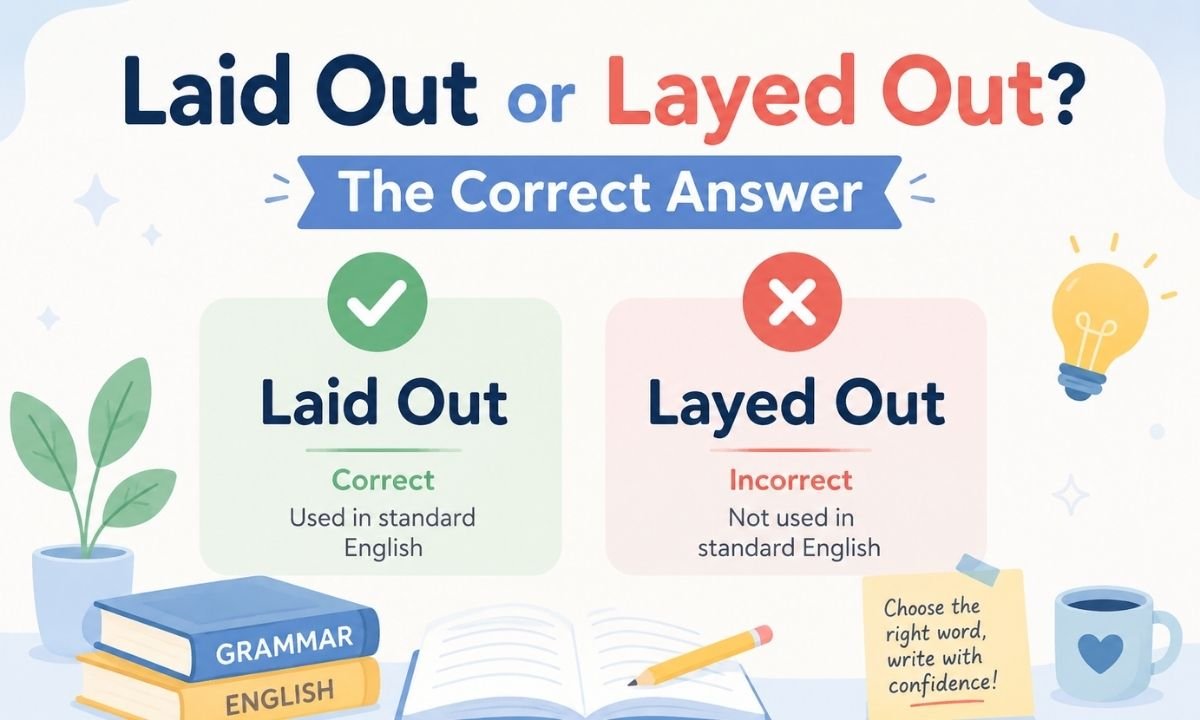
The correct spelling is laid out, not “layed out.” Whether you are talking about laid out or layed out plans, furniture, or someone relaxing in the sun, “laid” is the only correct past tense and past participle form. “Layed” is a common spelling mistake and is not accepted in standard English.
This article explains exactly why laid out or layed out confuses so many writers, even confident ones. You will learn the grammar rule behind “lay,” see real examples of “laid out” in everyday sentences, and pick up simple tricks to remember the correct spelling for good.
Quick Answer: Use “Laid Out,” Not “Layed Out”
Correct: She laid out her clothes for the morning. Incorrect: She layed out her clothes for the morning.
Why: “Lay” is an irregular verb. Its past tense and past participle form is “laid,” never “layed.” The spelling “layed” does not exist in standard English, no matter how it sounds.
The Simple Rule
The verb “lay” means to put something down. Its three main forms are:
- Base form: lay
- Past tense: laid
- Past participle: laid
There is no version of this verb that becomes “layed.” English speakers often add “-ed” to form the past tense of regular verbs, like “walked” or “played.” “Lay” does not follow that pattern. It is irregular, and its correct past form is always laid.
The 5-Second Test
If you are unsure whether to write “laid out” or “layed out,” ask yourself: can I say “laid” instead of “layed” and have it mean the same thing? The answer is always yes, because “layed” is simply incorrect. A faster test is to replace the phrase with “put”: “She put out her clothes” makes sense, confirming that “laid out” is the right choice.
Why So Many People Write “Layed Out” (And Why It Feels Correct)
The confusion around laid out or layed out comes from how English usually forms past tense verbs. Adding “-ed” works for thousands of verbs: “played,” “stayed,” “prayed.” Since “lay” rhymes with these words, it feels natural to add “-ed” and write “layed.” This pattern is called overregularization, and it is one of the most common spelling habits in English, especially among learners and even native speakers who type quickly.
Another reason for the mix-up is the verb “lie,” which means to rest in a horizontal position. Its past tense is also “lay” (confusingly, the same spelling as the base form of “lay”). This overlap between “lay” and “lie” causes writers to second-guess themselves and sometimes invent the incorrect spelling “layed” as a workaround. Understanding that “layed” is never correct removes this guesswork entirely.
What Does “Laid Out” Actually Mean?
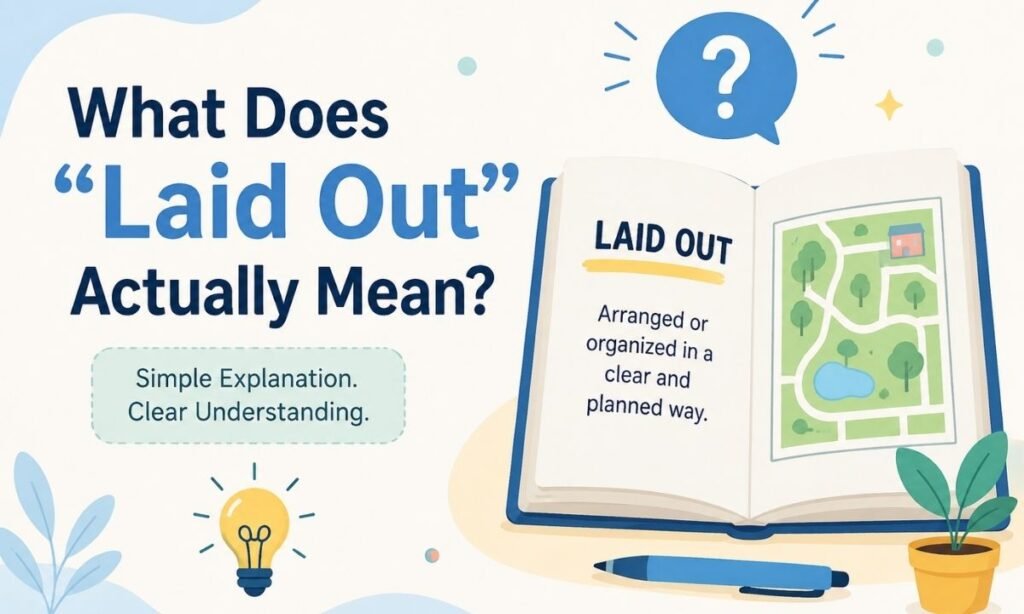
“Laid out” is a versatile phrasal verb with several related meanings, depending on context.
1. To Arrange or Organize Something
“Laid out” often describes arranging items in a clear or orderly way.
Correct: The chef laid out the ingredients before cooking.
2. To Explain Something Clearly
“Laid out” can mean explaining information in a structured, easy-to-follow way.
Correct: The manager laid out the new policy in simple terms.
3. To Present a Plan
This meaning refers to outlining a plan, project, or strategy.
Correct: The team laid out their goals for the next quarter.
4. To Spread Something Physically
“Laid out” also describes physically spreading something across a surface.
Correct: He laid out the map on the table.
Across all four meanings, the spelling stays the same. Whether you’re discussing a plan, a table setting, or a report, laid out or layed out always has one correct answer: laid out.
The Grammar Rule Behind “Laid Out”
Base Form → Past → Past Participle
Regular verbs follow a predictable pattern:
- walk → walked → walked
- play → played → played
Irregular verbs, including “lay,” break this pattern:
- lay → laid → laid
This is why laid out or layed out trips people up. The brain expects “-ed” to be added directly, but “lay” changes its spelling entirely instead of simply gaining a suffix.
Also, read this blog : Licence vs License
Why “Lay” Is Irregular
English has hundreds of irregular verbs inherited from Old English, and “lay” is one of them. Irregular verbs often change their internal vowel or form entirely rather than taking a standard ending. Compare “lay” to similar irregular verbs like “pay” (paid, not payed) and “say” (said, not sayed). Once you notice this pattern, it becomes easier to remember that “laid” follows the same irregular logic.
Laid out or layed out in the Sun

A common example that highlights this confusion is describing someone relaxing outdoors.
Correct: They laid out in the sun all afternoon. Incorrect: They layed out in the sun all afternoon.
Even in casual conversation, only “laid out” is grammatically correct. Some speakers use “lay out” here to mean “lie in the sun,” which technically overlaps with the verb “lie.” In strict grammar terms, “lie out” (lay, lain) is more accurate for describing rest, while “lay out” (laid, laid) technically means to place something down. However, “laid out in the sun” is widely accepted in everyday English to describe sunbathing, and “layed out” remains incorrect in every case.
When “Layed” May Appear (And Why It Usually Isn’t Standard)
You may occasionally see “layed” in informal writing, old texts, or as a surname (Layed is sometimes used as a proper noun). Outside of names, “layed” is not recognized by Cambridge Dictionary, Merriam-Webster, or Oxford as a standard verb form. If you see it in casual online writing, it is almost always a spelling mistake, not an accepted variant. For any formal, academic, or professional writing, “laid out” is the only correct choice.
Real Examples: How “Laid Out” Sounds in Everyday English
Workplace Examples
The supervisor laid out the safety procedures before the shift began.
Academic Examples
The professor laid out the exam requirements during the first class.
Everyday Conversation
“I already laid out your uniform for tomorrow,” she said.
Professional Writing
The proposal laid out a detailed timeline for the project’s completion.
Digital Communication
The email laid out three options for rescheduling the meeting.
These examples show how consistently “laid out” appears across different settings. Whether spoken or written, formal or casual, the rule never changes.
Is it laid out or layed out?
By now, the answer should be clear: it is always laid out. There is no context, tense, or sentence structure where “layed out” becomes correct. If you are ever unsure while writing, remember that “lay” behaves like “pay” and “say,” both of which drop the regular “-ed” pattern in favor of an irregular form. This single memory trick solves the laid out or layed out question permanently.
How to Never Confuse “Laid Out” and “Layed Out” Again
Memory Shortcut
Think: “lay, paid, said.” None of these irregular verbs add a plain “-ed.” If “payed” and “sayed” look wrong to you, “layed” should look wrong too.
The Replace-It Method
Replace “laid out” with “placed” or “arranged” in your sentence. If the sentence still makes sense, “laid out” is correct. This method works because “lay” fundamentally means to place something down.
Read-It-Aloud Method
Read your sentence aloud. If you hesitate on “layed,” it’s often a sign that your instinct already knows something is off, even before your eyes catch the misspelling.
The Editor Rule
Most spell-checkers and grammar tools will flag “layed” automatically. If you rely on writing software, trust that flag rather than overriding it, since “layed” has no standard use as a verb.
Common Mistakes People Make With “Lay”
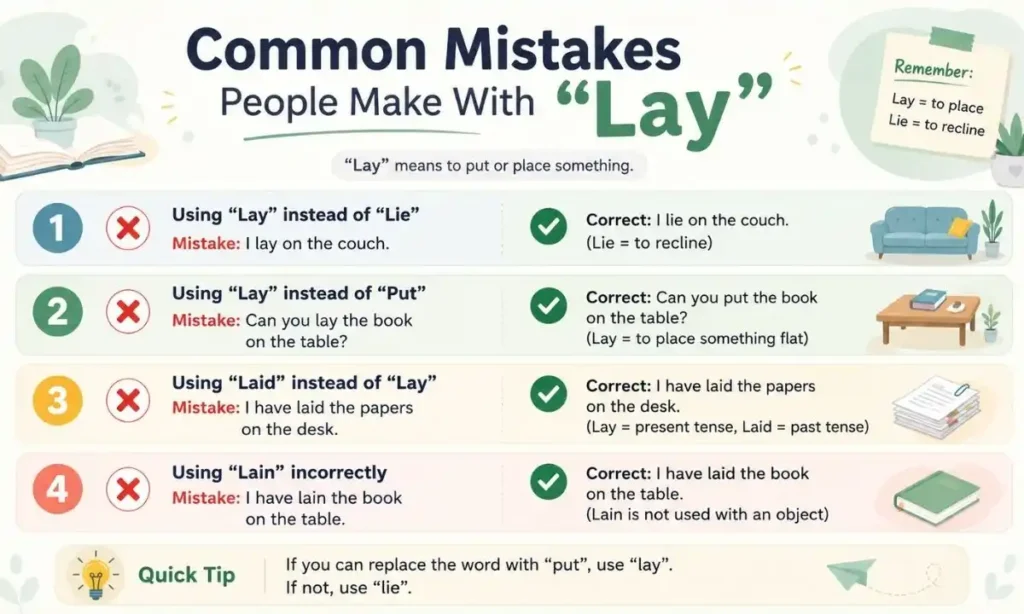
Lay vs Lie
“Lay” requires a direct object (you lay something down), while “lie” does not (you lie down yourself).
Correct: I lay the book on the desk. Correct: I lie down for a nap.
Laid vs Lain
“Laid” is the past form of “lay” (to place something). “Lain” is the past participle of “lie” (to rest).
Correct: She had laid the papers on the desk. Correct: He had lain in bed for hours.
Lay Out vs Layout
“Lay out” is a verb phrase describing an action. “Layout” is a noun describing a design or arrangement.
Correct: Please lay out the documents by category. Correct: I like the layout of this website.
Mini Usage Quiz
Test what you’ve learned:
- She ______ (laid/layed) out her plans for the weekend.
- The report ______ (laid/layed) out three main findings.
- They ______ (laid/layed) out in the sun for hours.
- He ______ (laid/layed) the tools out neatly.
Answers: 1. laid, 2. laid, 3. laid, 4. laid
Conclusion
The debate over laid out or layed out has one clear answer. “Laid out” is correct in every context, while “layed out” is a common misspelling with no place in standard English. Remembering that “lay” is an irregular verb, following the same pattern as “pay” and “say,” makes this rule easy to keep straight.
Next time you’re arranging a plan, describing a schedule, or writing about someone relaxing outside, trust that laid out is always the right choice. Whether you write for school, work, or everyday communication, getting laid out or layed out right shows attention to detail and strengthens your overall writing.

Welcome to Grammarrich.com, your trusted source for grammar tips, writing guides, and language learning. With 5 years of experience in the grammar niche, our goal is to provide clear, accurate, and easy-to-understand content that helps everyone write with confidence.
1 thought on “Laid Out or Layed Out? The Correct Answer”