

If you’ve typed “studder” into a search bar and paused, wondering if it looked wrong, your instinct was right. Stutter is the correct spelling, and studder or stutter is a mix-up that happens because of how the word sounds, not how it’s actually built. Once you see the pattern, you won’t second-guess it again.
This article walks through why studder or stutter trips up so many writers, what “stutter” actually means, and how to use it correctly in real sentences. You’ll also get the word’s origin, the British-versus-American picture, common mistakes to avoid, and a quick reference table you can bookmark.
Studder
“Studder” is not a word you’ll find in a dictionary. It has no entry in Oxford, Merriam-Webster, or Cambridge as a term for speech or for anything related to talking. If you search for it expecting a definition about hesitant speech, you won’t get one, because that definition doesn’t exist under this spelling.
So why does it show up so often? Simple phonetics. When people say “stutter” at a normal pace, the double “t” in the middle softens and can sound closer to a “d.” English does this with a lot of words — the middle consonant gets flattened in casual speech. Writers who spell words the way they hear them end up with “studder” instead of “stutter.” It’s a natural mistake, but it’s still a mistake.
Stutter
Stutter is the correct, dictionary-recognized spelling, and it works as both a verb and a noun.
- Verb: “He tends to stutter when he’s put on the spot.”
- Noun: “Her stutter barely shows up when she’s relaxed.”
As a verb, stutter describes the act of speaking with involuntary repetitions or pauses. As a noun, it names the condition or the moment itself. Both uses are standard, and both rely on the same spelling — always with the double “t.”
Studder / Stutter – Quick Answer
Here’s the short version if you just need the answer:
- Stutter — correct. Used in dictionaries, medical writing, and everyday English.
- Studder — incorrect. Not a recognized word in any standard English dictionary.
There’s no context — formal, casual, American, or British — where “studder” is the accepted spelling. When you’re deciding between studder or stutter, the choice isn’t close.
Examples
Seeing the two side by side makes the difference easy to spot.
Incorrect:
- “He has a studder when he’s tired.”
- “The interview made her studder more than usual.”
- “I noticed a studder in his voice on the call.”
Correct:
- “He has a stutter when he’s tired.”
- “The interview made her stutter more than usual.”
- “I noticed a stutter in his voice on the call.”
Swap the “d” for a “tt” and the sentence instantly reads as polished, correct English.
What does stutter mean?
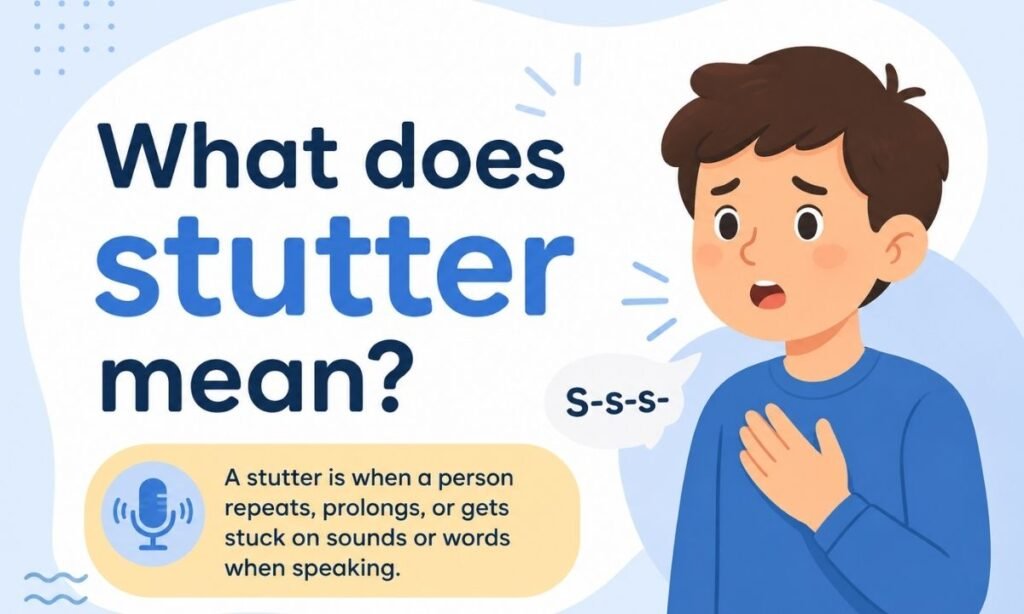
Stutter describes a speech pattern where sounds, syllables, or whole words get repeated, stretched out, or interrupted by a pause where nothing comes out at all. Speech-language professionals call these features repetition, prolongation, and blocking. Together, they make speech less smooth than intended, even though the speaker knows exactly what they want to say.
Stuttering shows up most often in early childhood, typically between ages two and six, while a child’s speech and language skills are developing quickly. For many kids, it fades on its own within a year or two. In other cases, it continues into the school years or adulthood, and that’s when speech therapy tends to make the biggest difference.
The word also has a looser, everyday use outside of speech. A car engine can stutter before it stalls. A video stream can stutter when the connection drops. In these cases, “stutter” just means a brief, uneven interruption — the core idea of the word stretched to cover more than talking.
The Origin of Stutter
Understanding where “stutter” comes from helps explain why the spelling has stayed so consistent. The word traces back to the Old English verb stotorian, meaning to stammer or speak haltingly. Over time, this shifted into the Middle English form stoteren, and eventually settled into the modern spelling we use today.
Linguists connect this root to a broader family of Germanic words built around repeated or stumbling motion — the same idea shows up in related Middle Low German terms describing a knocking or striking action, which mirrors the halting rhythm of stuttered speech itself.
There’s no comparable history behind “studder.” It never developed as a genuine variant spelling; it’s simply a modern phonetic slip, not an older or regional form of the word.
Also, read this blog: Laid Out or Layed Out?
British English vs American English Spelling
Both American and British English spell the word the same way: stutter. There’s no regional spelling split here, which makes this one easier than many transatlantic differences.
Where the two varieties diverge is in preferred terminology, not spelling. British speakers often use “stammer” in everyday conversation, while American speakers lean toward “stutter.” Clinically, speech-language professionals in both countries use stutter and stammer interchangeably to describe the same fluency condition.
So if you’re writing for a UK audience, “stammer” may sound more natural in casual contexts, but “stutter” is understood everywhere and remains correct on both sides of the Atlantic. Studder or stutter isn’t a US-vs-UK question at all — it’s simply a spelling question, and stutter wins in both variants.
Which Spelling Should You Use?
Always use stutter. There’s no situation — academic, professional, casual, or clinical — where “studder” is acceptable.
A simple way to lock in the spelling: think of other short, everyday words that share the same double-“t” pattern — butter, clutter, gutter, mutter. None of these get spelled with a “d” in the middle, and “stutter” follows the identical rule. If your spellchecker flags “studder” with a red underline, that’s the system confirming what dictionaries already show.
Studder or Stutter in Adults
This exact phrase — studder or stutter in adults — is a common search, usually from people who want to know both the correct spelling and whether adults can have this condition at all.
On spelling: nothing changes with age. It’s “stutter in adults,” the same as “stutter in children.” The word doesn’t take a different form based on who’s speaking.
On the condition itself: yes, adults can and do stutter. While it’s most commonly first noticed in early childhood, it can persist into adulthood for some people, and in rarer cases, it can develop later in life due to neurological events or, less commonly, emotional stress. Adults who stutter often find real improvement through:
- Speech therapy with a licensed speech-language pathologist
- Breathing and pacing techniques that reduce tension while speaking
- Practice in low-pressure settings before higher-stakes conversations
- Support groups, where shared experience reduces the isolation that often comes with the condition
Stuttering has no connection to intelligence, and many public speakers, broadcasters, and leaders manage it successfully throughout their careers.
Is it spelled stutter or studder?
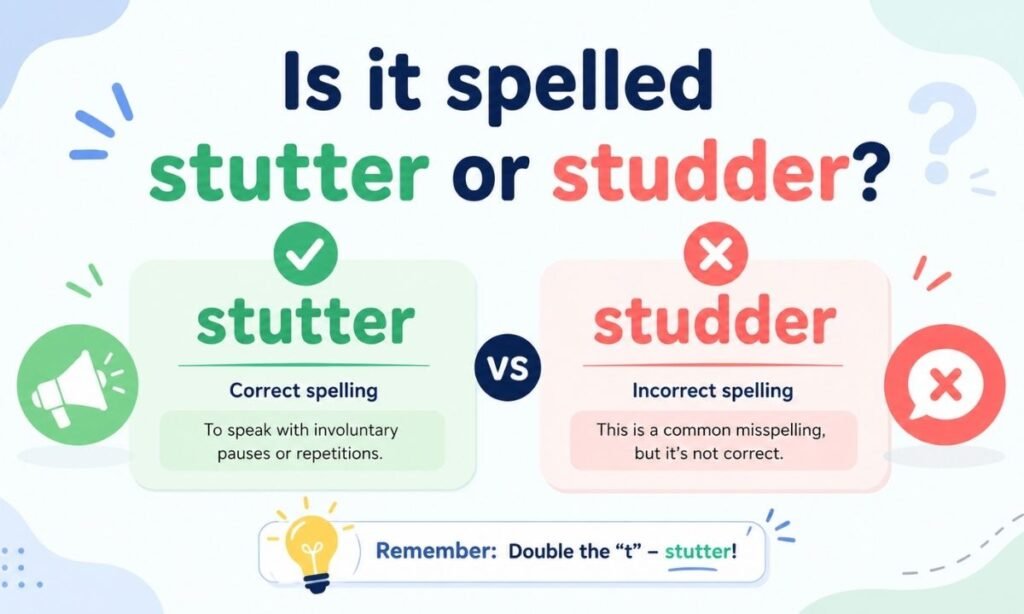
If you’ve skipped ahead looking for a fast confirmation: it’s stutter. Studder isn’t a recognized alternative, a regional variant, or an accepted informal spelling — it’s simply an error that happens because the word doesn’t sound the way it’s written. Whenever you’re unsure, picture the doubled “t” doing double duty, matching the repeated sounds the word itself describes.
Stutter Synonyms and Related Words
Having a few alternatives on hand is useful for writing that needs variety, especially in longer pieces about speech or communication.
General synonyms:
- Stammer
- Falter
- Hesitate
- Stumble over words
Clinical and technical terms:
- Fluency disorder
- Dysfluency
- Speech impediment
- Blocking
- Prolongation
Figurative uses:
- “The connection stuttered and the video froze.”
- “The engine stuttered twice before it caught.”
None of these related terms are spelled with a “d” in place of the double “t” — the same rule holds across every form of the word.
Common Mistakes with Studder / Stutter
Most errors follow a predictable pattern: writers substitute “d” for the middle consonant across every form of the word, not just the base spelling.
❌ Wrong:
- “She was studdering through her speech.”
- “His studder gets worse when he’s nervous.”
- “Is studdering something you can grow out of?”
✅ Correct:
- “She was stuttering through her speech.”
- “His stutter gets worse when he’s nervous.”
- “Is stuttering something you can grow out of?”
The fix is consistent: wherever “studder” appears — base form, -ing form, or noun — replace it with the equivalent form of “stutter.”
Stutter in Everyday Examples
Seeing the word in different real-world formats shows how naturally it fits into everyday writing.
“Just a heads-up before the call — I sometimes stutter a little when I’m speaking to a large group, so I may pause here and there.”
News
“During the broadcast, the reporter’s brief stutter went unnoticed by most viewers, who focused on the story itself rather than the delivery.”
Social Media
“Grew up hiding my stutter. Now I talk about it openly, and it’s honestly freeing.”
Formal Writing
“Individuals who stutter may experience increased communication anxiety in high-pressure settings, though the relationship between anxiety and stuttering frequency varies by individual.”
In every register, from a quick text to an academic sentence, the spelling doesn’t shift. It’s stutter throughout.
Studder / Stutter – Google Trends & Usage Data

Search interest around studder or stutter consistently favors “stutter,” which lines up with dictionary usage. “Studder” still gets typed into search bars regularly, largely because it reflects how the word sounds rather than how it’s spelled — a pattern common to many English words with doubled consonants.
This kind of confusion is worth taking seriously rather than dismissing. People searching this term are often trying to write about a real speech condition accurately, whether for a school assignment, a workplace message, or personal research about themselves or someone they know. Getting the spelling right matters because it’s the first step toward finding accurate, useful information on the topic.
Comparison Table: Studder vs Stutter
| Feature | Studder | Stutter |
| Correct spelling | No | Yes |
| Found in major dictionaries | No | Yes |
| Used in clinical/medical writing | Never | Always |
| Accepted in formal writing | Never | Always |
| Word origin | No documented history | Old English stotorian |
| Used in American English | No | Yes |
| Used in British English | No | Yes (alongside “stammer”) |
| Works as noun and verb | No | Yes |
Conclusion
When you’re weighing studder or stutter, the answer doesn’t change: stutter is correct, and studder isn’t a recognized word in any English dictionary. The confusion makes sense, since the doubled “t” softens in casual pronunciation, but the spelling itself has stayed fixed for centuries, all the way back to its Old English root.
Next time you’re unsure, remember the pattern shared with butter, clutter, and gutter — double “t,” no exceptions. Whether you’re writing an email, a school paper, or a quick social media post, stutter is the spelling that belongs there every time.

Welcome to Grammarrich.com, your trusted source for grammar tips, writing guides, and language learning. With 5 years of experience in the grammar niche, our goal is to provide clear, accurate, and easy-to-understand content that helps everyone write with confidence.
1 thought on “Studder or Stutter? Discover the Correct Word”