

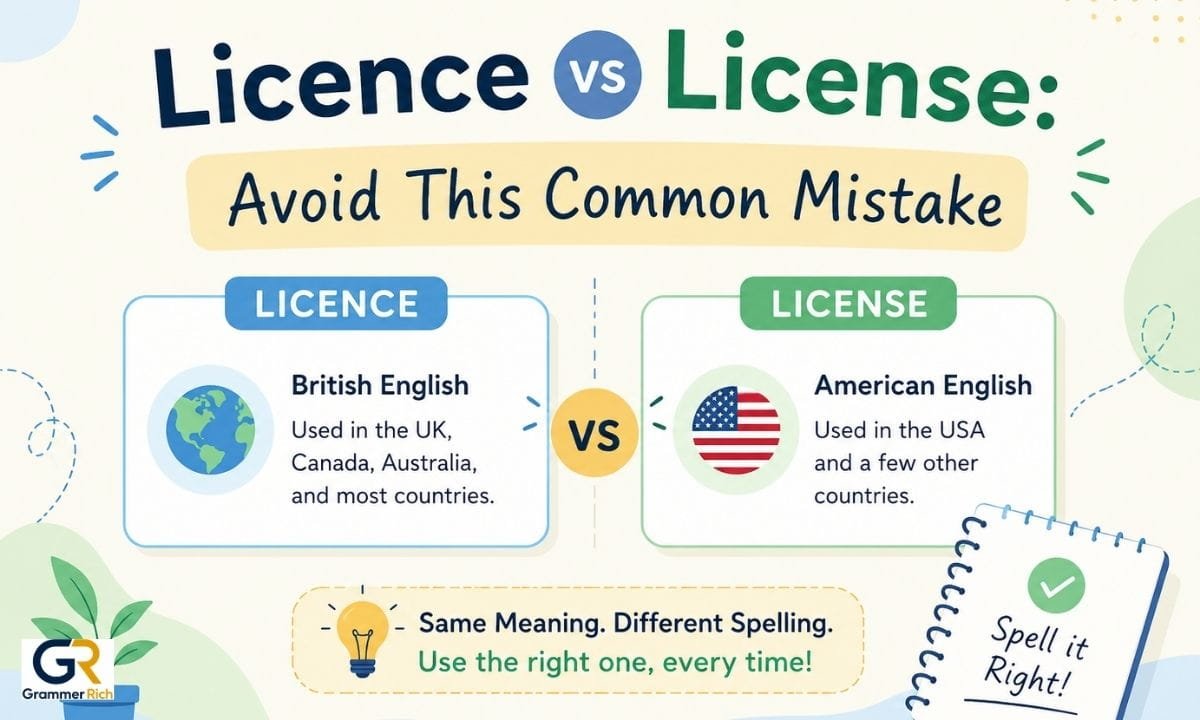
Licence vs license comes down to two things: which English you’re writing and which part of speech you need. In American English, “license” is correct for both the noun and the verb. In British, Australian, and Canadian English, the noun is “licence” and the verb is “license.”
This article breaks down the licence vs license rule in plain terms. You’ll see the meaning, correct spellings by region, real sentence examples, common mistakes, and what the Oxford English Dictionary says about the word’s history.
Quick Answer
- US English: Always use license (noun and verb).
- UK/Australian/Canadian English: Use licence for the noun, license for the verb.
- Example: “I need a driving licence” (UK noun) vs. “I need a driver’s license” (US noun).
Licence and License
The confusion around licence vs license exists because American English simplified the spelling, while British English kept a distinction that goes back centuries.
In the US, spelling reformers in the 19th century pushed for simpler, more consistent rules. As a result, American English dropped the extra spelling and settled on “license” for every use — as a noun (a permit) and as a verb (to grant permission).
British English never made that change. It kept two spellings based on grammatical role:
- Licence (with a c) is the noun — the thing you hold or apply for.
- License (with an s) is the verb — the action of granting permission.
This pattern isn’t unique to this word. English has other noun/verb pairs that shift a letter, like “advice” (noun) and “advise” (verb), or “practice” (noun) and “practise” (verb) in British English. If you already know that pattern, licence vs license follows the same logic: c for the noun, s for the verb.
Examples – Licence or License
Correct (UK, noun): “She renewed her driving licence last week.”
Correct (UK, verb): “The council will license three new taxis this year.”
Correct (US, noun and verb): “He applied for a business license, and the state will license his shop next month.”
Incorrect (UK): “She renewed her driving license last week.”
Why: In British English, the noun form must use c — “licence,” not “license.”
Licence vs license Meaning
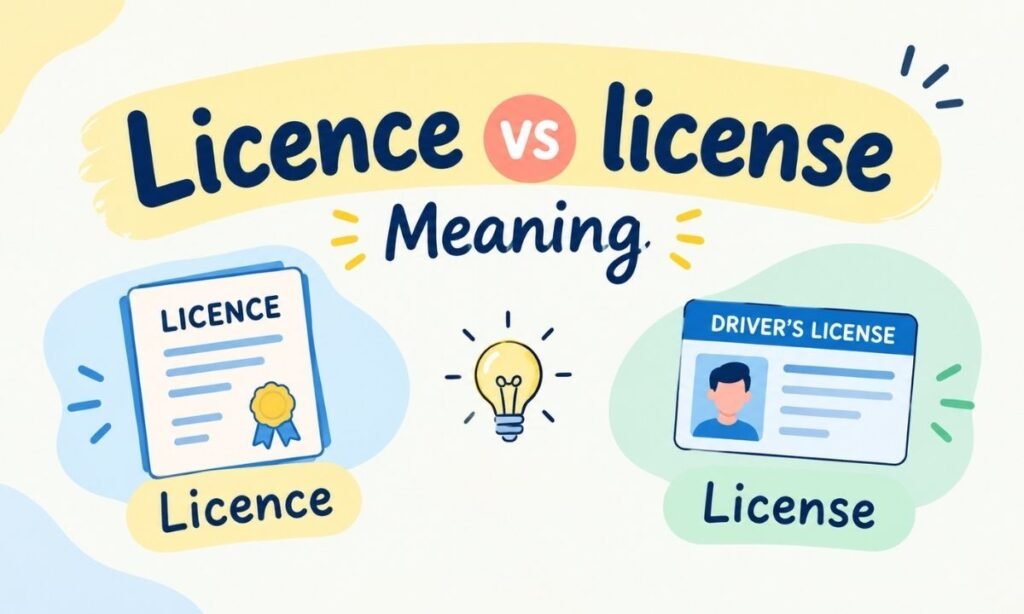
Regardless of spelling, the word means the same thing: official permission to do, use, or own something, often granted by a government body or authority. A licence (or license) can refer to:
- Permission to drive a vehicle
- Permission to sell goods, such as alcohol or firearms
- Permission to use software or intellectual property
- Formal approval to practice a profession, like law or medicine
The meaning doesn’t change between spellings — only the grammatical role does. This is why licence vs license is a spelling and grammar issue, not a meaning issue.
What are the spellings of licence?
Here’s a simple breakdown of every correct spelling by English variant and part of speech:
| English Variant | Noun | Verb | Adjective (past participle) |
| American English | license | license | licensed |
| British English | licence | license | licensed |
| Australian English | licence | license | licensed |
| Canadian English | licence | license | licensed |
Notice that “licensed” keeps the s spelling in every variant. This trips up a lot of writers, because they assume British English needs a c everywhere. It doesn’t — the c spelling only applies to the noun form.
Licence and license in a Sentence
Seeing the words in natural context makes the rule easier to remember than a definition alone.
UK noun: “You can’t sell alcohol here without a licence.”
UK verb: “The government plans to license more clinics next year.”
US (noun and verb): “Restaurants need a food license, and the health department will license each location after an inspection.”
Adjective form (all variants): “He is a licensed electrician.”
Each example reflects how the words function in a real sentence, not just as isolated definitions. This is the most reliable way to internalize licence vs license — by noticing the grammatical role first, then applying the correct spelling for your English variant.
Also, read this: Thank You, Thankyou, or Thank-You
Common Mistakes with Licence and license
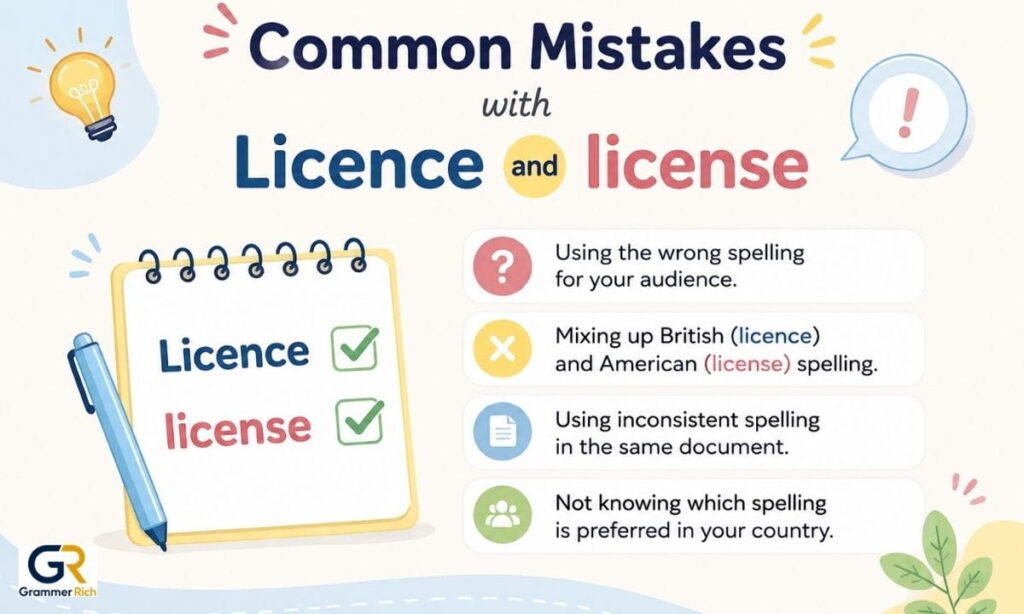
Most errors with licence vs license come from writers switching between American and British sources without noticing the difference, or applying the British split incorrectly.
Incorrect: “I need to license my dog.” (in UK English, referring to the document itself)
Correct: “I need a licence for my dog.”
Why: The document is a noun, so British English requires the c spelling.
Incorrect: “The council will licence the new bar.” (in UK English)
Correct: “The council will license the new bar.”
Why: This is an action — granting permission — so it needs the verb spelling, license.
Incorrect: “He has a licensed to drive.” (mixing US and UK forms)
Correct: “He has a license to drive” (US) or “He has a licence to drive” (UK).
Why: Mixing spellings within the same sentence or document creates an inconsistent, unprofessional result. Pick one English variant and apply its rule consistently throughout your writing.
Licence or license Oxford English Dictionary
According to the Oxford English Dictionary, the noun licence dates back to the Middle English period, with recorded use from the 14th century. The word traces back through Old French to the Latin licentia, meaning “freedom,” which in medieval Latin came to mean “authority” or “permission,” from licere, “to be lawful or permitted.”
The verb license developed slightly later, also tracing back to Old French and Latin roots, and entered English usage as a separate, related form. This shared origin explains why licence vs license refers to the same core idea of permission — the spelling split reflects grammar, not meaning.
The Oxford Learner’s Dictionary also confirms that British English keeps the noun/verb spelling distinction across common everyday phrases, such as driving licence, marriage licence, off-licence, provisional licence, and television licence — all using the noun form with a c.
Licence vs license Pronunciation
Both spellings are pronounced exactly the same way: LY-suhns (rhymes with “silence”). The pronunciation gives no clue about which spelling to use — that’s determined entirely by grammar (noun or verb) and by which English variant you’re writing in. This is one reason the mistake is so common: your ear can’t help you here, only the grammar rule can.
Is it Software Licence or License?
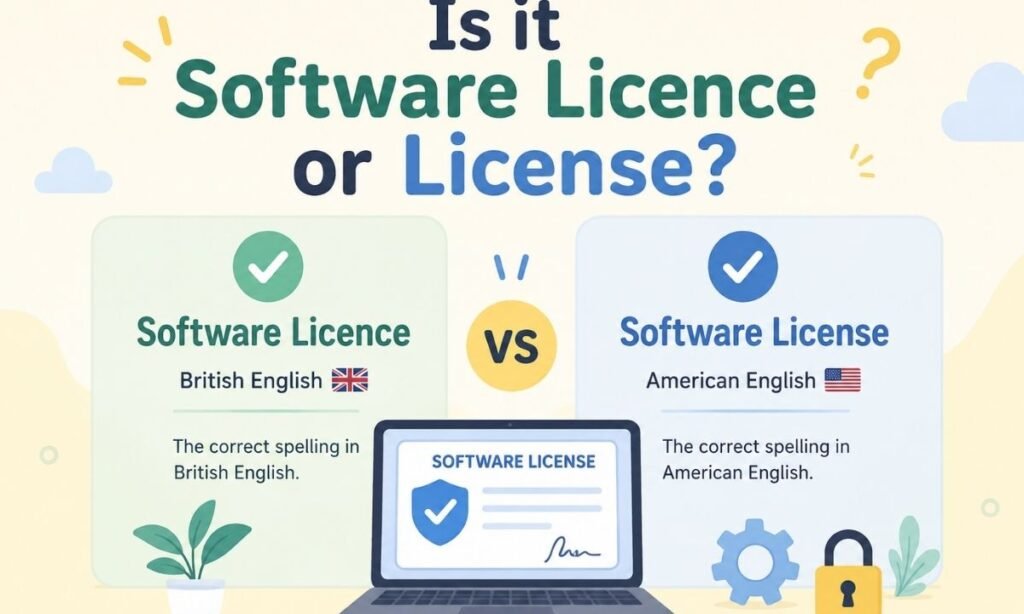
In software and technology writing, “license” (with an s) is the standard spelling internationally, even in many UK-based tech companies and publications. This is largely because software licensing terminology developed heavily in American contexts, and terms like “software license,” “license key,” and “license agreement” have become the global default in tech writing.
That said, formal British organizations and government documents may still use “licence” when referring to the legal document itself — for example, a UK company’s official software licence agreement filed with a regulator. If you’re writing for a general international audience, “software license” is the safer, more widely recognized choice. If you’re writing specifically for a British audience in a formal context, “software licence” (noun) is grammatically correct.
Conclusion
Licence vs license isn’t about one form being wrong — it’s about matching the spelling to your English variant and to the word’s grammatical role. American English keeps things simple with one spelling, “license,” for everything. British, Australian, and Canadian English split it: “licence” for the noun, “license” for the verb.
The easiest way to get licence vs license right every time is to ask two questions: which English am I writing, and is this word acting as a noun or a verb? Once you know the answer to both, the correct spelling follows automatically.

Welcome to Grammarrich.com, your trusted source for grammar tips, writing guides, and language learning. With 5 years of experience in the grammar niche, our goal is to provide clear, accurate, and easy-to-understand content that helps everyone write with confidence.
1 thought on “Licence vs License: Avoid This Common Mistake”