

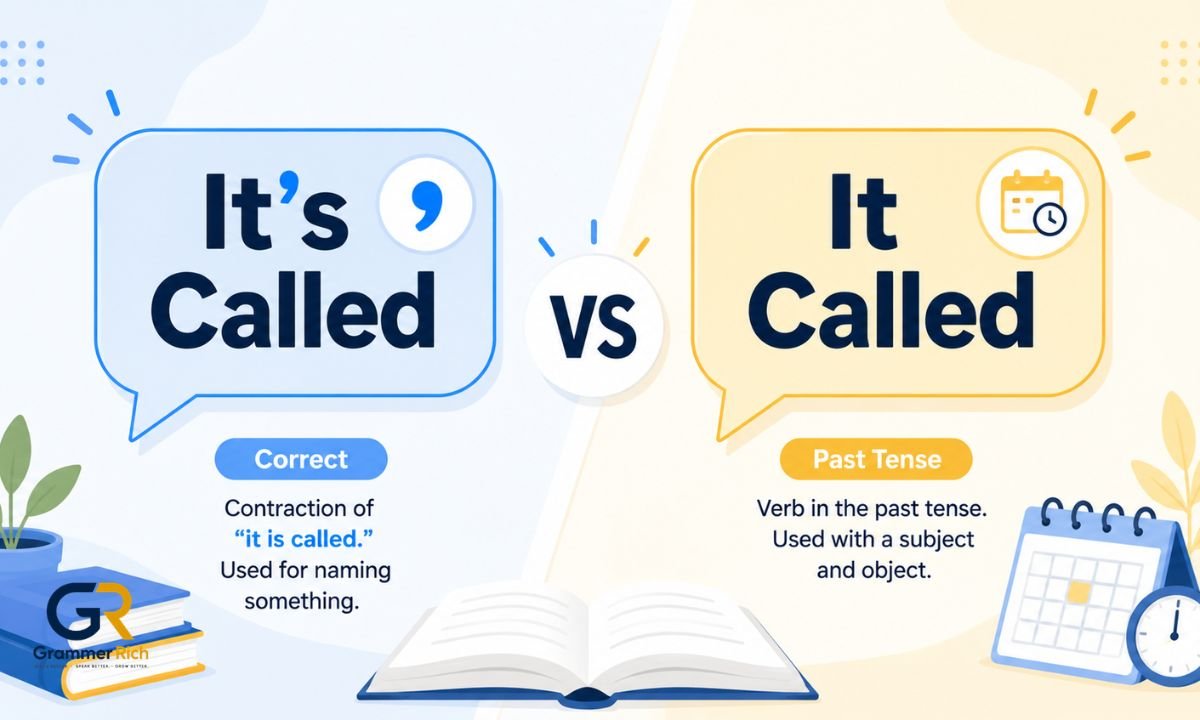
“It’s called” and “It called” look almost identical, but they work differently. “It’s called” is a contraction of “it is called,” used to name or label something in the present. “It called” is simple past tense, describing an action that already happened. So if you’re naming a thing, use “it’s called.” If you’re describing a past action, use “it called.”
Mixing these two up is one of the most common slip-ups in everyday writing, and honestly, it’s easy to see why. Its Called vs It Called might seem like a tiny detail, but it changes your meaning completely. Below, we’ll break down the grammar, share real examples, and help you never confuse Its Called vs It Called again.
Quick Answer
Here’s the short version, before we go deep into Its Called vs It Called.
- Use “it’s called” when you’re naming or describing something. Example: “This dish is called ratatouille.”
- Use “it called” when you’re describing a past action performed by “it.” Example: “The dog barked because it called for attention.”
That’s the entire Its Called vs It Called puzzle in two bullet points. Everything else in this guide just fills in the details.
Which Is Correct: “It Called” or “It’s Called”?

Both phrases are grammatically correct — they’re just used in completely different situations. That’s the heart of the Its Called vs It Called confusion. Neither one is universally “right” or “wrong.” Context decides everything.
- “It’s called” works when you want to name, define, or label something. It’s built from “it” + “is” + “called,” and the apostrophe signals that contraction.
- “It called” works when “it” (an animal, machine, object, or abstract subject) performed the act of calling in the past.
If you swap them, your sentence usually still makes grammatical sense, but the meaning shifts entirely. That’s exactly why Its Called vs It Called trips up so many writers, especially non-native English speakers.
Meaning and Explanation
Its Called
Wait — technically, “its called” (no apostrophe) isn’t standard English at all. “Its” is a possessive pronoun, similar to “his” or “her,” and it can’t pair directly with “called” to form a complete verb phrase. When people search for Its Called vs It Called, they often mean “it’s called” (with the apostrophe), not the possessive “its.”
So to be precise:
- ✅ “It’s called” — correct, means “it is called.”
- ❌ “Its called” — incorrect, missing the necessary apostrophe.
This is the single biggest source of Its Called vs It Called mistakes online. People type “its” out of habit, forgetting the sentence actually needs the contraction “it’s.”
Also, read this : Acception vs Exception
It Called
“It called” is refreshingly simple. It’s just the past tense of “call,” applied to a non-human or non-gendered subject (“it”). No apostrophe, no contraction — just a straightforward verb in past tense.
Examples:
- “The phone rang, but it called back moments later.” (Not natural — see notes below)
- “The bird called out from the tree.”
- “It called for a change in strategy.”
Once you separate the possessive pronoun “its” from the contraction “it’s,” the rest of the Its Called vs It Called puzzle becomes much easier to solve.
Why Do Brits Say “Called” Instead of “Named”?

British English speakers often say “it’s called” where American English speakers might say “it’s named” or “they call it.” This isn’t a grammar rule — it’s a stylistic tendency.
- British English: “This street is called Baker Street.”
- American English: “This street is named Baker Street” (though “called” is also common and understood).
Both versions are grammatically fine. The Its Called vs It Called debate doesn’t really split along American vs. British lines when it comes to naming — but “called” tends to feel slightly more conversational and common in British usage, especially in speech.
Common Mistakes
Here are the most frequent errors people make with Its Called vs It Called:
- Dropping the apostrophe: Writing “its called” instead of “it’s called.”
- Using past tense when naming something in the present: Writing “This flower it called a tulip” instead of “This flower is called a tulip.”
- Confusing possession with contraction: Thinking “its” always means “belonging to it,” and forgetting it can never stand in for “it is.”
- Overusing “it called” in unnatural contexts: “It called” needs a clear subject and past action — it doesn’t work as a general naming phrase.
- Autocorrect errors: Phone keyboards frequently “correct” it’s to its, quietly introducing Its Called vs It Called mistakes into your writing.
Avoiding these five mistakes solves about 90% of the Its Called vs It Called confusion people run into.
Its Called vs It Called: Comparison Table
| Feature | It’s Called | It Called |
| Full form | It is called | Past tense of “call” |
| Grammar role | Contraction (naming/labeling) | Verb phrase (past action) |
| Apostrophe | Yes | No |
| Tense | Present | Past |
| Example | “It’s called a paradox.” | “It called out in the dark.” |
| Common error | Writing “its called” | Using it for naming (incorrect) |
This table sums up the Its Called vs It Called comparison at a glance — bookmark it if you tend to second-guess yourself.
American vs British English
Grammatically, Its Called vs It Called behaves the same on both sides of the Atlantic. The apostrophe rule doesn’t change, and the past tense rule doesn’t change either. What does shift is word choice and tone:
- Americans may lean toward “is known as” or “is named” in formal writing.
- Brits tend to favor “is called” even in fairly formal contexts.
Either way, the core Its Called vs It Called rule — contraction for naming, past tense for action — holds true everywhere English is spoken.
Examples in Everyday Sentences
Seeing Its Called vs It Called in real sentences makes the rule stick much faster than memorizing definitions.
“It’s called” examples:
- “This app is called Notion.”
- “That constellation is called Orion.”
- “It’s called a run-on sentence when you don’t use proper punctuation.”
“It called” examples:
- “The teacher called on a student, and it called attention to the mistake.”
- “My cat sat by the window, and it called out to the birds.”
- “The meeting was postponed after it called for last-minute changes.”
Practicing with sentences like these is the fastest way to lock in the Its Called vs It Called rule for good.
Conclusion
At its core, Its Called vs It Called comes down to one simple test: are you naming something, or describing a past action? Use “it’s called” for the first, and “it called” for the second. Keep that rule in mind, and you’ll never second-guess Its Called vs It Called again.

Welcome to Grammarrich.com, your trusted source for grammar tips, writing guides, and language learning. With 5 years of experience in the grammar niche, our goal is to provide clear, accurate, and easy-to-understand content that helps everyone write with confidence.
2 thoughts on “Its Called vs It Called: Meaning, Difference & Examples ”