

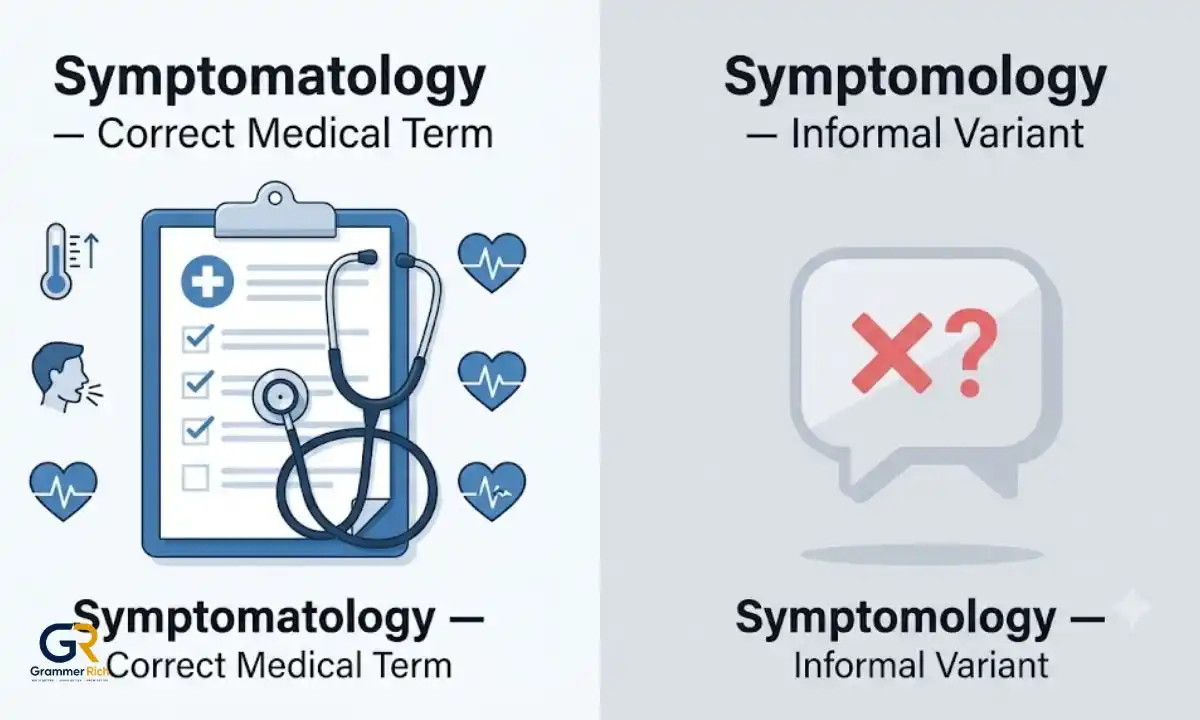
Symptomatology and symptomology both refer to the study or pattern of disease symptoms, but they aren’t perfectly equal. Symptomatology is the older, medically preferred term found in dictionaries and clinical writing. Symptomology is a shortened variant that’s grown common in everyday and web usage, though many editors still flag it as informal.
So which one should you use? It depends on your audience. Symptomatology vs Symptomology isn’t really about right or wrong — it’s about context. Doctors and journals lean formal. Everyday writers often go casual. This guide breaks down when each version fits best.
Symptomatology vs Symptomology Meaning in Medical Context

At the core, both words point to the same idea: the collection and study of symptoms associated with a disease. But symptomatology is the term you’ll find rooted deep in medical literature, textbooks, and journals. It combines “symptom” with the Greek-derived suffix “-ology,” meaning the study of something.
Symptomology, on the other hand, looks like a shortened cousin. It’s used casually in speech and informal writing, but it hasn’t earned the same footing in clinical or academic contexts. Some style guides and editors flag it as a variant spelling rather than a fully separate word.
Here’s the quick takeaway:
- Symptomatology = the formal, medically preferred term.
- Symptomology = an informal variant, sometimes used interchangeably but less authoritative.
When precision matters — in a chart note, a research paper, or a diagnostic report — symptomatology is the safer, more credible choice.
Symptomatology Definition and Its Role in Clinical Practice
Symptomatology refers to the branch of medicine concerned with symptoms, as well as the set of symptoms themselves that characterize a particular disease or condition. It’s not just a fancy word for “symptoms” — it implies a structured, evaluated pattern.
In clinical practice, symptomatology shapes how physicians build a diagnosis. A doctor doesn’t just note that a patient has a fever; they document the full symptomatology, including onset, duration, severity, and associated signs. This structured approach supports differential diagnosis and guides treatment decisions.
Clinical symptomatology also plays a role in:
- Tracking disease progression over time.
- Comparing symptom clusters across patients.
- Supporting evidence-based medicine through documented patterns.
- Informing medical research and epidemiological studies.
Because symptomatology carries this weight, it appears constantly in medical journals, psychiatric evaluations, and neurology reports. It’s the term healthcare professionals reach for when precision and credibility matter.
Symptomology Definition and Why It Creates Confusion
Symptomology means, in practice, the same thing people intend when they use symptomatology — but it lacks the same long-standing acceptance. The confusion often comes from how naturally it rolls off the tongue; dropping the extra syllable feels efficient.
Some dictionaries do list symptomology as a variant, which adds to the mix-up. Writers see it in a dictionary entry and assume it’s fully interchangeable with symptomatology. In casual conversation, that’s mostly fine. In academic writing or hospital documentation, it can read as a shortcut rather than a deliberate word choice.
A few reasons symptomology keeps popping up:
- It’s shorter and easier to say quickly.
- Autocorrect and spell-check tools don’t always flag it.
- It appears in some non-peer-reviewed health articles online.
Understanding symptomatology vs symptomology means recognizing that one has earned formal standing through consistent, long-term use, while the other is still riding on that credibility.
What is an example of symptomology?

An example of symptomology in casual use might be: “The symptomology of the illness included fatigue, mild fever, and body aches.” Notice how it functions exactly like symptomatology would in that sentence — this is where the overlap causes confusion.
In more formal writing, you’d more likely see: “The patient’s symptomatology was consistent with early-stage influenza, including fatigue, mild fever, and myalgia.” The meaning doesn’t change, but the tone shifts toward clinical precision.
Symptomatology vs Symptomology Difference in Medical Usage
The real symptomatology vs symptomology difference boils down to acceptance and context rather than meaning. Both describe the study or pattern of symptoms, but only symptomatology consistently appears in peer-reviewed journals, WHO guidelines, and formal diagnostic documentation.
| Feature | Symptomatology | Symptomology |
| Formality | Standard, formal | Informal variant |
| Dictionary status | Fully established | Listed as variant in some dictionaries |
| Common usage | Medical journals, clinical notes, research | Casual speech, informal articles |
| Recommended for academic writing | Yes | Generally no |
| Etymology clarity | Symptom + -ology (clear, traditional) | Same root, shortened form |
| Risk of being flagged by editors | Low | Moderate to high |
If you’re writing for a healthcare professional audience, academic paper, or hospital record, symptomatology is the safer bet every time.
Examples in Clinical Context

Seeing symptomatology vs symptomology in action helps cement the distinction. Below are examples that reflect how each term shows up in real medical documentation and conversation.
- “The neurologist documented the patient’s symptomatology, noting tremors and gait instability.”
- “Psychiatric symptomatology included mood swings, insomnia, and irritability over three weeks.”
- “Respiratory symptomatology in the outbreak included cough, breathlessness, and chest tightness.”
- Informal: “Her symptomology sounded like a bad case of the flu.”
- Informal: “The symptomology described online didn’t match his actual condition.”
Notice the pattern: formal charts and journal entries lean on symptomatology, while quick, conversational references sometimes slip into symptomology without much scrutiny.
COVID Usage and Public Confusion
The pandemic pushed both terms into everyday vocabulary, and that’s part of why the symptomatology vs symptomology mix-up became so common. News outlets, health blogs, and social media posts described COVID-19 symptomatology constantly — fever, cough, fatigue, loss of taste, breathlessness.
Because so much pandemic-era content was written quickly and informally, symptomology crept into public use more than it had before. Search interest in “symptomatology vs symptomology COVID” spiked as readers noticed both spellings and wanted clarity.
Public health communication generally favored symptomatology in official guidance, while informal commentary and quick explainers often used symptomology interchangeably. This split reinforced the idea that both words mean the same thing, even though only one holds firmer linguistic ground.
How Symptomatology Is Used in Medicine and Clinical Practice
Symptomatology isn’t just a label — it’s a working tool. Physicians use it to organize disease manifestation into a coherent narrative that supports diagnosis and treatment planning.
In practice, symptomatology in medicine covers:
- Subjective symptoms — what the patient reports feeling (pain, nausea, dizziness).
- Objective signs — what a clinician observes or measures (rash, elevated temperature).
- Symptom clusters — groups of symptoms that frequently occur together and hint at a specific condition.
- Progression patterns — how symptoms evolve, worsen, or resolve over time.
This structured symptom assessment feeds directly into diagnostic accuracy. Without organized symptomatology, diagnosis becomes guesswork rather than evidence-based reasoning.
Symptomology in Medical Research and Its Limitations
Symptomology does occasionally appear in academic writing, but its use is inconsistent and often discouraged by style guides tied to medical publishing. Peer-reviewed journals overwhelmingly default to symptomatology because it signals precision and aligns with established terminology.
When symptomology does show up in research contexts, it’s usually in less formal sections, secondary sources, or writing aimed at a general audience rather than clinicians. Some limitations worth noting:
- Editors may flag or “correct” symptomology to symptomatology during review.
- Inconsistent usage can weaken perceived credibility in a paper.
- Search and citation tools may treat the two terms unevenly, affecting discoverability.
For anyone doing clinical research or academic writing, defaulting to symptomatology avoids this friction entirely.
Clinical Symptomatology and Diagnostic Importance
Clinical symptomatology is central to differential diagnosis — the process of distinguishing one condition from another based on symptom patterns. A cluster of symptoms rarely points to just one disease, so clinicians rely on structured symptomatology to narrow possibilities.
For instance, fatigue, headache, and mood changes could suggest anything from a thyroid disorder to depression to a viral infection. It’s the fuller symptomatology — combined with lab testing and imaging — that helps clinicians land on an accurate diagnosis.
This is why clinical symptomatology isn’t just descriptive language; it’s diagnostic infrastructure. Every symptom noted contributes to a bigger clinical picture.
Signs vs Symptoms Difference in Clinical Diagnosis

Before going further into symptomatology vs symptomology, it helps to separate signs from symptoms, since both feed into overall symptomatology.
- Symptoms are subjective — only the patient can report them (pain, nausea, fatigue).
- Signs are objective — a clinician can observe or measure them (fever, rash, abnormal heart rate).
Symptomatology captures both. A thorough clinical presentation blends what the patient describes with what the provider observes, creating a complete picture rather than relying on one side alone.
What is the difference between symptomatic and symptomatic and symptom?
A symptom is the individual sign of illness — a headache, a cough, joint pain. Symptomatic is the adjective form, describing something that shows or relates to symptoms, as in “the patient is symptomatic for strep throat.”
So while “symptom” names the specific experience, “symptomatic” describes a state or condition tied to those symptoms. Neither should be confused with symptomatology, which refers to the broader study or full set of symptoms rather than a single instance or descriptive state.
Limitations of Symptomatology in Diagnosis
Symptomatology is powerful, but it isn’t infallible. Relying on symptom patterns alone has real limitations that clinicians must account for.
- Symptoms can overlap across multiple unrelated conditions.
- Patient-reported symptoms may be inconsistent or hard to quantify.
- Some diseases present with minimal or atypical symptomatology, delaying diagnosis.
- Cultural and individual differences affect how symptoms are described or reported.
Because of these limitations, symptomatology works best alongside lab testing, imaging, and clinical history rather than as a standalone diagnostic tool.
Practice Exercises
Choose the Correct Term (Medical Context)
- The physician documented the patient’s ______ in detail. (symptomatology / symptomology)
- Her ______ included fatigue and mild fever. (symptomatology / symptomology)
- The journal article focused on the ______ of early-onset diabetes.
Identify Correct or Incorrect Usage
- “The neurologist reviewed the patient’s symptomology for the case study.” — Correct or Incorrect?
- “The WHO guidelines describe symptomatology consistent with respiratory infection.” — Correct or Incorrect?
Rewrite for Clinical Accuracy
- Rewrite: “Her symptomology sounded like the flu.”
- Rewrite: “The report described unusual symptomology in the outbreak.”
Clinical Application Scenarios
- A patient presents with cough, fever, and fatigue. Write one sentence documenting their symptomatology.
- A research paper needs a formal term for a symptom cluster study. Which word fits better?
Match the Concept
Match each term to its correct description: symptomatology, symptomology, symptomatic, symptom.
Diagnostic Thinking
Explain in two sentences why a clinician would prefer documenting “symptomatology” rather than “symptomology” in a hospital chart.
Answer Key
Choose the Correct Term
- symptomatology
- symptomatology (or informally symptomology in casual speech)
- symptomatology
Correct / Incorrect Usage
- Acceptable informally, but symptomatology is preferred in formal case studies.
- Correct — symptomatology is standard in official health guidance.
Rewrite Answers (Correct Versions)
- “Her symptomatology was consistent with influenza.”
- “The report described unusual symptomatology in the outbreak.”
Clinical Application Scenarios
- “The patient’s symptomatology included cough, fever, and fatigue, consistent with a respiratory infection.”
- Symptomatology fits better for formal academic or clinical research writing.
Match the Concept
- Symptomatology — the study/pattern of symptoms
- Symptomology — informal variant of symptomatology
- Symptomatic — showing signs of a condition
- Symptom — a single reported or observed indication of illness
Diagnostic Thinking
Symptomatology is the recognized medical term, so using it in a chart keeps documentation consistent with journals, guidelines, and other clinicians’ records. It also protects the credibility of the report if it’s ever reviewed, cited, or used in research.
Conclusion
The symptomatology vs symptomology debate isn’t really a coin flip — symptomatology is the term with real staying power in medicine, research, and clinical documentation, while symptomology remains an informal shortcut that hasn’t earned the same trust. Stick with symptomatology whenever precision, credibility, or formal writing is on the line, and save symptomology for casual conversation, if you use it at all. Now you’ll never mix them up again.

Welcome to Grammarrich.com, your trusted source for grammar tips, writing guides, and language learning. With 5 years of experience in the grammar niche, our goal is to provide clear, accurate, and easy-to-understand content that helps everyone write with confidence.