

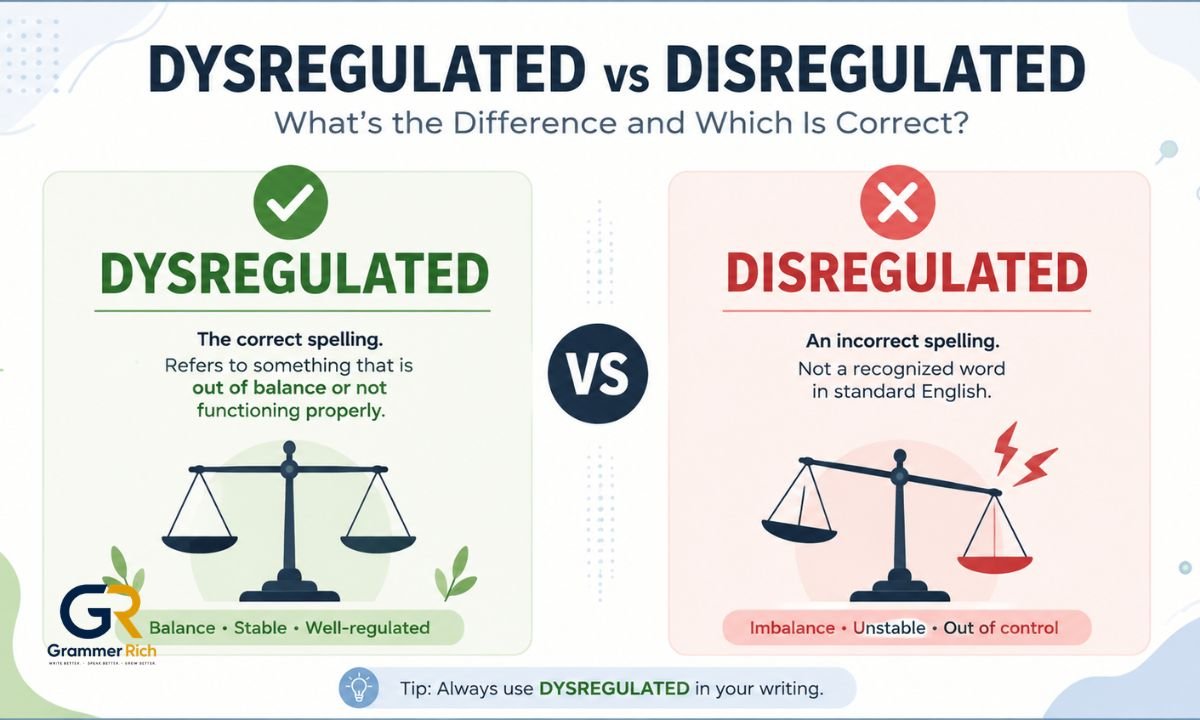
Dysregulated is the correct word—it means a system, emotion, or behavior has lost its normal balance or control, as in “a dysregulated nervous system.” Disregulated is simply a common misspelling; it isn’t recognized in standard dictionaries. So whenever you’re describing emotional, hormonal, or physiological imbalance, dysregulated is the one to use.
Still second-guessing yourself every time you type it? You’re not alone. The dysregulated vs disregulated mix-up trips up writers, students, and even clinicians. In this guide, we’ll break down where the confusion started, show real examples of correct usage, and help you never second-guess dysregulated vs disregulated again.
The Core Difference You Need to Know
There is no real debate here, linguistically speaking. In the dysregulated vs disregulated comparison, only one term is standard English.
- Dysregulated = correct, dictionary-recognized, used in psychology and medicine
- Disregulated = incorrect spelling, not found in standard dictionaries
The confusion happens because “dis-” is one of the most common prefixes in English (disagree, disconnect, distrust), so people’s brains autocorrect “dys-” into the more familiar pattern. Once you understand why “dys-” exists as its own prefix, the dysregulated vs disregulated mix-up stops happening.
What Does Dysregulated Mean? A Clear, Practical Definition
Dysregulated describes something — usually emotions, behavior, or a bodily system — that has lost its normal balance or control. It’s the adjective form of “dysregulation,” a term borrowed from clinical psychology and physiology.
Plain-English Definition
Something dysregulated is out of sync. A dysregulated emotional state means feelings are too intense, too fast, or too hard to manage. A dysregulated nervous system means the body’s stress response fires when it shouldn’t, or doesn’t calm down when it should. In every case, “dysregulated” points to a breakdown in normal regulation — not a total absence of it.
Understanding the Prefix: Why “Dys” Changes Everything
Prefixes carry meaning, and this is where the dysregulated vs disregulated question gets settled for good.
Prefix Breakdown
| Prefix | Meaning | Example Words |
| Dys- | Bad, abnormal, impaired | Dysfunction, dyslexia, dysregulated |
| Dis- | Not, opposite of, reversal | Disconnect, disagree, disregard |
“Dys-” comes from Greek and signals that something is functioning badly, not absent. “Dis-” comes from Latin and usually signals negation or reversal. Regulation isn’t being negated in a dysregulated state — it’s malfunctioning. That’s precisely why “dys-” is the linguistically correct prefix, and why “disregulated” never made it into any dictionary.
Why “Disregulated” Keeps Showing Up (Even Though It’s Wrong)
Despite being incorrect, “disregulated” is everywhere — in comment sections, casual therapy talk, even some student essays. The dysregulated vs disregulated mix-up isn’t random; it follows a predictable pattern.
Common Reasons People Use “Disregulated”
- “Dis-” is a far more common prefix in everyday vocabulary
- Words like “disregard” and “disorder” sound similar and prime the brain
- Autocorrect sometimes fails to flag it, especially in informal apps
- Spoken language blurs the “dys” and “dis” sounds
Reality Check: Is “Disregulated” a Word? (Detailed Breakdown)
No. “Disregulated” doesn’t appear as a standard entry in Merriam-Webster or Cambridge Dictionary. It’s what linguists call an eggcorn — a misheard or misremembered version of a real word that sounds plausible. In the dysregulated vs disregulated pairing, only the “dys-” version has dictionary backing and academic use.
Dysregulated vs Disregulated Reddit

Search Reddit threads on parenting, ADHD, or mental health subreddits, and you’ll see the dysregulated vs disregulated question pop up regularly. Commenters often ask which spelling is “official,” and the top replies consistently point to “dysregulated” as correct — usually with someone linking a dictionary to settle the debate. It’s a useful reminder that even outside formal writing, careful readers notice and correct the error.
Why “Disregulated” Feels Right (But Isn’t)
Language often follows familiarity, not logic. Because “dis-” attaches to so many everyday words, “disregulated” feels natural even though it’s wrong.
The Real Reason Behind the Confusion
Your brain pattern-matches. It hears “regulated” and instinctively reaches for the prefix it uses most — “dis-” — instead of the less common but grammatically correct “dys-.” This is the psychological root of the entire dysregulated vs disregulated debate.
Why “Dysregulated” Is the Correct Term
Prefix Meaning Matters
Since “dys-” means “bad” or “impaired,” dysregulated literally translates to “badly regulated” — which perfectly matches how the word is used in clinical and everyday contexts. “Disregulated” would technically suggest regulation was removed entirely, which isn’t the intended meaning.
Key Insight
Dictionaries, academic journals, and clinical literature all use “dysregulated.” That consistency alone should settle the dysregulated vs disregulated question for any writer aiming for accuracy.
What Happens If You Use “Disregulated”?
In Professional Writing
Using “disregulated” in a report, article, or workplace email signals a lack of attention to detail. Readers familiar with the correct term may see it as a red flag.
In Academic or Medical Contexts
Psychology papers, clinical notes, and medical documentation require precision. “Disregulated” would likely be flagged by an editor, professor, or reviewer immediately.
Online Content
Search engines and readers both favor accuracy. Getting the dysregulated vs disregulated distinction wrong can undercut your credibility, even in a casual blog post.
Dysregulated vs Disregulated Child
Parents and educators often search this exact phrase when trying to understand a child’s emotional outbursts. A dysregulated child struggles to manage big emotions — meltdowns, sudden anger, or trouble calming down after being upset. “Disregulated child” isn’t a recognized term; the correct phrase used by pediatricians, therapists, and school counselors is always “dysregulated child.”
Spot the Difference
❌ Incorrect:
“She felt completely disregulated after the stressful meeting.”
✅ Correct:
“She felt completely dysregulated after the stressful meeting.”
Why You Won’t Find “Disregulated” in Dictionaries
Here’s What You’ll Notice
Look up “dysregulated” in Merriam-Webster or Cambridge Dictionary, and you’ll find a clear entry rooted in psychology and physiology. Search “disregulated,” and you’ll get either no results or a redirect suggesting “dysregulated” instead. That gap is the clearest evidence in the entire dysregulated vs disregulated debate.
Dysregulated or Disregulated UK

British English follows the same rule as American English here — there’s no regional variation. Cambridge Dictionary, a UK-based authority, lists “dysregulated” and “dysregulation” as the standard forms. So whether you’re writing for a US or UK audience, the dysregulated vs disregulated answer stays the same: “dysregulated” wins everywhere.
Also, read this Blog: Togather vs Together: Which Spelling Is Correct?
When People Accidentally Use It
Most people who write “disregulated” aren’t trying to invent a new word — they’re simply misremembering the prefix. It often slips through in fast typing, voice-to-text transcription, or casual social media posts where spell-check isn’t strict.
Quick Fix Strategy
Simple Rule to Remember
Think “dysfunction,” not “disconnect.” Since dysregulated relates to a malfunction in regulation, pairing it mentally with other “dys-” words (dysfunction, dyslexia, dystrophy) makes the correct spelling stick.
Memory Trick That Actually Works
Picture a dysfunctional traffic light — stuck between red and green, sending confused signals. That’s dysregulation. There’s no “dis” in “dysfunction,” and there shouldn’t be one in “dysregulated” either. Once this image clicks, the dysregulated vs disregulated mix-up rarely happens again.
Don’t Let a Small Mistake Undermine You
One misspelled word won’t ruin your writing, but repeated errors chip away at credibility — especially in psychology-related content, academic papers, or professional communication where precision matters.
Dysregulated Meaning in Psychology: Where It Matters Most
Dysregulated Definition Psychology
In psychology, dysregulation refers to poor control over emotional, behavioral, or physiological responses. It’s a foundational concept in understanding conditions like ADHD, anxiety disorders, and trauma responses.
Emotional Dysregulation Meaning
Emotional dysregulation means difficulty managing the intensity or duration of emotional reactions. A person might go from calm to overwhelmed in seconds, or struggle to return to baseline after being upset.
What Emotional Dysregulation Looks Like in Real Life
Dysregulated Behavior Examples
- Sudden anger over minor frustrations
- Crying that feels disproportionate to the situation
- Difficulty calming down even after the trigger is gone
- Impulsive reactions followed by regret
Short Scenario
A student gets one critical comment on an assignment and spirals into panic for the rest of the day, unable to focus on anything else. That’s dysregulation in action — the emotional response outlasts and outweighs the trigger.
Dysregulated Emotions vs Normal Emotional Responses
Normal emotional responses rise, peak, and settle within a reasonable timeframe. Dysregulated emotions spike quickly, stay elevated longer, and feel harder to control. The difference isn’t having strong feelings — everyone does — it’s the ability to regulate and recover from them.
Dysregulated Nervous System
Signs of a Dysregulated Nervous System
- Constant feeling of being “on edge”
- Trouble sleeping despite exhaustion
- Overreacting to minor stressors
- Difficulty relaxing even in safe environments
What’s Going On Inside
A dysregulated nervous system stays stuck in fight-or-flight mode longer than necessary, or swings unpredictably between hyperarousal and shutdown. This is common after chronic stress or trauma.
Dysregulation in Biology: More Than Just Emotions
Scientific Examples
Dysregulation isn’t limited to psychology. Biologists use it to describe cells, genes, or hormone levels that stop functioning within a normal range — like a dysregulated immune response or dysregulated blood sugar.
Core Concept
In every field, the meaning stays consistent: a system that should self-correct isn’t doing so properly. This shared logic is part of why the dysregulated vs disregulated spelling question matters across disciplines, not just in psychology.
A Common Mix-Up
Quick Analogy
Think of a thermostat that’s dysregulated — it doesn’t turn off at the right temperature, so the room overheats or freezes. Regulation still exists; it’s just broken. That’s the heart of every dysregulated vs disregulated conversation.
Difference Between Dysregulated vs Disregulated

To summarize plainly: dysregulated is a real, dictionary-backed term describing impaired regulation. Disregulated is a misspelling with no dictionary entry. There’s no context — academic, clinical, casual — where “disregulated” is the preferred or correct choice.
Mental Health Dysregulation: Conditions Linked to It
Common Conditions
- ADHD
- Borderline personality disorder
- Autism spectrum conditions
- PTSD and complex trauma
- Anxiety and mood disorders
Dysregulation shows up as a symptom or feature across many diagnoses, which is part of why accurate terminology matters so much in clinical writing.
Workplace Emotional Dysregulation
Analysis
Emotional dysregulation at work might look like snapping at a colleague over a small mistake, shutting down during feedback conversations, or feeling unable to focus after a stressful email. Left unaddressed, it can affect relationships and performance, making self-awareness and coping strategies genuinely useful workplace skills.
Dysregulated Child Symptoms and Treatment
Symptoms
- Frequent meltdowns disproportionate to the trigger
- Difficulty transitioning between activities
- Trouble self-soothing
- Sensory sensitivities
Treatment Approaches
Occupational therapy, cognitive behavioral techniques, parent coaching, and consistent routines all help children build regulation skills over time. Early support often makes a significant difference.
How to Fix Emotional Dysregulation (Actionable Steps)
Practical Strategies
- Practice naming emotions as they happen
- Use grounding techniques like deep breathing or the 5-4-3-2-1 method
- Build predictable routines to reduce baseline stress
- Work with a therapist trained in emotional regulation skills
Quick Tip
Pause before reacting — even five seconds can interrupt a dysregulated response and create room for a calmer choice.
Dys vs Dis Words: Why This Confusion Keeps Happening
Comparison Table
| Correct (Dys-) | Meaning | Incorrect (Dis-) Version |
| Dysregulated | Badly regulated | Disregulated ❌ |
| Dysfunction | Impaired function | Disfunction ❌ |
| Dyslexia | Reading difficulty | Dislexia ❌ |
| Dystrophy | Abnormal growth/development | Distrophy ❌ |
Notice the pattern: every “dys-” word describes something malfunctioning, not something removed. That consistent logic is the real answer to the dysregulated vs disregulated question, once and for all.
Signs of a Dysregulated Nervous System You Shouldn’t Ignore
Persistent anxiety, chronic fatigue, irritability, and trouble concentrating can all point to a nervous system stuck out of balance. These aren’t just “bad days” — they’re signals worth paying attention to, and worth discussing with a professional if they persist.
Quick Practice: Dysregulated vs Disregulated
Fill in the Blank
“After the argument, he felt completely _______ (dysregulated/disregulated).”
Fix the Sentence
“Her nervous system became disregulated under pressure.” → Correct: “Her nervous system became dysregulated under pressure.”
Bonus Challenge (Try This One)
Can you spot which sentence is correct without peeking at the table above? “The child’s emotions were dysregulated” or “The child’s emotions were disregulated”? (The first one wins.)
Pro Tip
Whenever you’re unsure, swap in “dysfunctional” mentally. If that word fits the sentence’s logic, “dysregulated” is the spelling you want.
Key Takeaways You’ll Actually Remember
- Dysregulated is correct; disregulated is not a recognized word
- “Dys-” means impaired or abnormal, matching the intended meaning
- Dictionaries, psychology literature, and medical writing all use “dysregulated”
- The mistake happens because “dis-” is a more familiar prefix
- Use the “dysfunction” memory trick to lock in the correct spelling
Reference Cambridge Dictionary Definitions
Cambridge Dictionary defines “dysregulation” as a state in which a system that normally regulates something — such as emotions or hormones — is not working properly. This definition anchors the entire dysregulated vs disregulated discussion in a clear, authoritative source.
Conclusion
The dysregulated vs disregulated question has a clean, dictionary-backed answer: dysregulated is correct, and disregulated isn’t a recognized word in any major dictionary. Whether you’re writing about a child’s meltdown, a stressful workplace moment, or the nervous system’s stress response, “dysregulated” is the term that carries real linguistic and clinical weight. Keep the “dysfunction” memory trick handy, and you’ll never second-guess the dysregulated vs disregulated spelling again.

Welcome to Grammarrich.com, your trusted source for grammar tips, writing guides, and language learning. With 5 years of experience in the grammar niche, our goal is to provide clear, accurate, and easy-to-understand content that helps everyone write with confidence.