

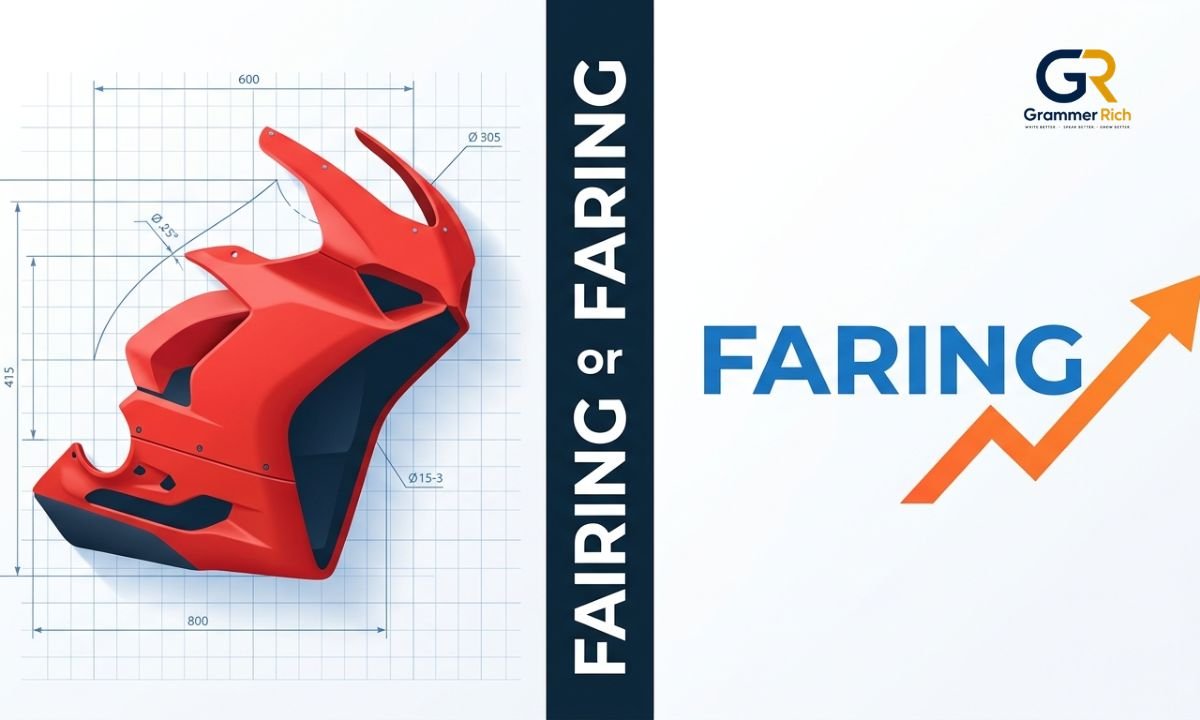
Most people searching this term are actually looking for “faring,” the present participle of “fare,” meaning how someone or something is progressing — as in “How is she faring?” “Fairing,” by contrast, is a noun referring to a smooth structural covering, commonly seen on motorcycles, boats, and aircraft, used to reduce drag. So if you’re describing progress or performance, use faring. If you’re talking about a physical shell or cover, fairing is your word.
Confusing these two trips up even careful writers, and honestly, it’s easy to see why — they sound identical and differ by one letter. Whether you’re writing about how a project is faring or shopping for a motorcycle fairing, this guide breaks down the difference in plain terms. No jargon, no guesswork — just clear examples so you’ll never mix up fairing or faring again.
Quick Answer: Fairing or Faring?
Here’s the short version. Faring is a verb form — it tracks progress, health, or performance (“How are you faring?”). Fairing is a noun — it names a physical, aerodynamic cover found on vehicles and machines. They’re not interchangeable, even though spellcheck won’t flag either one. Once you separate the action word from the object word, the fairing or faring question basically solves itself.
Meaning of “Fairing”
“Fairing” is a noun, and it refers to a structural component, usually rigid, added to a vehicle or object to smooth out its shape. Engineers use fairings to cut wind resistance, reduce drag, and improve overall aerodynamic efficiency. You’ll see this word constantly in motorsports, aviation, and aerospace writing.
A few concrete examples:
- The motorcycle fairing protects the rider from wind and covers the engine.
- A rocket fairing shields the payload during launch and separates once the craft reaches space.
- An aircraft fairing smooths the joint between the wing and the fuselage to reduce drag.
- Boat builders use a fairing to streamline the hull and improve speed through water.
In every case, fairing describes a physical, tangible object — a shell, casing, or housing. It’s never used to describe how a person or situation is doing. If you can touch it, bolt it on, or unbolt it, you’re almost certainly dealing with a fairing.
Merriam-Webster and Cambridge Dictionary both classify fairing strictly as a noun tied to structural or aerodynamic design, which lines up with how engineers and technical writers actually use the term.
There’s also a second, older sense of “fairing” worth knowing about: a small gift bought at a fair, a meaning that survives mostly in older British literature and poetry. It’s rare in modern usage, but if you stumble across it in a classic novel, that’s the sense at play — not aerodynamics. Outside of literary contexts, though, the engineering meaning dominates almost every modern search for fairing or faring, so it’s the definition worth memorizing first.
Meaning of “Faring”
“Faring” comes from the verb “fare,” which means to get along, manage, or progress through a situation. Add “-ing,” and you get the present participle: faring. It shows up most often in questions about wellbeing or performance.
Typical usage looks like this:
- “How are you faring after the surgery?”
- “The new employee is faring well in her first month.”
- “Investors want to know how the company is faring during the downturn.”
- “He’s faring better than expected on the new medication.”
Notice the pattern: faring always attaches to a subject that’s doing something — coping, progressing, performing. It never refers to a physical object. This is the cleanest way to separate fairing or faring in your head: faring answers “how is it going,” while fairing answers “what is that part called.”
The root verb “fare” is older than most people realize. It originally meant “to travel” or “to journey,” which is why we still say “farewell” when someone sets off on a trip. Over centuries, the meaning broadened from physical travel to general progress through any situation — a job, an illness, a business quarter. That history explains why faring feels natural in check-in questions: you’re essentially asking how someone’s journey through a circumstance is going.
How Are You Faring or Fairing?

This exact phrase is one of the most searched variations of the topic, and the answer is simple: it’s always “how are you faring.” The phrase is a polite, slightly formal way of asking someone how they’re coping or getting along, similar to “how are you holding up” or “how are things going.”
“Fairing” would never fit here, because the sentence needs a verb describing an ongoing state, not a noun naming an object. If you catch yourself typing “how are you fairing,” swap the second “i” and “a” — you’re one letter away from correct.
Key Differences Between Fairing and Faring
Seeing both words side by side makes the fairing or faring decision much easier.
| Feature | Fairing | Faring |
| Part of speech | Noun | Verb (present participle) |
| Root word | Related to “fair” (smooth, streamlined) | From “fare” (to get along, travel) |
| Meaning | A structural cover that reduces drag | Progressing, coping, or performing |
| Common field | Engineering, aviation, motorsports | Everyday conversation, business, health |
| Example sentence | “The fairing cracked during the crash.” | “She’s faring well after the move.” |
| Can you touch it? | Yes — it’s a physical object | No — it describes a condition |
Fairing or Faring: Synonyms

Swapping in a synonym is a quick way to double-check yourself before you hit publish.
Synonyms for fairing (noun): casing, shell, housing, cover, aerodynamic panel, streamlined shield.
Synonyms for faring (verb): coping, managing, doing, progressing, getting along, performing.
If “coping” or “getting along” fits your sentence, you want faring. If “casing” or “shell” fits, you want fairing. This simple substitution test resolves most fairing or faring confusion in seconds.
Also, read this: Grately vs Greatly
Common Mistakes People Make
A few patterns show up again and again in everyday writing:
- Writing “how is he fairing” instead of “how is he faring” — the most frequent slip by far.
- Describing a motorcycle’s “faring” instead of its “fairing” in product listings and reviews.
- Assuming both words are interchangeable spellings of the same term, when they’re actually unrelated in origin.
- Autocorrect silently swapping one for the other, since both are valid English words and neither gets flagged.
None of these mistakes are really about grammar skill — they’re about two words that sound identical but serve completely different jobs.
There’s also a subtler mistake worth flagging: using “fairing” in a headline or title when the intended meaning is progress, simply because it looks like the “correct” spelling of a more familiar word. Content writers covering business or health topics sometimes default to fairing out of habit, especially if they’ve recently written about motorcycles or aviation. A quick find-and-replace check before publishing catches most of these slips before readers ever see them.
Memory Tricks to Never Confuse Them Again
A couple of small mental hooks make the fairing or faring distinction stick for good.
- “Fairing has a hard shell, like an egg.” Both “fairing” and “egg” bring physical, solid objects to mind — that link can help you remember fairing is a noun.
- “Faring rhymes with caring, and caring is about people.” Faring, like caring, deals with how someone or something is doing.
- Ask yourself: “Can I kick it?” If yes, it’s a fairing. If the answer is “no, it’s a feeling or a status,” it’s faring.
Pick whichever trick clicks for you — the goal is just to stop second-guessing every time you type either word.
American vs British English Differences
Good news here: there’s no real transatlantic split. Both American and British English use fairing as a noun for structural covers, and faring as the present participle of “fare.” Cambridge Dictionary (British-based) and Merriam-Webster (American-based) define the two words the same way. The only regional variation worth noting is that “fare” itself — meaning to get along or to travel — leans slightly more formal and literary in British English, while American English tends to use it mostly in the “faring well/poorly” construction.
When to Use Fairing in Technical Writing
Technical and engineering writing is where “fairing” appears most often, so precision matters. Use fairing when referring to any component designed to reduce aerodynamic drag or streamline a shape — motorcycle bodywork, rocket nose cones, aircraft wing-to-body joints, or boat hulls. In manuals, spec sheets, and product descriptions, fairing should always function as a noun, often paired with descriptive terms like “carbon fiber fairing,” “vehicle fairing,” or “aerodynamic fairing.”
Keep it concrete: describe what the fairing is made of, what it covers, and what problem it solves (usually drag reduction or protection). Avoid using fairing as a verb — it isn’t one, and doing so will read as an error to any technically literate audience.
When to Use Faring in Conversation or Writing
Faring belongs in everyday, conversational, and reflective writing — anywhere you’re checking in on progress, health, or performance. It fits naturally in emails, health updates, business reports, and casual conversation: “How’s the new diet faring?” “The team is faring better than last quarter.” “He’s faring okay, all things considered.”
Because faring is a verb form, it needs a subject and usually pairs with “is,” “are,” or “was” — “The project is faring well” reads naturally, while “The project fairing well” does not. Keep that grammatical scaffolding in mind and faring will almost always land correctly.
Is “How Are You Faring” a Friendly Greeting?

Yes, generally. “How are you faring?” functions as a warmer, more thoughtful cousin of “how are you doing?” It’s often used after someone has been through something difficult — an illness, a big move, a hard project — so it carries a slightly more caring, checking-in tone than a casual hallway greeting. It’s appropriate in both personal and professional contexts, though it does sound a touch more formal than “how’s it going.”
Why These Words Get Confused So Often
Fairing and faring are homophones — they sound completely identical when spoken aloud, which is the root cause of nearly all the confusion. English is full of these near-twin spellings, and spoken language gives listeners zero clues about which one is meant. Add in the fact that both are legitimate dictionary words, so spellcheckers stay silent, and it’s easy to see why fairing or faring mix-ups slip past even experienced editors. The words also come from different root sources — “fairing” ties back to “fair” in the sense of smooth or even, while “faring” descends from the older verb “fare,” meaning to travel or get along — so there’s no shared etymology to lean on either.
Frequency plays a role too. “Faring” shows up constantly in everyday speech and writing, while “fairing” is largely confined to technical and engineering fields. Readers outside those industries simply encounter fairing far less often, so when they do need to write it, their brain defaults to the more familiar spelling — faring — even when the sentence calls for the noun. Recognizing that bias is often enough to stop it from happening.
Quick Practice Quiz
Test yourself before moving on. Fill in fairing or faring for each sentence:
- “How is your grandmother _______ after the fall?” (faring)
- “The mechanic replaced the cracked motorcycle _______.” (fairing)
- “Sales are _______ better than analysts predicted.” (faring)
- “Engineers redesigned the rocket’s nose _______ for better aerodynamics.” (fairing)
- “He’s _______ reasonably well given the circumstances.” (faring)
If you got most of these right, the fairing or faring distinction has already clicked.
Conclusion
The fairing or faring rule really comes down to one question: are you describing an object or a condition? Fairing is the physical cover you’d find on a motorcycle, rocket, or aircraft. Faring is the verb you use to describe how someone or something is getting along. Keep that noun-versus-verb split in mind, run the quick synonym test when you’re unsure, and you’ll never second-guess fairing or faring again.

Welcome to Grammarrich.com, your trusted source for grammar tips, writing guides, and language learning. With 5 years of experience in the grammar niche, our goal is to provide clear, accurate, and easy-to-understand content that helps everyone write with confidence.