

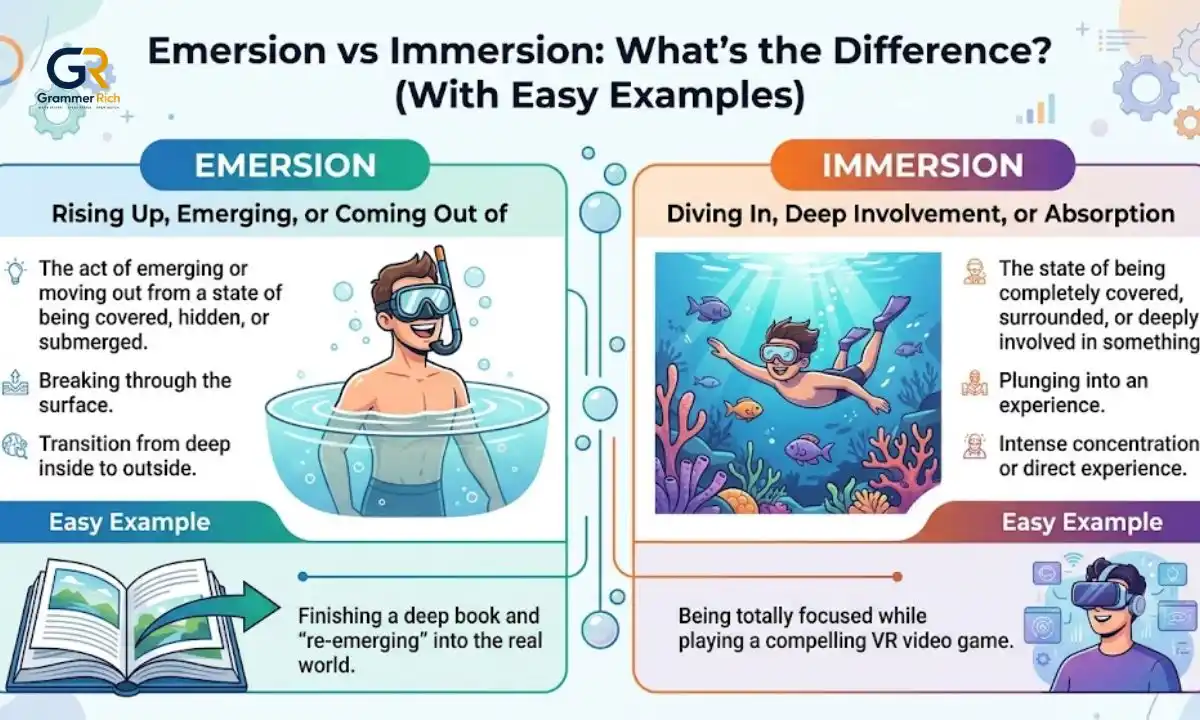
Emersion and immersion aren’t verb tenses of the same word — they’re two separate words with opposite meanings. Emersion means emerging or coming out of something, like a diver breaking the surface. Immersion means being fully submerged or absorbed, like learning a language by living abroad. Use “immersion” for full engagement, and “emersion” for emerging out.
Mixing these two up is one of the most common word mistakes in English, and honestly, it’s an easy trap to fall into. They look almost identical but mean opposite things. In this guide, we’ll break down Emersion vs Immersion with real examples, simple memory tricks, and the exact moments to use each one correctly.
Emersion vs Immersion: A Quick Comparison
Here’s the short version before we go deeper. If you only have ten seconds, this table covers the core of Emersion vs Immersion.
| Feature | Emersion | Immersion |
| Core meaning | Coming out or emerging | Going fully into |
| Direction | Outward, surfacing | Inward, submerging |
| Common fields | Astronomy, marine biology, environmental science | Education, psychology, tech, language learning |
| Frequency of use | Rare, technical | Common, everyday |
| Example | The submarine’s emersion took ten minutes. | She learned French through total immersion. |
| Related idea | Reflection after an experience | Deep engagement during an experience |
Immersion shows up constantly — in classrooms, marketing copy, and gaming reviews. Emersion, on the other hand, mostly lives in scientific and technical writing. That frequency gap is part of why so many people default to “immersion” even when “emersion” is technically correct.
Emersion Meaning, Definition and Scientific Context

Emersion Definition
Emersion is a noun that describes the act of emerging — rising up out of a liquid, a shadow, or a state. Cambridge Dictionary and Merriam-Webster both define it around this idea of “coming forth” or “becoming visible again” after being hidden or submerged. It’s the opposite motion of immersion, not a typo of it.
Think of a diver breaking the surface after a deep dive, or a satellite reappearing after passing behind a planet. Both moments are technically an emersion.
Scientific Fields Where Emersion Is Used
Emersion isn’t a word you’ll hear at the coffee shop. It lives mostly in scientific vocabulary, where precision matters more than casual conversation.
Marine biology
In marine biology, emersion describes when intertidal organisms — like barnacles or mussels — are exposed to air as the tide goes out. Researchers studying intertidal zones track emersion time to understand how species survive periods out of water.
Astronomy
In astronomy, emersion refers to when a celestial body reappears after an occultation or eclipse — for example, when the moon “emerges” from Earth’s shadow. This is a standard term in astronomical terminology, distinct from immersion, which describes the moment a body disappears from view.
Environmental science
Environmental scientists use emersion when describing wetlands, riverbanks, or soil that becomes exposed as water levels drop. It’s a precise way to describe changing environmental conditions without lengthy explanation.
Origin and Etymology of Emersion
Emersion comes from the Latin emergere — “to rise out” or “to come forth.” That’s the same root that gives us “emerge” and “emergency” (originally tied to a sudden rising-up of circumstances). Immersion, by contrast, comes from immergere, meaning “to dip into” or “to plunge.” The two words were never meant to be interchangeable; their Latin roots point in literally opposite directions.
Emersion vs Immersion Blender

Here’s a quick myth-buster: there’s no such thing as an “emersion blender.” The kitchen tool that blends soup right in the pot is an immersion blender — because the blade goes into the liquid. This is one of the most searched Emersion vs Immersion mistakes online, and it’s an easy one to fix once you remember the direction each word implies.
Immersion Definition and Meaning
Immersion Definition
Immersion is the act of being fully submerged, absorbed, or engaged in something. It can be physical (a body underwater) or psychological (a mind fully absorbed in a task, story, or environment).
Physical Immersion
Physical immersion is the literal kind — dipping an object or a person into a liquid. Immersion baptism, for instance, involves fully submerging a person in water as part of a religious ceremony.
Psychological Immersion
Psychological immersion describes deep mental engagement. When a novel is so gripping you forget where you are, that’s immersion. When a classroom activity captures a student’s full attention, that’s immersion too.
Immersion in Technology and Digital Environments
Virtual reality
Virtual reality is built entirely around immersion. A good VR headset creates a sense of “being there,” which developers simply call immersive experience design. The entire industry measures success in terms of how immersive a simulation feels.
Gaming and entertainment
Gamers talk about immersion constantly — a game that pulls you into its world so completely you lose track of time. Reviewers rate games partly on their immersive quality, from sound design to storytelling.
Emersion vs Immersion: Key Differences
Direction of Experience
Immersion moves inward — you’re entering an experience. Emersion moves outward — you’re leaving or surfacing from one. That single directional difference is the fastest way to settle any Emersion vs Immersion confusion.
Also, read this: meating-vs-meeting
Stage of Experience
Immersion happens during an experience — while you’re submerged, absorbed, or engaged. Emersion happens after — the moment of coming back out or reappearing.
Frequency of Use
Immersion appears constantly across education, marketing, tech, and casual conversation. Emersion is reserved almost entirely for scientific and technical contexts, which is exactly why it feels unfamiliar to most readers.
Emersion vs Immersion in Education
Immersion Learning Programs
Language immersion programs place students in an environment where only the target language is spoken. The idea is simple: surround learners with a language until it becomes second nature, rather than teaching it in short, isolated lessons.
Benefits of Immersive Learning
- Faster vocabulary retention through constant exposure
- Improved listening and pronunciation skills
- Greater cultural understanding alongside language skills
- Increased learner confidence in real conversations
Bilingual education programs often rely heavily on this immersive model, especially in early childhood settings where language acquisition happens naturally.
Emersion vs Immersion in Language Learning
Immersion Phase
During the immersion phase, learners are actively surrounded by the new language — through conversation, media, or travel. This is the active, absorbing part of the process.
Emersion Phase
The emersion phase is less discussed but just as real: it’s the period after immersion ends, when learners step back and reflect on what they absorbed. Teachers sometimes build in an “emersion” reflection period, encouraging students to process the experience rather than just consume it.
Emersion vs Immersion Psychology
Psychological Immersion
In psychology, immersion describes total cognitive absorption — the state where outside distractions fade because attention is completely locked onto one task or environment. This overlaps closely with what’s known as flow state.
Emersion Reflection in Psychology
Emersion, in a psychological sense, refers to the reflective phase after an intense experience — stepping back to process emotions, thoughts, or lessons learned. Therapists sometimes describe this as an “emersion period” following an emotionally immersive event, like grief processing or trauma recovery work.
Emersion vs Immersion Examples
Examples of Emersion
- The turtle’s emersion from the pond signaled it was time to bask in the sun.
- Astronomers timed the star’s emersion from behind the eclipse.
- After weeks of intense study, her emersion from the research project left her exhausted but proud.
Examples of Immersion
- He achieved fluency through six months of immersion in Spain.
- The museum’s exhibit offered full sensory immersion.
- Immersion in the novel made her forget her phone was even ringing.
Cultural Immersion Through Travel

Cultural immersion means living like a local rather than observing from the outside — eating regional food, speaking the language, and following daily customs instead of sticking to tourist routes. Travelers who prioritize cultural immersion often report a deeper, more lasting connection to the places they visit compared to standard sightseeing trips.
Common Mistakes Writers Make
Even experienced writers slip up on Emersion vs Immersion. Here are the two most frequent errors.
Mistake: Using Immersion When Emersion Is Correct
Writers describing a subject “emerging” from water, shadow, or an experience sometimes default to “immersion” out of habit, since it’s the more familiar word. This flips the meaning entirely.
Mistake: Assuming the Words Mean the Same Thing
Because they look and sound alike, some readers assume emersion and immersion are simply variant spellings. They’re not. One means going in; the other means coming out.
What Is the Correct Spelling of Emersion?

“Emersion” — E-M-E-R-S-I-O-N — is the correct spelling for the concept of emerging or surfacing. It’s frequently misspelled as “immersion” simply because that’s the more common word, but they are two distinct terms with two distinct meanings, both valid in standard English dictionaries.
Memory Trick for Emersion vs Immersion
Here’s the easiest way to lock this in permanently:
- Immersion starts with “im-,” like “in.” Think: Immersion = In.
- Emersion starts with “e-,” like “exit” or “emerge.” Think: Emersion = Exit.
Key Takeaways
Emersion
- Means coming out or emerging
- Common in astronomy, marine biology, environmental science
- Rare in everyday conversation
Immersion
- Means going fully into something
- Common in education, psychology, tech, and daily language
- Can be physical or psychological
Reference Cambridge Dictionary Definitions
For an authoritative check, Cambridge Dictionary and Merriam-Webster both define these terms clearly and consistently with the explanations above — a useful cross-check whenever you want to confirm usage before publishing or submitting written work.
Conclusion
The rule is simple once it clicks: immersion means going in, emersion means coming out. Whenever you’re describing deep engagement — in a language, a story, a culture — reach for immersion. Whenever you’re describing something surfacing, emerging, or reappearing, emersion is your word. Keep that direction in mind, and you’ll never mix up Emersion vs Immersion again.

Welcome to Grammarrich.com, your trusted source for grammar tips, writing guides, and language learning. With 5 years of experience in the grammar niche, our goal is to provide clear, accurate, and easy-to-understand content that helps everyone write with confidence.