

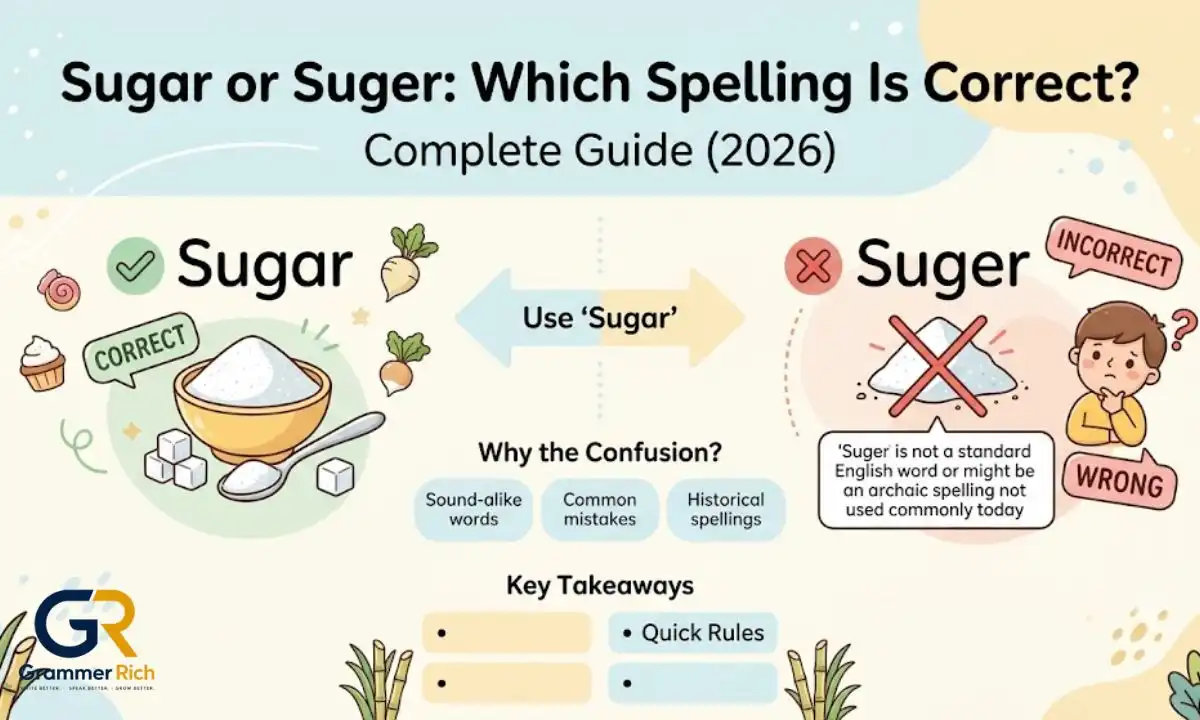
Sugar is the correct spelling — it’s the standard English word for the sweet, crystalline substance used in food and drinks. Suger is simply a common misspelling with no accepted use in formal or informal writing. So whenever you’re second-guessing yourself, go with “sugar.” It’s the only version you’ll find in dictionaries, recipes, or grammar guides.
Ever paused mid-sentence, unsure if it’s sugar or suger? You’re not alone — this mix-up trips up more people than you’d expect. In this guide, we’ll break down why the confusion happens, show you simple tricks to remember the right spelling, and clear up any lingering doubts for good.
Sugar or Suger — What Is the Correct Spelling?
There’s no debate here the way there is with words like “gray” and “grey.” Sugar is the only accepted spelling in both American and British English. “Suger” doesn’t appear in Merriam-Webster, Cambridge Dictionary, or Oxford — it’s a phonetic slip, not a regional variant.
Quick answer box:
- ✅ Correct: sugar
- ❌ Incorrect: suger
- Part of speech: noun
- Pronunciation: /ˈʃʊɡ.ər/ (“SHUG-er”)
Why Do People Write “Suger” Instead of “Sugar”?
Understanding the mix-up helps it stop happening. A few reasons come up again and again.
1. Pronunciation Confusion
The word starts with an “sh” sound, not “s,” which throws off spellers who try to sound it out letter by letter. The “a” in the middle also gets swallowed in casual speech, making “e” feel like a natural fit.
2. Phonetic Typing
Because English spelling isn’t always phonetic, people who type based on sound rather than memory often land on “suger.” It looks like it should match the pronunciation — it just doesn’t match the dictionary.
3. Fast Typing Errors
On mobile keyboards especially, “a” and “e” sit close together. A quick thumb-swipe can turn “sugar” into “suger” without anyone noticing until autocorrect flags it.
4. Lack of Awareness
Some spellers genuinely haven’t seen the word written often enough to lock in the correct form, especially English language learners encountering it more in speech than in text.
Is It Spelled Sugar or Suger?
To put it plainly: it’s always sugar. There’s no formal, informal, American, British, or Australian version where “suger” is accepted. If you see it written that way — in a text, a recipe, or online — it’s a typo, not an alternate spelling.
What Does “Sugar” Mean?
Simple Meaning
In everyday language, sugar refers to the sweet, crystalline substance used to sweeten food and drinks — the stuff in your sugar bowl or coffee.
Scientific Meaning
In chemistry and nutrition, sugar is a broader term for carbohydrates with a sweet taste, including glucose, fructose, and sucrose. Table sugar specifically is sucrose, a compound made of one glucose molecule and one fructose molecule joined together.
What Is Sugar Made Of?
Table sugar (sucrose) is extracted and refined from plants, then crystallized into the familiar granules.
Natural Sources of Sugar
- Sugarcane — the most common global source
- Sugar beet — widely used in colder climates
- Fruits — naturally contain fructose
- Milk — contains lactose, a milk sugar
Types of Sugar You Should Know
Not all sugar is the same, and the distinctions matter for both grammar clarity and health context.
1. Natural Sugar
Occurs naturally in whole foods like fruit and dairy, usually alongside fiber, vitamins, and minerals.
2. Added Sugar
Sugar introduced during processing or preparation — think sodas, candy, and baked goods.
3. Simple Sugars
Single or double-molecule sugars (glucose, fructose, sucrose) that the body absorbs quickly.
4. Complex Sugars
Longer carbohydrate chains, like starches, that break down more slowly and provide steadier energy.
Is Sugar a Carbohydrate?
Yes. Sugar is a type of carbohydrate — specifically, a simple carbohydrate.
Quick Breakdown
| Term | Category | Example |
| Sugar | Simple carbohydrate | Table sugar, honey |
| Starch | Complex carbohydrate | Bread, rice, potatoes |
| Fiber | Complex carbohydrate | Vegetables, whole grains |
How to Use “Sugar” in Sentences (Examples)

Examples:
- She added a spoonful of sugar to her tea.
- Too much sugar in processed snacks adds up fast.
- Sugarcane is harvested and processed into refined sugar.
Formal vs Informal Use
Formally, “sugar” appears in nutrition labels, scientific writing, and health guidelines (“added sugars,” “free sugars”). Informally, it shows up in everyday speech, recipes, and even as a term of endearment (“hey, sugar”) — but the spelling never changes.
Sugar Pronunciation: Why It Confuses People
The “su” combination produces a “sh” sound in English — the same pattern seen in words like “sure” and “issue.” That mismatch between letters and sound is the root of most sugar-or-suger confusion.
Sugar or Suger Reddit
Search Reddit or any spelling forum, and you’ll find the same pattern repeating: people asking whether “suger” is an accepted British spelling, an old form, or a typo. The consistent answer from grammar communities and dictionaries alike is that it’s simply an error — not a recognized variant anywhere in the English-speaking world.
Common Misspellings of Sugar
- Suger
- Shugar
- Sugur
- Sugor
None of these appear in any standard dictionary. If autocorrect changes one of these to “sugar,” that’s the correct fix.
Sugar in Food and Daily Life
Sugar shows up in far more places than the sugar bowl.
Common Sources
- Soft drinks and juices
- Baked goods and desserts
- Breakfast cereals
- Sauces and condiments (ketchup, salad dressing)
- Flavored yogurts
Is Sugar Bad for You? (Health Overview)

Sugar itself isn’t inherently harmful in small amounts — the concern is usually excess added sugar, not sugar occurring naturally in fruit or dairy.
Potential Effects of Too Much Sugar
- Increased risk of weight gain and obesity
- Higher risk of type 2 diabetes over time
- Tooth decay from frequent sugar exposure
- Energy spikes followed by crashes
How Much Sugar Should You Consume Daily?
Recommended Intake
The World Health Organization suggests limiting free sugars to less than 10% of total daily energy intake, with additional benefits from reducing further to below 5% — roughly 25 grams (about 6 teaspoons) for an average adult.
Natural vs Added Sugar — What’s the Difference?
Natural sugar comes packaged with fiber, water, and nutrients (as in an apple), which slows absorption. Added sugar is stripped of those benefits and often hides in foods that don’t taste overtly sweet, like bread or pasta sauce.
How to Reduce Sugar Intake
- Check nutrition labels for “added sugars”
- Swap sodas for water or unsweetened tea
- Choose whole fruit over fruit juice
- Cook more meals at home to control added sugar
- Read ingredient lists for hidden sugar names (syrup, dextrose, maltose)
Sugar Alternatives You Can Consider
- Honey — a natural sweetener with trace nutrients
- Stevia — a plant-based, zero-calorie sweetener
- Maple syrup — a less processed alternative with a distinct flavor
Quick Summary: Sugar vs Suger
| Sugar | Suger | |
| Correct spelling | ✅ Yes | ❌ No |
| Found in dictionaries | ✅ Yes | ❌ No |
| Common cause | — | Phonetic typing, typos |
| Usage | Standard in all English | Not accepted anywhere |
Conclusion
The rule is simple and stays simple: it’s always sugar, never “suger.” The confusion comes down to pronunciation and quick typing, not any real grammatical exception. Once you remember that the word starts with a “sh” sound but is spelled with an “s,” and that the middle vowel is “a,” the mix-up disappears for good. Now you’ll never second-guess that spelling again.

Welcome to Grammarrich.com, your trusted source for grammar tips, writing guides, and language learning. With 5 years of experience in the grammar niche, our goal is to provide clear, accurate, and easy-to-understand content that helps everyone write with confidence.