

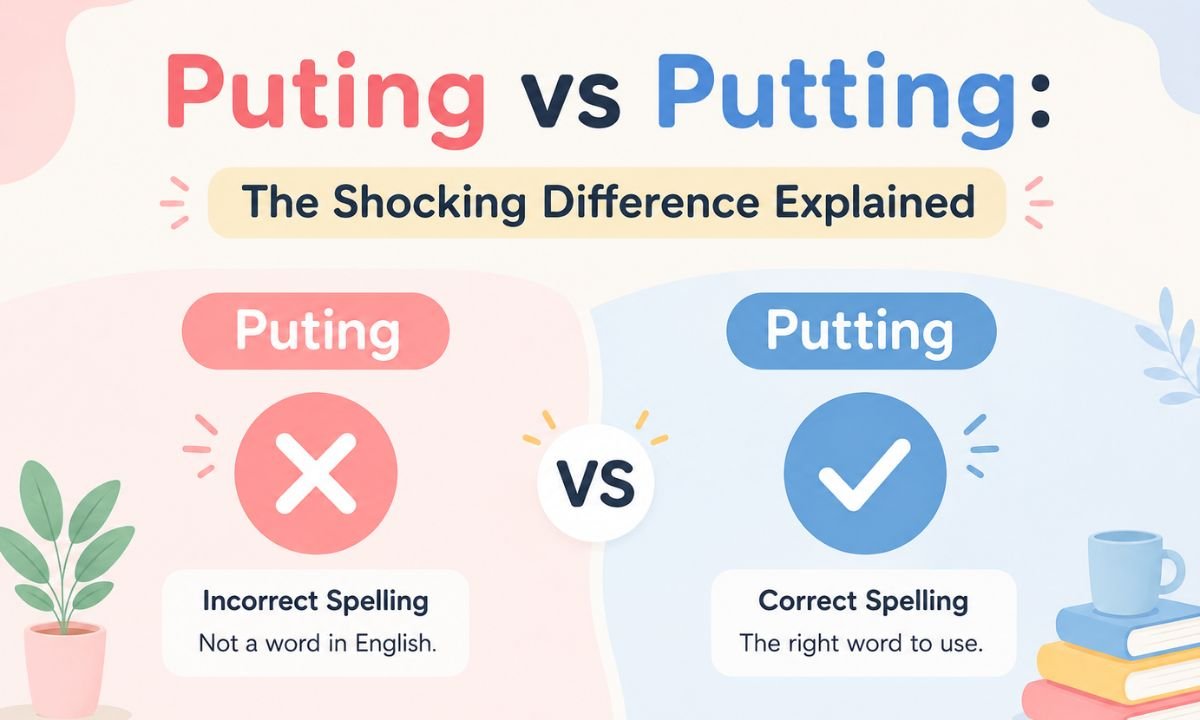
Putting is the only correct spelling. Puting is a common misspelling and is never correct in standard English. The confusion in Puting vs Putting comes from a simple spelling rule that most people forget: when you add “-ing” to a short verb like “put,” you double the final consonant.
In this guide, I’ll walk you through exactly why Puting vs Putting has such a clear answer, how the spelling rule works, and where people get tripped up — including the special case of golf. By the end, you’ll never second-guess this spelling again.
My Quick Answer
- Correct: Putting
- Incorrect: Puting
- Why: The verb “put” is a one-syllable word ending in a single consonant after a single vowel. When you add “-ing,” English spelling rules require you to double that final consonant.
Example: Correct: “She is putting the keys on the table.” Incorrect: “She is puting the keys on the table.”
That’s the short version of Puting vs Putting. Now let’s look at the rule behind it.
Why I Found It’s Spelled “Putting”
When I first looked into Puting vs Putting, I realized the answer comes down to one spelling pattern that shows up across hundreds of English verbs, not just “put.” English has a rule for short verbs that end in a single vowel followed by a single consonant. To keep the vowel sound short when you add “-ing,” you double the last letter.
“Put” fits this pattern exactly. It has one syllable, one vowel (u), and one final consonant (t). Without doubling the “t,” the word would look like “puting,” which would visually suggest a long “u” sound, similar to “cute” turning into “cuting.” Doubling the consonant keeps the short “u” sound intact, so the correct form stays “putting.”
The CVC Rule I Follow
This pattern has a name: the CVC rule, short for Consonant-Vowel-Consonant. It applies when a one-syllable word ends in this exact pattern and you’re adding a suffix that starts with a vowel, like “-ing,” “-ed,” or “-er.”
Here’s how it plays out with similar words:
| Base Word | Pattern | Correct “-ing” Form |
| put | C-V-C | putting |
| run | C-V-C | running |
| stop | C-V-C | stopping |
| sit | C-V-C | sitting |
Notice that none of these words are spelled with a single consonant before “-ing.” That’s exactly why Puting vs Putting has a clear winner: the CVC rule makes “puting” grammatically wrong, no matter how it’s used in a sentence.
My Definition and Meaning Analysis
“Putting” is the present participle and gerund form of the verb “put.” Depending on the sentence, it can describe an action in progress or function as a noun. Understanding both uses helps make sense of Puting vs Putting beyond just spelling.
1. Placing or Moving
Most often, “putting” describes the act of placing, moving, or positioning something somewhere.
Example: “He is putting his books back on the shelf.” Example: “Putting the plan into action took less time than expected.”
In both sentences, “putting” refers to the physical or figurative act of placing something.
2. In Golf
“Putting” also has a specialized meaning in sports. In golf, a “putt” is a gentle stroke used to roll the ball into the hole on the green, and “putting” refers to this specific action.
Example: “Her putting improved after weeks of practice.”
This second meaning is where a lot of readers searching Puting vs Putting actually land, since the golf term is sometimes assumed to have a different spelling rule. It doesn’t — the same CVC logic applies.
Is Putting a Correct Word

Yes. “Putting” is a fully correct, standard English word listed in every major dictionary, including Merriam-Webster and the Cambridge Dictionary. It’s the standard “-ing” form of “put” and is used constantly in everyday writing, speech, and sports commentary.
“Puting,” on the other hand, does not appear as a valid entry in any standard dictionary. It’s not a regional variant, an informal spelling, or an alternate form — it’s simply an error. So when people search Puting vs Putting hoping one might be a British vs. American spelling difference, the answer is no. Both US and UK English use “putting” the same way.
Also, read this: Studder or Stutter
The Golf Connection: A Special Case
Golf brings up Puting vs Putting more often than you’d expect, mostly because golf has its own vocabulary: “putt,” “putter,” and “putting green.” Some learners assume sports terminology follows different spelling logic than everyday grammar. It doesn’t.
A “putt” is the noun for the short, controlled stroke on the green. A “putter” is the club used to make that stroke. And “putting” — whether you’re talking about placing an object or making a golf stroke — follows the exact same doubling rule.
Why are they spelled the same?
Both meanings of “putting” trace back to the same base verb pattern. The golf term “putt” actually developed as a variant pronunciation and spelling of “put,” dating back to Scottish English. Because “putt” also ends in a single vowel and consonant pattern (in this case, already doubled), adding “-ing” keeps that double consonant: “putting.” So the general meaning and the golf meaning end up looking identical, even though their origins took slightly different paths.
Examples I Use
Here are a few more sentences that show correct usage clearly:
Correct: “I’m putting the groceries away.” Incorrect: “I’m puting the groceries away.” Why: The CVC rule requires the doubled “t” before adding “-ing.”
Correct: “The golfer focused on her putting technique.” Incorrect: “The golfer focused on her puting technique.” Why: Even in the golf context, “putting” keeps the doubled consonant.
Correct: “Putting off the decision won’t help.” Incorrect: “Puting off the decision won’t help.” Why: “Putting off” is a phrasal verb meaning to delay, and it follows the same spelling rule as every other use of “putting.”
What do we call putting?
Grammatically, “putting” is called a present participle when it follows a helping verb like “is,” “was,” or “are” (e.g., “She is putting”). It’s called a gerund when it acts as a noun (e.g., “Putting things off causes stress”). In golf, it’s simply referred to as a putting stroke or putting technique, describing the skill of rolling the ball toward the hole.
Common Mistakes of Puting vs Putting
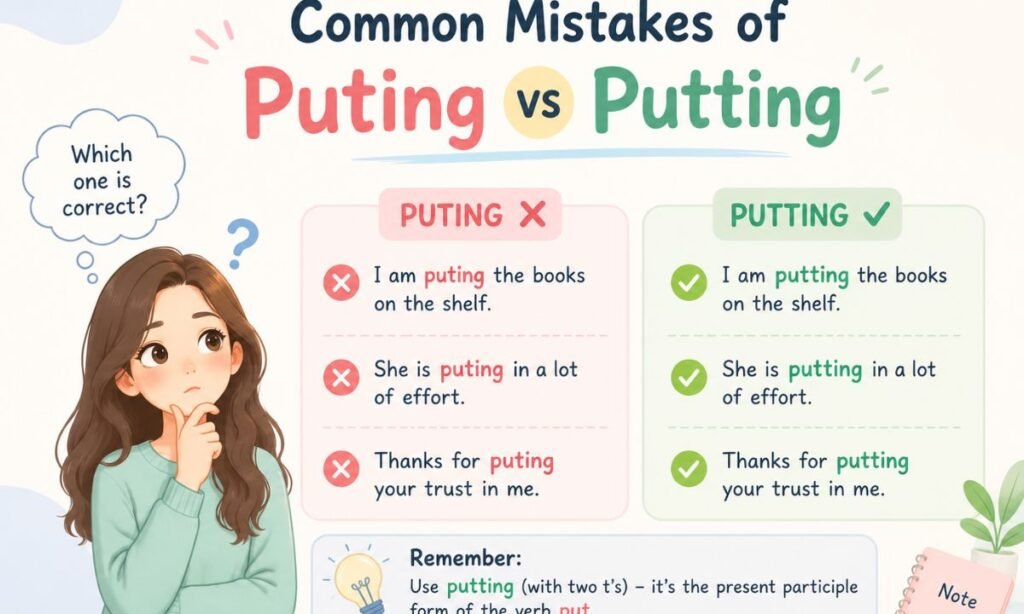
Most mistakes with Puting vs Putting come from forgetting the doubling rule, especially among ESL learners whose first language doesn’t use consonant doubling.
Incorrect: “She was puting her phone away when it rang.” Correct: “She was putting her phone away when it rang.” Why: The single “t” breaks the CVC spelling rule for one-syllable verbs.
Incorrect: “He kept puting things off.” Correct: “He kept putting things off.” Why: Phrasal verbs built on “put” follow the same doubling pattern as the base verb.
Incorrect: “Her puting has really improved this season.” Correct: “Her putting has really improved this season.” Why: The golf-specific meaning doesn’t change the spelling rule.
A simple way to avoid this mistake is to say the word out loud and check: does it rhyme with “cutting” or “fitting”? If yes, it needs the double “t.”
Putting vs Puting: My Summary Table
| Point | Putting | Puting |
| Spelling status | Correct | Incorrect |
| Dictionary entry | Yes | No |
| Follows CVC rule | Yes | No |
| Used in golf | Yes | No |
| Used in everyday speech | Yes | No |
Did you know?
The CVC doubling rule isn’t unique to “put.” It applies to dozens of common one-syllable verbs, including “hop” (hopping), “swim” (swimming), and “plan” (planning). Once you learn this one rule, Puting vs Putting stops being confusing, and so do many similar spelling questions.
Explore More Grammar Guides
If confusing word pairs like this trip you up often, it helps to review other commonly misspelled “-ing” forms and consonant-doubling rules, since the same logic explains many similar mix-ups across English spelling.
Conclusion
Putting is correct. Puting is not. That’s the core answer to Puting vs Putting, and it comes down to a single spelling rule: one-syllable verbs ending in a single vowel and consonant double that consonant before adding “-ing.” Whether you’re talking about placing an object or making a golf stroke, “putting” always keeps its double “t.”
The next time you’re unsure about Puting vs Putting, just remember the CVC rule and compare it to familiar words like “running” or “sitting.” That one mental check is enough to keep your spelling accurate every time.

Welcome to Grammarrich.com, your trusted source for grammar tips, writing guides, and language learning. With 5 years of experience in the grammar niche, our goal is to provide clear, accurate, and easy-to-understand content that helps everyone write with confidence.
1 thought on “Puting vs Putting: The Shocking Difference Explained”