

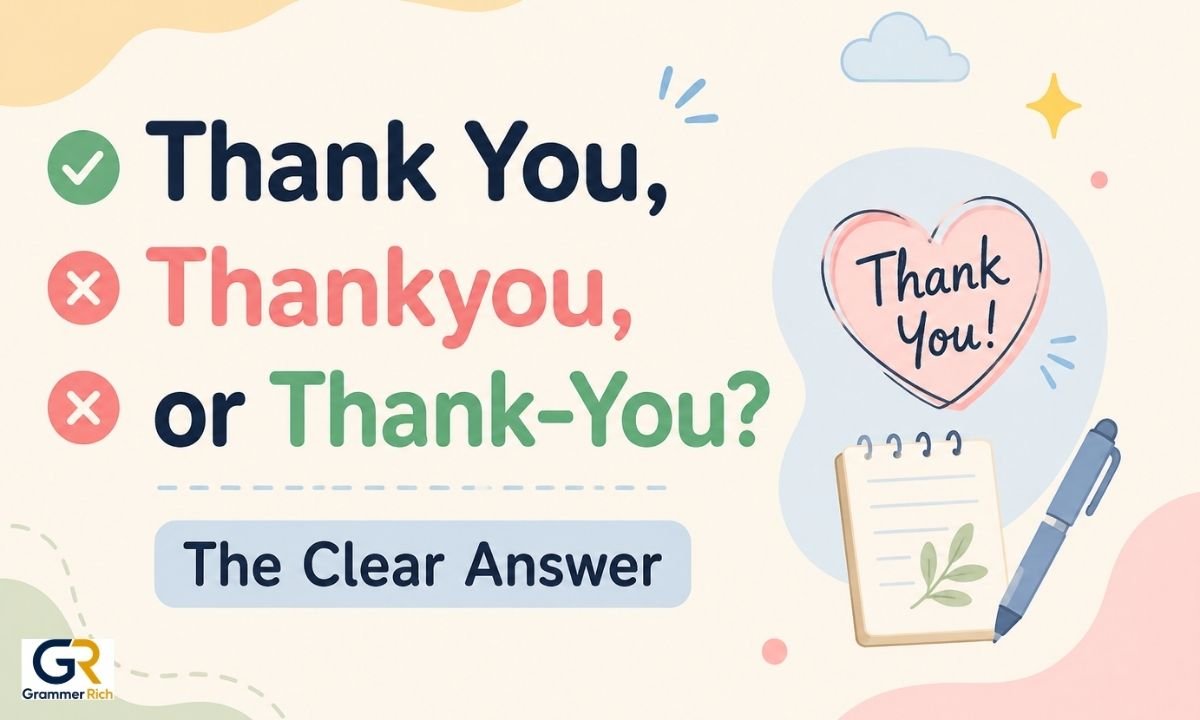
“Thank you” is the correct spelling when you are thanking someone directly, and it is always written as two separate words. The debate over Thank You, Thankyou, or Thank-You usually comes down to grammar, not personal preference — each form has a different job in a sentence.
This guide answers Thank You, Thankyou, or Thank-You clearly and quickly. You will learn when to use two words, when to add a hyphen, and why “thankyou” is not standard in formal writing. Simple examples make each rule easy to remember.
Contents
Thank You

“Thank you” (two words, no hyphen) is the standard spelling. Use it as a greeting, a verb phrase, or a polite exclamation, such as “Thank you for calling.”
Thankyou
“Thankyou” (one word) shows up in casual texts and social media posts. Major dictionaries do not treat it as a standard headword, so it’s best avoided in schoolwork, emails, or professional writing.
Thank-you
“Thank-you” (hyphenated) works as a noun or an adjective, usually right before another noun, as in “a thank-you card” or “a thank-you gift.”
Quick Answer
- Correct for saying thanks directly: Thank you (two words)
- Correct before a noun (adjective) or as a standalone noun: Thank-you (hyphenated)
- Informal, not standard: Thankyou (one word)
Example: “Thank you for the gift. I wrote her a thank-you note.”
Thankyou or Thank You Oxford Dictionary

Dictionaries settle this question fairly consistently. Oxford’s learner dictionaries list “thank you” as a headword with two functions: an exclamation (“Thank you!”) and a noun (“She left without so much as a thank you”). When the word comes before a noun and works as a describing word, Oxford’s own example sentences hyphenate it, as in “a thank-you letter.”
That pattern matters for anyone deciding between Thank You, Thankyou, or Thank-You. Oxford does not list “thankyou” as a separate, correct headword. Other well-known dictionaries, including Collins and Merriam-Webster’s related entries, follow a similar pattern: “thank you” stays as two words in its basic form, while a hyphen appears once the phrase turns into a noun or adjective attached to another word.
This is why style guides recommend two words for the everyday expression of gratitude and reserve the hyphen for the noun or adjective use. The one-word spelling, “thankyou,” has grown more common in casual British and American writing, but it has not become a standard dictionary entry the way “thank you” and “thank-you” have.
Also, read this: Monkeys or Monkies
Thank You Thankyou or Thank You in a Sentence
The spelling depends on the grammatical job the word is doing. This is the real rule behind Thank You, Thankyou, or Thank-You, and once you understand the pattern, you won’t need to guess again.
1. As a verb phrase or exclamation — use “thank you” (two words).
This is the most common use. You are speaking directly to someone, either as a full sentence or as part of one.
- “Thank you for helping me move.”
- “Thank you, I appreciate it.”
2. As a noun — use “thank-you” (hyphenated) or “thank you” (two words).
Here, the word refers to an act of thanking, not the act of speaking to someone. Formal style guides such as AP Style prefer the hyphen in this role, though some dictionaries also list the two-word spelling as acceptable for the noun.
- “She gave a small thank-you before leaving the stage.”
- “He never got a thank you for the extra hours he worked.”
3. As an adjective before a noun — always use “thank-you” (hyphenated).
When the phrase directly describes the noun that follows it, English grammar calls for a hyphen. This keeps the compound adjective clear and avoids confusion.
- “I mailed a thank-you card yesterday.”
- “The thank-you speech ran longer than expected.”
4. As one word — avoid “thankyou” in formal contexts.
“Thankyou” tries to combine the noun and adjective uses into a single word. It appears informally, especially in the UK, but it is not the version taught in style guides or listed as standard in major dictionaries.
Thank You Thankyou or Thank You Examples
Seeing the three forms side by side makes the rule easier to apply.
Correct: “Thank you for your quick response.”
Incorrect: “Thankyou for your quick response.”
Why: This is a verb phrase spoken to someone directly, so it needs two separate words.
Correct: “I sent a thank-you note to my interviewer.”
Incorrect: “I sent a thankyou note to my interviewer.”
Why: “Thank-you” describes the noun “note,” so English grammar requires the hyphen here.
Correct: “Thank you very much for the recommendation.”
Incorrect: “Thank-you very much for the recommendation.”
Why: This is a direct expression of gratitude, not a noun or adjective, so no hyphen is needed.
Correct: “Her thank-you was brief but sincere.”
Incorrect: “Her thankyou was brief but sincere.”
Why: Even in the noun form, dictionaries prefer “thank-you” with a hyphen over the single-word spelling.
These pairs show why the question of Thank You, Thankyou, or Thank-You always comes back to function. Ask yourself: Am I speaking to someone (two words), or am I describing a noun (hyphen)? That single question solves almost every case.
Is Thank You One Word
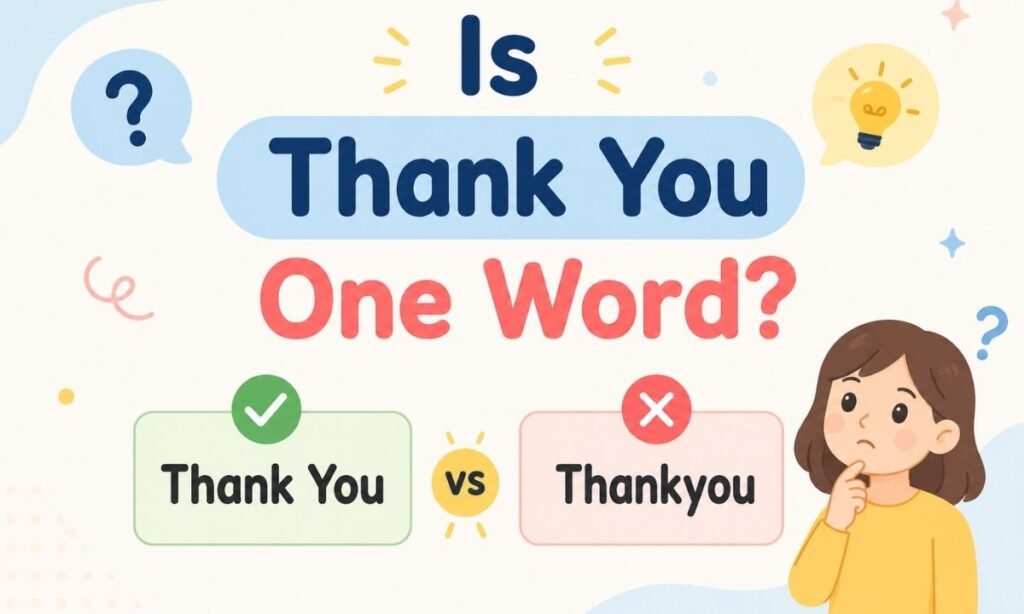
No. “Thank you,” in its main and most common form, is always two words. It began as a shortened version of “I thank you,” and that origin explains the spacing — it is a small sentence, not a single term.
The confusion around Thank You, Thankyou, or Thank-You usually starts because English does turn some two-word phrases into single compound words over time (think of “email” or “website”). “Thank you” has not followed that path in standard dictionaries. It keeps its two-word form as a verb phrase and exclamation, and it only changes — by adding a hyphen — when it functions as a noun or adjective.
So while “thankyou” appears often enough in casual writing that most readers will understand it, it is not the version to use in essays, cover letters, business emails, or any writing that needs to look polished.
Thank You Message
When writing a thank-you message, card, or note, the same rules apply throughout the message itself.
- Opening line (verb phrase): “Thank you so much for the birthday gift.”
- Describing the item (adjective): “This thank-you card doesn’t fully capture how grateful I am.”
- Referring to the act (noun): “Consider this small thank-you a start.”
A short thank-you message might read:
“Thank you for the wonderful dinner last night. I really enjoyed catching up, and I wanted to send a proper thank-you note instead of just a text.”
Notice how “thank you” and “thank-you” both appear correctly in the same short message, each doing a different grammatical job.
Conclusion
The answer to Thank You, Thankyou, or Thank-You depends on what job the phrase is doing in your sentence. Use “thank you” as two words when you are directly thanking someone. Use “thank-you” with a hyphen when it works as a noun or describes another noun, such as a card, note, or gift.
“Thankyou” as one word remains informal and is best avoided in schoolwork, professional emails, and formal writing. Once you remember this simple rule, deciding between Thank You, Thankyou, or Thank-You becomes automatic — check the function first, and the correct spelling follows naturally.

Welcome to Grammarrich.com, your trusted source for grammar tips, writing guides, and language learning. With 5 years of experience in the grammar niche, our goal is to provide clear, accurate, and easy-to-understand content that helps everyone write with confidence.
1 thought on “Thank You, Thankyou, or Thank-You? The Clear Answer”