

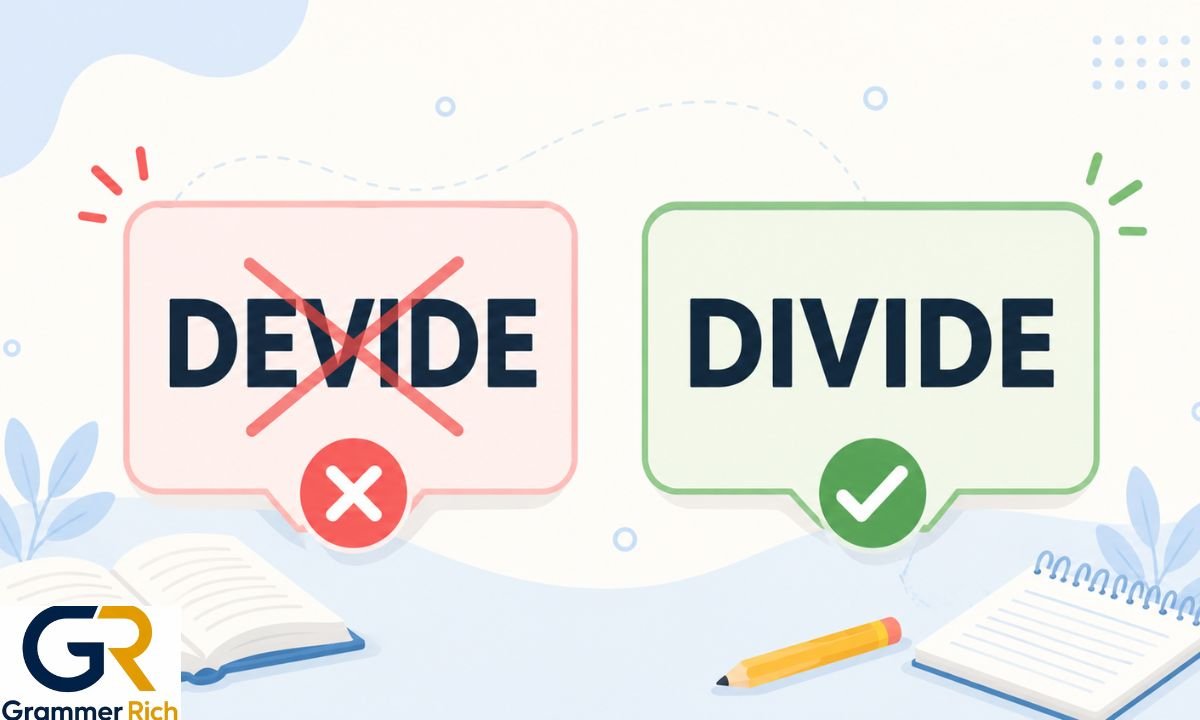
If you’ve typed “devide” and your spell-checker flagged it, here’s the short version: divide is the correct spelling. “Devide” is not a real English word — it’s simply a common misspelling. In this article, you’ll learn why people make this mistake, how to use “divide” correctly, and what to watch for in related words like “division” and “divided.”
Devide
“Devide” has no meaning in standard English. It doesn’t appear in dictionaries, and it isn’t a regional variant used anywhere in the English-speaking world. If you see it in writing, it’s a typo or a spelling error — nothing more.
Divide
“Divide” is the correct, standard spelling used in every form of English, from casual conversation to academic writing. It works as both a verb (“divide the cake”) and a noun (“a growing divide between the two groups”).
Devide or Divide – Quick Answer
Correct spelling: divide Incorrect spelling: devide
The confusion happens because the first syllable is unstressed, so it can sound like “deh” instead of “dih” when spoken quickly. But the spelling never changes — it’s always “i,” not “e,” in that first syllable.
Examples:
- Correct: “Please divide the pizza into six slices.”
- Incorrect: “Please devide the pizza into six slices.”
- Correct: “The teacher asked the students to divide into groups.”
- Incorrect: “The teacher asked the students to devide into groups.”
What Does Divide Mean?
As a verb, divide means to split something into two or more parts. You divide a number in math, divide a room with a curtain, or divide your time between two projects.
As a noun, divide refers to a difference or a gap between two things or groups — for example, “the digital divide” or “a political divide.”
Both uses follow the same spelling rule: it’s always d-i-v-i-d-e.
Is Devide a Real Word?
No. “Devide” is not listed in any standard English dictionary, including Merriam-Webster, Cambridge, or Oxford. It’s a spelling error that happens because of how the word sounds when spoken casually, not because it’s an accepted alternative spelling. If your writing includes “devide,” a spell-checker or grammar tool will flag it every time.
The Origin of Divide
The word “divide” comes from the Latin word dividere, meaning “to force apart” or “to separate.” It entered English through Old French in the 14th century and has kept the same core meaning ever since: to split something into separate parts. Understanding this origin helps explain the spelling — the Latin root has an “i” in that first syllable, which carried over into English and never became an “e.”
British English vs American English Spelling
Unlike words such as “colour” (UK) and “color” (US), or “organise” (UK) and “organize” (US), divide has no regional spelling variation. British English, American English, Australian English, and Canadian English all spell it the same way: divide.
This is different from many commonly confused spelling pairs, where the correct answer depends on which English variant you’re using. With “devide or divide,” there’s no regional exception to remember — only one spelling is ever correct.
Which Spelling Should You Use?
Always use divide, regardless of whether you’re writing for a US, UK, or international audience. There’s no context — formal, informal, academic, or casual — where “devide” is acceptable. If you’re ever unsure, remember: the correct spelling matches the word “diverse” and “divine” in its opening sound pattern, all starting with “di.”
Also, read this: Nicked or Knicked
Common Mistakes with Devide or Divide

Incorrect: She devided the money equally. Correct: She divided the money equally. Why: The past tense keeps the same “i” spelling; only the ending changes to “-ed.”
Incorrect: There was a clear devision between the two teams. Correct: There was a clear division between the two teams. Why: The noun form “division” follows the same “i” spelling as “divide.”
Incorrect: The road devides into two paths. Correct: The road divides into two paths. Why: The present tense “divides” keeps the original spelling and simply adds “-s.”
Why Do People Misspell Divide as Devide?
The most common reason is pronunciation. In natural speech, the first syllable of “divide” is unstressed, so it often sounds like a soft “deh” sound rather than a clear “dih.” This is called vowel reduction, and it happens with many English words. Because English spelling doesn’t always match pronunciation, writers sometimes spell words the way they sound rather than the way they’re written — leading to “devide” instead of “divide.”
Autocorrect and fast typing can also contribute, especially when typing quickly on a phone keyboard where the “e” and “i” keys are close together.
Divide in Everyday Examples
Emails
“Let’s divide the tasks between the two teams before Friday’s deadline.”
News
“The proposed policy has divided public opinion across the country.”
Social Media
“This movie is really dividing fans — some love it, some hate it.”
Formal Writing
“The committee will divide the budget into four equal categories for the fiscal year.”
Devide or Divide in Grammar Rules

“Divide” is a regular verb, meaning it follows standard English conjugation patterns:
- Base form: divide
- Third-person singular: divides
- Past tense: divided
- Past participle: divided
- Present participle: dividing
Example sentence patterns:
- “I divide the class into groups.” (present)
- “She divided the cake.” (past)
- “We are dividing the profits.” (present continuous)
- “The land had been divided long ago.” (past perfect passive)
None of these forms ever use an “e” in place of the “i” — the spelling stays consistent across every tense.
Synonyms and Related Words for Divide
Depending on context, you can replace “divide” with:
- Split
- Separate
- Partition
- Segment
- Distribute
- Share out
- Allocate
Related noun and adjective forms include: division (the act or result of dividing), divisor (the number you divide by in math), dividend (the number being divided), and divided (the adjective form, as in “a divided opinion”).
Devide or Divide – Google Trends & Usage Data

“Devide” is a well-known misspelling that shows up regularly in search queries, which is exactly why people land on comparison pages like this one. Search platforms and dictionaries consistently treat it as a typo redirect toward “divide” rather than as a recognized spelling. Exact search volume numbers change over time and vary by tool, so rather than quoting a specific figure, the reliable takeaway is this: if you’re searching “devide or divide,” you already have the instinct that something’s off — and that instinct is correct.
Comparison Table: Devide vs Divide
| Feature | Devide | Divide |
| Correct spelling | ❌ No | ✅ Yes |
| Found in dictionaries | ❌ No | ✅ Yes |
| Used in US English | ❌ No | ✅ Yes |
| Used in UK English | ❌ No | ✅ Yes |
| Grammatically valid | ❌ No | ✅ Yes |
| Common cause | Mispronunciation/typing error | Standard English spelling |
Conclusion
“Divide” is the correct spelling in all forms of English — there’s no regional exception and no valid alternative. “Devide” is simply a common mistake caused by how the word sounds when spoken. Once you remember that the first syllable is spelled with an “i,” not an “e,” you won’t second-guess it again.

Welcome to Grammarrich.com, your trusted source for grammar tips, writing guides, and language learning. With 5 years of experience in the grammar niche, our goal is to provide clear, accurate, and easy-to-understand content that helps everyone write with confidence.