

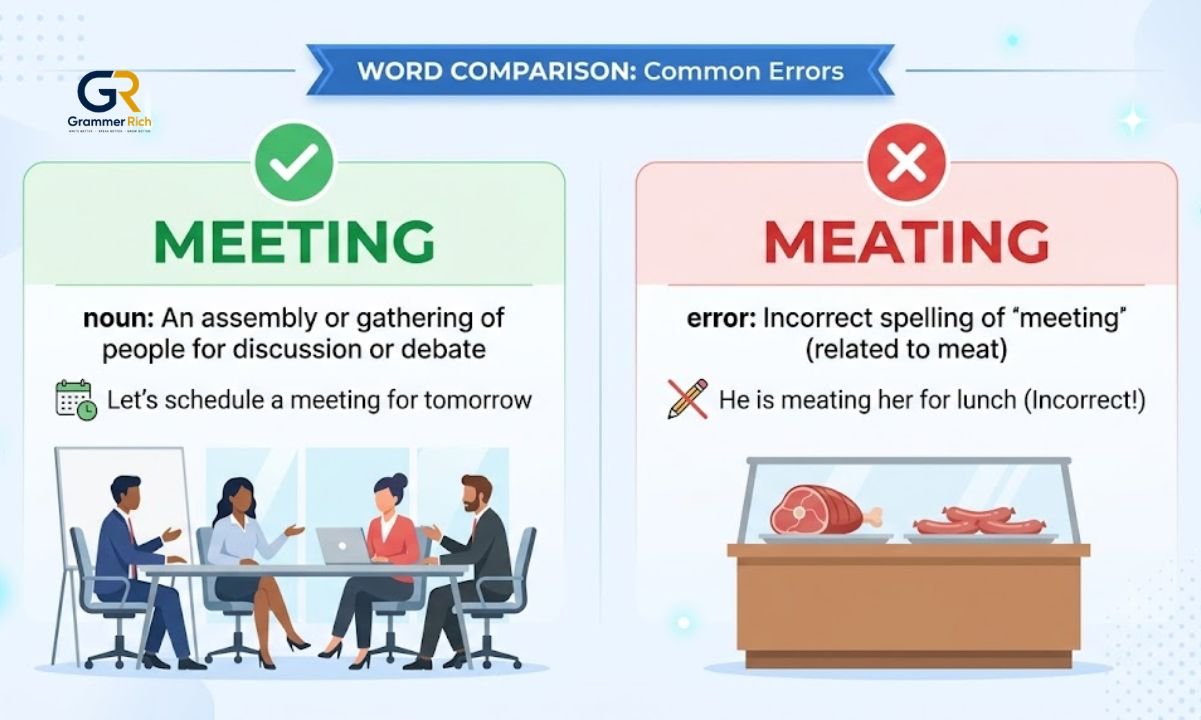
“Meeting” is the correct spelling in every standard context—it’s the noun and gerund form of the verb “meet,” used for gatherings, appointments, and video calls. “Meating” isn’t a recognized English word; it’s a common typo that occasionally shows up in casual writing or gets confused with meat-related terms in cooking contexts. Stick with “meeting” whenever you’re scheduling or discussing an event.
So why does this mix-up keep happening? Autocorrect glitches, quick typing, and simple muscle memory all play a part. In this guide, we’ll break down the meating vs meeting confusion once and for all, showing you exactly when each spelling (or lack thereof) applies, plus tricks to never second-guess yourself again.
Quick Answer
Meeting is correct. Meating is a spelling mistake, usually caused by autocorrect, rushed typing, or confusion with the word “meat.” Use “meeting” any time you’re referring to a scheduled discussion, whether it’s in person, online, or over the phone.
Origins and Meanings of Meeting and Meating

English is full of words that sound alike but mean completely different things, and this pair is a textbook example. Understanding where each word comes from makes the difference obvious.
Meeting Meaning in English
A meeting is an event where two or more people come together to talk, plan, or make decisions. It comes from the verb “meet,” which has been part of English for centuries. Add “-ing” and you get the noun or present-participle form: meeting. According to Cambridge Dictionary, a meeting is an occasion when people come together to discuss something.
Meating Meaning
“Meating” isn’t found in any standard dictionary. It looks like it should relate to “meat” (the food), but adding “-ing” to “meat” doesn’t create a recognized English word. Most of the time, people who write “meating” actually mean “meeting” — it’s a slip, not a real term.
Meting Meaning
Here’s where it gets interesting. Meting is a real word — it’s the present participle of “mete,” meaning to distribute or give out something, usually in the phrase “meting out punishment” or “meting out justice.” It’s often confused with “meeting” simply because the words look so similar on the page.
Meeting Correct Spelling
The correct spelling is always m-e-e-t-i-n-g. Double “e,” followed by “ting.” There’s no version of this word that includes an “a.” If you see “meating” in a document, it needs to be corrected to “meeting.”
A simple way to remember it: think of the verb “meet,” then just add “-ing.” No extra letters, no shortcuts.
Correct Spelling and Pronunciation

Getting the spelling right also means understanding the sound. “Meeting” is pronounced MEE-ting, with the stress on the first syllable. The double “e” makes a long “ee” sound, similar to the word “tree” or “free.”
Here’s a simple pronunciation breakdown:
| Word | Pronunciation | Sound Pattern |
| Meeting | MEE-ting | Long “ee” + “ting” |
| Meating (incorrect) | N/A | Not a standard word |
| Meting | MEE-ting (same sound, different word) | Long “ee” + “ting” |
Notice that “meeting” and “meting” are actually pronounced almost identically, which adds to the confusion. The context of the sentence is what tells you which one is meant.
How to Use ‘Meeting’ in Sentences
Once you’re confident in the spelling, using “meeting” correctly in a sentence becomes easy. Here are a few examples across different contexts:
- We have a team meeting scheduled for 10 a.m. tomorrow.
- The online meeting link didn’t work, so we switched to a phone call.
- Our Google Meet meeting ran twenty minutes longer than planned.
- She called an emergency business meeting to discuss the budget.
- The conference meeting included representatives from three countries.
- It was a casual meeting, so nobody wore formal attire.
Notice how “meeting” fits naturally into both formal and casual settings — from a formal meeting in a boardroom to a quick chat labeled a virtual meeting on your calendar.
Why ‘Meating’ is Usually Incorrect

There’s no context in standard English where “meating” is the correct choice. It’s almost always one of the following:
- A typo caused by typing too fast.
- An autocorrect error on mobile keyboards.
- Confusion between “meat” (the food) and “meeting” (the gathering).
- A non-native speaker guessing at spelling based on pronunciation.
None of these reasons make “meating” acceptable in professional or academic writing. If you’re proofreading a document and spot it, replace it with “meeting” every time.
Common Confusions and Mistakes
English has several word groups that trip people up because they sound alike but mean different things. Let’s break down the most relevant ones here.
Meet vs Meat vs Meeting
- Meet (verb): to come together with someone. Example: “Let’s meet at noon.”
- Meat (noun): food from an animal. Example: “She doesn’t eat meat.”
- Meeting (noun): a gathering to discuss something. Example: “The meeting starts at 3 p.m.”
These three words are pronounced very differently, so the confusion is almost always about spelling, not sound.
Meeting vs Meting
- Meeting: a scheduled gathering.
- Meting: distributing or dispensing something, as in “meting out advice.”
These two are pronounced almost the same way, so writers often swap them by accident, especially in formal or legal writing.
Spelling Mistakes in English
Spelling mistakes like this one are common because English pronunciation doesn’t always match its spelling patterns. Words with double letters, silent letters, or similar-sounding pairs are frequent trouble spots for both native speakers and English language learners.
Scenarios
Picture this: you’re drafting a calendar invite on your phone, typing fast, and autocorrect changes “meeting” to “meating” without you noticing. Or maybe you’re a non-native speaker who’s only ever heard the word spoken aloud and guessed at the spelling. Both scenarios are common — and both are easy to fix once you know the rule.
Examples for Clarity
To lock in the correct usage, here are more real-world examples showing “meeting” used properly:
- The HR department scheduled a team meeting to discuss new policies.
- Can you send the meeting room number before we start?
- The client requested a virtual meeting instead of an in-person visit.
- After the conference meeting, everyone received a summary email.
- His calendar was full of back-to-back online meetings all week.
Each example uses “meeting” correctly and naturally, whether it’s describing a formal setting or a quick chat.
What is the Meaning of Meating or Meeting?
To sum it up plainly: “meeting” is the only correct term, referring to any planned or spontaneous gathering where people talk, plan, or make decisions together. “Meating” carries no accepted meaning in English — it’s simply a misspelling that should always be corrected to “meeting.”
Practice Session: Meating vs Meeting
Ready to test what you’ve learned? Try these quick exercises.
Fill in the Blank
- We have a ______ at 2 p.m. today. (meeting/meating)
- The manager called an emergency ______ after the report was released. (meeting/meating)
- Our ______ was rescheduled to next Monday. (meeting/meating)
Correct the Sentences
- “Let’s have a meating tomorrow morning.” → Let’s have a meeting tomorrow morning.
- “The team meating went well.” → The team meeting went well.
- “I’ll send the meating link shortly.” → I’ll send the meeting link shortly.
Scenarios
Imagine you’re proofreading a coworker’s email before it goes out to twenty clients, and you spot “meating” three times. Fixing it before sending keeps the message looking professional and error-free.
Answer
All blanks above should be filled with “meeting.” “Meating” is never the correct choice in standard English.
Tips to Avoid Mistakes
- Always double-check autocorrect suggestions before hitting send.
- Remember the double “e” in “meeting” — think of the word “meet” plus “-ing.”
- Read your sentence aloud; if it’s about a gathering, it’s “meeting.”
- Use a grammar checker or proofreading tool for important documents.
- When unsure, search for the word in a trusted dictionary like Cambridge Dictionary before publishing.
Conclusion
The rule is simple: meeting is correct, and meating is a spelling mistake to avoid in any professional or academic writing. Whether you’re scheduling a business meeting, joining a virtual meeting, or writing a quick calendar note, stick with the double “e” spelling every time. Now you’ll never mix up Meating vs Meeting again.

Welcome to Grammarrich.com, your trusted source for grammar tips, writing guides, and language learning. With 5 years of experience in the grammar niche, our goal is to provide clear, accurate, and easy-to-understand content that helps everyone write with confidence.