

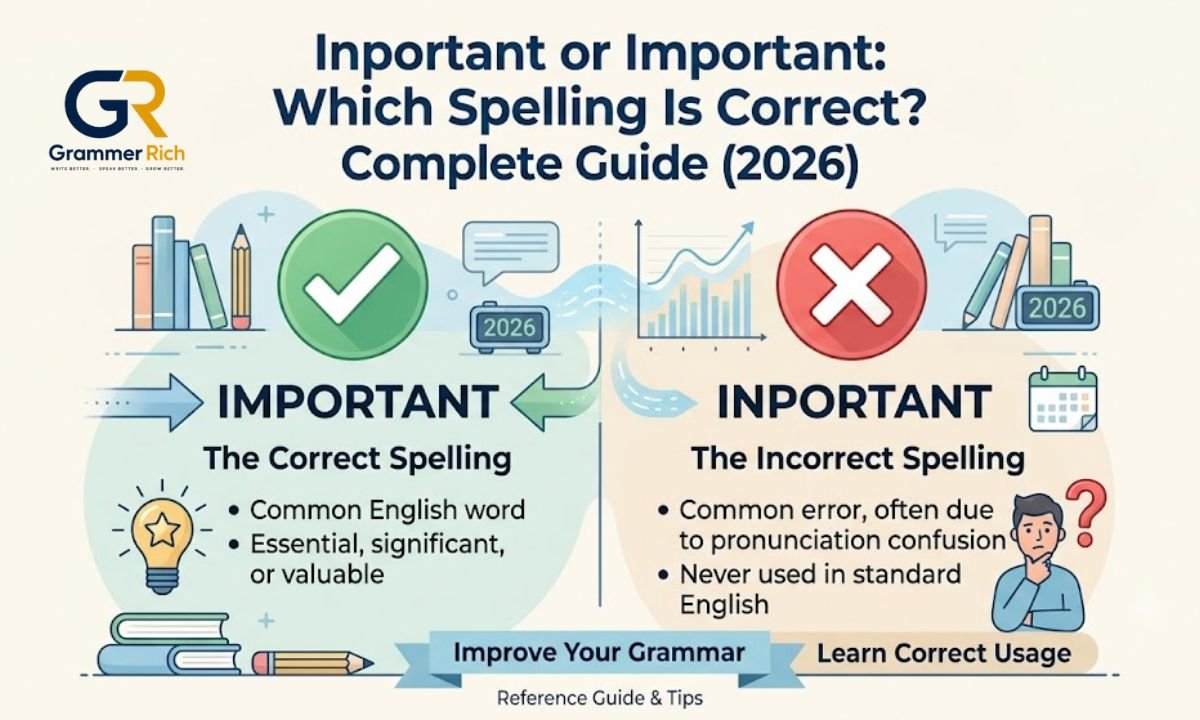
“Inportant” is simply a misspelling of “important” — there’s no grammatical distinction between the two, no past tense or past participle involved. “Important” is the only correct spelling in every context, whether you’re writing an email, an essay, or a text message. If you’ve typed “inportant,” just fix the “n” to an “m” and move on.
So why does this typo show up so often? Probably because the “m” and “n” keys sit right next to each other, and our fingers move faster than our brains. In this guide, we’ll break down why “inportant or important” trips people up, how to remember the right spelling for good, and a few tricks to catch typos before they slip into your writing.
Inportant or Important – Quick Answer
Important is correct. Inportant is not a word in any dictionary — not Merriam-Webster, not Cambridge, not Oxford. It’s a common spelling mistake, usually caused by typing speed or by the way the word sounds when spoken quickly.
- ✅ Correct: important
- ❌ Incorrect: inportant
Which Is Correct, Important or Important?

This question usually pops up when someone has already typed “inportant” and wants a quick gut-check. There’s really only one answer here: important, spelled with an “m,” is the standard English spelling everywhere — in the US, the UK, and Australia. There’s no regional variant, no old-fashioned form, and no alternate spelling that swaps the “m” for an “n.”
Grammar checkers, spellcheckers, and every major dictionary agree. If a document or app ever suggests “inportant” is acceptable, that’s a bug, not a rule.
What Does “Important” Mean?
“Important” is an adjective. It describes something that matters, carries weight, or deserves attention. Merriam-Webster defines it broadly as something marked by significance, and Cambridge Dictionary echoes that: something that is important is worth caring about because of its effect or value.
A few quick examples:
- This is an important meeting — don’t be late.
- Sleep is important for your health.
- Her feedback was genuinely important to the final decision.
Notice the “m” right after the first syllable. That’s the letter people accidentally swap for an “n.”
Why Do People Write “Inportant”?
This spelling error isn’t random. It usually comes down to a few predictable habits:
- Pronunciation-based spelling error — when you say “important” fast, the “m” sound can blur, making “in-” feel like a natural prefix.
- Typing mistake — on a keyboard, “m” and “n” sit side by side, so a rushed typist hits the wrong one.
- Mobile typing errors — autocorrect on phones doesn’t always catch it, especially with swipe-typing.
- Familiar prefix bias — “in-” is a common English prefix (inactive, incomplete), so the brain sometimes defaults to it out of habit.
None of these make “inportant” correct. They just explain why the mistake is so common.
Inportant or Important in a Sentence
Seeing both forms side by side makes the difference obvious:
- ❌ This is an inportant decision for the company.
- ✅ This is an important decision for the company.
- ❌ Please pay inportant attention to the instructions.
- ✅ Please pay important attention to the instructions.
Once you see it written out, “inportant” looks off. The trouble usually starts when you’re typing fast and don’t glance back.
The Origin of Important
“Important” traces back to Latin. It comes from importare, meaning “to bring in” or “to carry significance,” filtered through French important before settling into English. The Latin root explains the “m” — it’s part of the original word structure, not a random letter.
Understanding the origin helps with memory: the word was never built from the prefix “in-” plus “portant.” It’s one unified term borrowed and adapted over centuries, which is part of why English spelling rules don’t offer a clean shortcut here. You simply have to remember the correct form.
British English vs American English

Good news if you were worried about regional spelling differences: there’s no split here. Unlike “colour” vs “color” or “organise” vs “organize,” important is spelled identically in British English, American English, and Australian English. This is one of the rare English words where every major variety agrees completely.
Inportant or Important Synonym

If you want to avoid repeating “important” too often in your writing, here are some solid synonyms:
- Significant
- Essential
- Crucial
- Vital
- Notable
- Key
- Critical
- Meaningful
These words carry a similar weight and can help your writing feel less repetitive, especially in professional or academic pieces.
Which Spelling Should You Use?
Always use important. There is no context — formal, informal, technical, or casual — where “inportant” is the accepted spelling. If you’re ever unsure while writing quickly, a quick pause to check is worth it, especially in professional writing or job applications where typos can hurt your credibility.
Common Mistakes with Inportant or Important
Writing What You Hear
Spoken English often blurs sounds together. When “important” is said at normal speed, the “m” can sound soft, nudging some writers toward “inportant” without realizing it.
Trusting Sound Over Spelling
English isn’t a fully phonetic language, so relying purely on pronunciation is risky. Many commonly misspelled words follow this same pattern — the way a word sounds doesn’t always match how it’s spelled.
Ignoring Spellcheck Warnings
Most spellcheckers will flag “inportant” instantly. The mistake usually happens when someone types quickly, on mobile, or dismisses the red underline without looking closely.
Inportant or Important in Everyday Use
Emails
Professional emails often use this word to flag urgency (“This is an important update”). A typo here can look careless to a client, boss, or colleague.
School & Education
Students frequently use “important” in essays and assignments to highlight key points. Teachers and grading rubrics often mark spelling errors like “inportant” down, even in strong essays.
Work & Business
Business writing — reports, memos, proposals — leans heavily on this adjective. Since these documents shape decisions, spelling accuracy matters for professional writing standards.
News & Media
Journalists use “important” constantly to signal newsworthy events. Editorial standards make spelling errors here especially noticeable to readers.
Social Media
Casual posts are more forgiving, but “inportant” still stands out, especially in captions meant to look polished or professional.
Inportant or Important – Search & Usage Insight
Search data shows people often type “inportant or important” directly into Google when they’re unsure, rather than searching “how to spell important.” This suggests the confusion is less about not knowing the word and more about a quick typing slip they want confirmed. It’s one of the more common spelling mistakes searched by ESL learners and native speakers alike.
Comparison Table: Inportant vs Important
| Feature | Inportant | Important |
| Correct spelling | ❌ No | ✅ Yes |
| Found in dictionaries | ❌ No | ✅ Yes |
| Used in British English | ❌ No | ✅ Yes |
| Used in American English | ❌ No | ✅ Yes |
| Grammatically valid word | ❌ No | ✅ Yes |
| Common cause | Typing/pronunciation error | Standard English spelling |
Conclusion
There’s no real debate between “inportant or important” — important is the only correct spelling, in every dialect and every context. The mix-up almost always comes down to fast typing or a blurred pronunciation, not a genuine grammar rule. Once you notice the “m,” the habit sticks fast. Keep this guide bookmarked, run a quick proofread on anything important you send out, and you’ll never mix them up again.

Welcome to Grammarrich.com, your trusted source for grammar tips, writing guides, and language learning. With 5 years of experience in the grammar niche, our goal is to provide clear, accurate, and easy-to-understand content that helps everyone write with confidence.