

Apologize vs Apologise is a spelling question, not a grammar one. Both words are correct and mean the same thing. “Apologize” is the American spelling. “Apologise” is the usual British spelling.
This guide explains the apologize vs apologise choice in plain English. You will see where each spelling is used, how the verb forms change, and which common mistakes to avoid. You will also learn how to pick one spelling and stay consistent.
Quick Answer: Use apologize for American English and apologise for British English. Neither is wrong. In the apologize vs apologise choice, only your audience matters.
Example: “I apologize for the delay.” (US) / “I apologise for the delay.” (UK)
Apologize vs Apologise: What’s the Difference?
There is no difference in meaning, grammar, or sound. The difference is only the spelling of the ending: -ize or -ise. The apologize vs apologise difference is regional, the same way “color” and “colour” are.
Is “Apologize” Correct?
Yes. It is the standard spelling in the United States and Canada. It is also accepted in British writing that follows Oxford style, which prefers -ize endings for words like this.
Is “Apologise” Correct?
Yes. It is the common spelling in the UK, Australia, New Zealand, and Ireland. Do not treat it as a typing mistake in those places.
What Does “Apologize” or “Apologise” Mean?
To apologize (or apologise) means to tell someone you are sorry for something you did or said. It is a verb. The person who receives the apology and the reason for it usually follow the verb.
Apologize or Apologise to Someone
Use to before the person who receives the apology.
- “I need to apologize to my neighbor.”
- “She apologised to the whole team.”
Apologize or Apologise for Something
Use for before the reason.
- “He apologized for the mistake.”
- “They apologised for being late.”
You can combine both: “I apologize to you for the mix-up.”
When Should You Use “Apologize”?
Use “apologize” when your readers are mainly American or Canadian. Also use it if your publisher or style guide follows Oxford spelling.
“Apologize” in Formal Writing
In formal US writing, “apologize” is the only spelling readers expect. This includes business letters, legal notices, school essays, and official statements.
“The company apologizes for any inconvenience.”
“Apologize” in Everyday Writing
In emails, texts, and social posts to a US audience, the same rule applies. “Apologize” looks normal to American readers, and “apologise” may look slightly off.
When Should You Use “Apologise”?
Use “apologise” when your readers are mainly in the UK, Australia, New Zealand, or Ireland. The same rule covers school work in those countries, where teachers usually expect British spelling.
“Apologise” in Professional Writing
British business writing normally uses “apologise.” Customer emails, press statements, and reports all follow this pattern.
“We apologise for the disruption to your service.”
Apologize vs Apologise Examples
Here is how the apologize vs apologise choice looks in real sentences. The meaning stays the same each time.
| American English | British English |
| I apologize for the noise. | I apologise for the noise. |
| She apologized to her teacher. | She apologised to her teacher. |
| We are apologizing for the error. | We are apologising for the error. |
| He never apologizes first. | He never apologises first. |
A Workplace Example
US email:
“Hi Maria, I apologize for missing yesterday’s meeting. I will send my notes today.”
UK email:
“Hi Maria, I apologise for missing yesterday’s meeting. I will send my notes today.”
Only the spelling changes. The tone and meaning stay the same.
Apologize or Apologise Oxford Dictionary
Oxford dictionaries list “apologize” with “apologise” as a British variant. Cambridge Dictionary presents “apologise” as the British spelling of the same word. Merriam-Webster, which focuses on American English, uses “apologize” as its main entry.
So the major dictionaries agree. They do not call either form wrong. They simply label the region.
This is also why you may see “apologize” in British books. Oxford University Press uses -ize in British spelling for words with Greek roots. Check the dictionary of your own region or your style guide if you are unsure.
Apologize vs Apologise in Different Verb Forms
The apologize vs apologise split continues in every verb form. The ending changes; the pattern does not.
| Form | American | British |
| Base form | apologize | apologise |
| Third person singular | apologizes | apologises |
| Past tense | apologized | apologised |
| Present participle | apologizing | apologising |
Base Form
Use the base form after “to,” “will,” “can,” and “should.”
“I want to apologize.” / “You should apologise.”
Third Person Singular
Add -s for he, she, and it.
“She apologizes quickly.” / “He apologises often.”
Past Tense
Add -d. The past tense and past participle are the same.
“I apologized yesterday.” / “I have apologised twice.”
Present Participle
Drop the final -e and add -ing.
“He is apologizing now.” / “They are apologising now.”
Apologize vs Apologise in American and British English
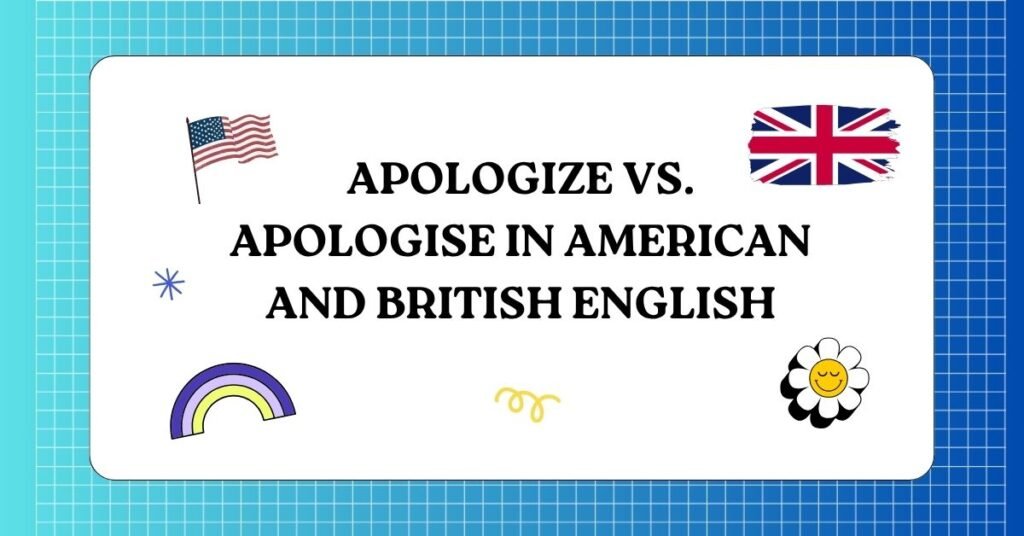
Here is where each spelling is normal:
- -ize (apologize): United States, Canada
- -ise (apologise): United Kingdom, Australia, New Zealand, Ireland
- Both seen: British writing that follows Oxford spelling
The same pattern appears in many words: realize/realise, organize/organise, recognize/recognise. A few words, such as “advertise” and “surprise,” are spelled with -ise everywhere. “Apologize” is not one of them.
Why Does the Z/S Difference Exist?
The -ize ending comes from Greek, through Latin. French later used -iser, and many British writers started to follow the French form with -ise. American English kept -ize and made it standard.
British English never fully settled on one. That is why Oxford style still prefers -ize, while most British newspapers and schools use -ise.
Apologise or Apologize Pronunciation
Both spellings sound the same. The stress falls on the second syllable, and the ending sounds like “eyes.”
- UK: uh-POL-uh-jyz
- US: uh-PAH-luh-jyz
The only difference is the vowel in the second syllable, which is normal accent variation. The spelling does not change how you say the word.
Also, read this: Focusing vs Focussing:
Which Spelling Should You Use?
Choose by audience, then keep your choice the same throughout.
Use “Apologize” for American English
Use it for US readers, US schools, and US companies. It is also the safe choice for Canadian writing.
Use “Apologise” for British English
Use it for readers in the UK, Australia, New Zealand, and Ireland. If a UK teacher or editor asks for British spelling, this is the form to use.
What If You Write for an International Audience?
Pick one spelling and use it everywhere on your site or in your document. Most international readers understand both. The usual choice is the spelling of your main market. Write it down in your style guide so every writer follows it.
Is “Apologize” or “Apologise” More Correct?
Neither is more correct. Both are fully correct spellings of one word. The only wrong choice is mixing them in the same document, or using the one your audience does not expect.
Common Mistakes With Apologize and Apologise
The most frequent apologize vs apologise error is inconsistency. Below are the real problems writers face.
Mixing American and British Spellings
Incorrect: “We apologize for the delay, and we apologise again for the error.”
Correct: “We apologize for the delay, and we apologize again for the error.”
Why: Pick one spelling and keep it.
Using “Apologise” in American English
Incorrect (US): “I apologise for the mix-up.”
Correct (US): “I apologize for the mix-up.”
Why: American readers expect -ize, and “apologise” can look like a typo.
Using “Apologize” in British Style
Incorrect (UK house style): “We apologize for the disruption.”
Correct (UK house style): “We apologise for the disruption.”
Why: If a British editor expects -ise, “apologize” breaks the style. (Oxford style is the exception.)
Confusing “Apology” With “Apologize”
Incorrect: “He apology for his mistake.”
Correct: “He apologized for his mistake.” / “He made an apology.”
Why: “Apology” is a noun, so it cannot act as the verb.
Using “Apologies” as the Verb
Incorrect: “She apologies every morning.”
Correct: “She apologizes every morning.” / “She apologises every morning.”
Why: The third-person verb form is “apologizes/apologises.” “Apologies” is the plural noun.
Apologize vs Apologise Synonym
Sometimes a different word works better than either spelling. These are useful alternatives:
- Say sorry: casual and friendly. “He said sorry to his sister.”
- Express regret: formal. “The airline expressed regret for the delay.”
- Ask for forgiveness: personal and emotional.
- Beg someone’s pardon: old-fashioned and polite.
- Make amends: to do something to fix the problem, not just say sorry.
None of these has a US/UK spelling problem, except “apologise/apologize” itself.
Apologize or Apologise in a Sentence
Three sentence patterns cover most real uses.
Apologize or Apologise for Something
The pattern is: apologize + for + noun.
- “I apologize for the confusion.”
- “We apologise for the inconvenience.”
Apologize or Apologise to Someone
The pattern is: apologize + to + person.
- “He apologized to the customer.”
- “You should apologise to your sister.”
Do not say “apologize someone.” The preposition “to” is needed.
Apologize or Apologise for Doing Something
The pattern is: apologize + for + -ing verb.
- “I apologize for forgetting your name.”
- “She apologised for arriving late.”
After “for,” use the -ing form, not “to + verb.”
A Practical Case Study: Choosing the Right Spelling
These two examples are made up, but they show real decisions writers make.
Case Study: A US Company
Brightline Software is based in Texas and sells mostly to American customers. Its support team used both “apologize” and “apologise” in emails, because some writers were trained in the UK. Customers noticed the mix and started to question the quality of the emails.
Case Study: A UK Company
Northgate Travel is based in Manchester. It uses “apologise” in every email, but one new writer used “apologize” in a booking message. Her editor changed it to match the company’s British house style.
The Lesson
Neither company had a wrong spelling. The problem was inconsistency. Decide on one form, put it in your style guide, and check it before you publish.
Apologize vs Apologise: A Useful Style Checklist
Use this checklist for any apologize vs apologise decision:
- Who is my main audience: US or UK?
- Does my school, publisher, or company have a style guide?
- Have I used the same spelling in every verb form (apologizes, apologized, apologizing)?
- Have I used the matching spelling in other words, like “organize” and “organise”?
- Have I used “apologize/apologise” as a verb, and “apology/apologies” as nouns?
- Did I use “to” for the person and “for” for the reason?
How to Remember the Difference Between Apologize and Apologise
Think of Z as the American letter, since Americans call it “zee.” British English uses S, and you can link that to “Sorry, Sir.” It is not a rule, just a helpful memory hook.
Another simple trick: match the spelling to the rest of your writing. If you write “color,” use “apologize.” If you write “colour,” use “apologise.”
Apologize vs Apologise: Quick Comparison
Here is the apologize vs apologise difference at a glance:
| Feature | Apologize | Apologise |
| Meaning | To say sorry | To say sorry |
| Main region | US, Canada | UK, Australia, NZ, Ireland |
| Past tense | apologized | apologised |
| Pronunciation | Same | Same |
| Correct? | Yes | Yes |
| Related noun | apology | apology |
Conclusion
The apologize vs apologise question has a simple answer. Both spellings are correct, and both mean the same thing. Use “apologize” for American English and “apologise” for British English.
Before you publish, check that your spelling is consistent. In any apologize vs apologise decision, your audience and style guide matter more than the word itself.

Welcome to Grammarrich.com, your trusted source for grammar tips, writing guides, and language learning. With 5 years of experience in the grammar niche, our goal is to provide clear, accurate, and easy-to-understand content that helps everyone write with confidence.