

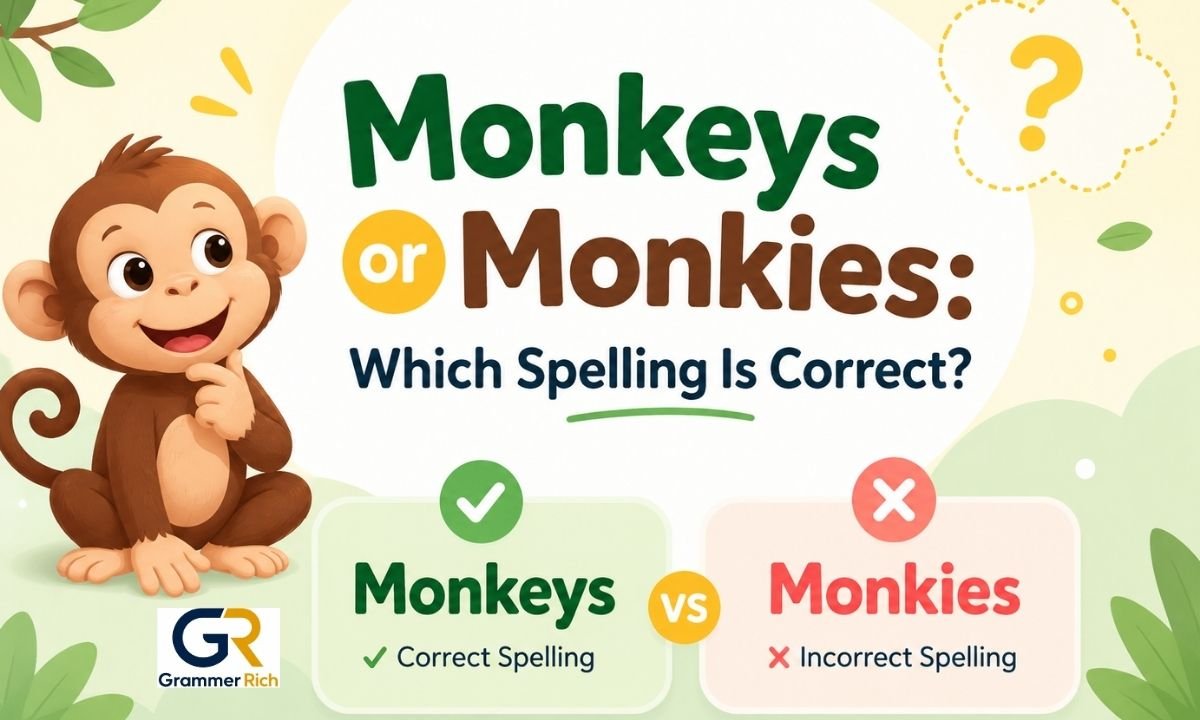
Monkeys is the correct spelling. Monkies is not a real word — it’s a common misspelling. If you’ve been typing Monkeys or Monkies and aren’t sure which one to trust, the short answer is simple: only one of them follows English spelling rules, and it’s “monkeys.”
This confusion is more common than you’d think, especially among ESL learners and even native speakers who mix up plural rules for words ending in “y.” Once you understand the small rule behind it, you’ll never second-guess Monkeys or Monkies again.
Monkeys or Monkies – Quick Answer
- ✅ Correct: monkeys
- ❌ Incorrect: monkies
- Why: “Monkey” ends in a vowel (e) followed by y. When a word ends in vowel + y, you simply add -s to make it plural. You do not change the y to i.
Example: The zoo has three monkeys in the new enclosure.
Is It Spelled Monkeys or Monkies?
There is only one accepted spelling for the plural of “monkey,” and that is “monkeys.” No major dictionary — not Merriam-Webster, not Oxford, not Cambridge — lists “monkies” as an alternate spelling. It simply doesn’t exist as standard English.
Correct: “The monkeys climbed to the top of the tree.”
Incorrect: “The monkies climbed to the top of the tree.”
Why: English plural rules depend on what letter comes right before the final “y.” In “monkey,” that letter is “e,” a vowel. Vowel + y words keep the y and just add s. That’s the entire rule, and it’s why debates over Monkeys or Monkies always end the same way — monkeys wins.
The Origin of Monkeys or Monkies
The word “monkey” has been part of English since around the 1500s. Its exact origin isn’t fully settled by linguists, but one common theory links it to “Moneke,” a name used for a monkey character in old European fable literature. From there, “monkey” entered everyday English as the standard word for the animal.
The plural form followed ordinary English pluralization from the start — there’s no historical version of “monkies” in standard usage. So when people search Monkeys or Monkies today, they aren’t uncovering some old alternate spelling; they’re usually just applying the wrong plural rule by habit.
British English vs American English Spelling
Good news here: there’s no split between British and American English on this word. Unlike words such as “colour/color” or “organise/organize,” Monkeys or Monkies is not a US-vs-UK spelling issue. Both British and American dictionaries agree on one spelling.
- US English: monkeys
- UK English: monkeys
If you’ve seen a spelling difference claimed somewhere, it isn’t accurate. This is one of those rare cases where English varieties are in complete agreement.
Which Spelling Should You Use?
Always use “monkeys,” regardless of where your audience is located or which style guide you follow. There is no formal, informal, academic, or regional context where “monkies” is acceptable. Whether you’re writing a children’s book, a science article about primates, or a casual social media caption, the rule doesn’t change.
If you’re ever unsure while typing quickly, a simple check works: ask whether the letter before the final “y” is a vowel. In “monkey,” it’s “e,” so you keep the y and add s. That one check settles Monkeys or Monkies every time.
Also, read this; Volumn or Volume
Why Is It “Monkeys” and Not “Monkies”?
Why “monkeys” ends in a -y and “s” letter
English has a clear rule for plural nouns ending in “y”:
- If a vowel comes before the “y,” just add -s. Examples: monkey → monkeys, boy → boys, day → days, toy → toys.
- If a consonant comes before the “y,” change the “y” to i and add -es. Examples: baby → babies, city → cities, story → stories.
“Monkey” ends in “-ey,” and “e” is a vowel. That places it firmly in the first group. So the “y” stays exactly as it is, and you just add “s” — giving you “monkeys.”
Why is the plural of monkey monkeys and not monkies?
The mistake usually happens because people mentally group “monkey” with words like “baby” or “city,” where the y-to-i change does apply. But those words end in a consonant before the “y” (b in baby, t in city), which is a different pattern entirely. “Monkey” doesn’t belong in that group because of the vowel “e” right before the final “y.” Once you separate these two patterns in your mind, the answer to Monkeys or Monkies becomes automatic.
Monkeys or Monkies Funny
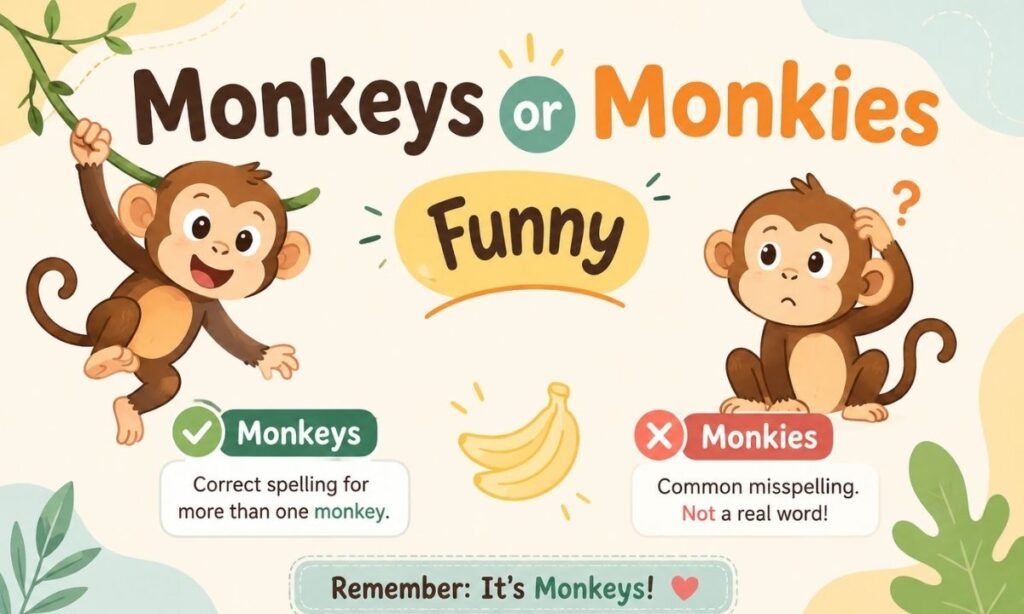
You may have come across “monkies” in memes, jokes, or casual internet posts — sometimes intentionally, as a playful or exaggerated misspelling, and sometimes as a genuine typo that got shared and repeated. This is common with animal names and internet culture in general; a misspelling catches on because it looks amusing or informal, not because it’s grammatically correct.
It’s worth knowing the difference: using “monkies” as a deliberate joke in a meme caption is a stylistic choice, but using it in an essay, email, or any formal writing is a spelling error. If you’re searching Monkeys or Monkies because you saw it written both ways online, that’s exactly why — one version is standard English, and the other is informal or accidental.
Common Mistakes with Monkeys or Monkies
Incorrect: “I saw two monkies at the sanctuary.” Correct: “I saw two monkeys at the sanctuary.” Why: “Monkey” follows the vowel + y rule, so the plural adds only “s.”
Incorrect: “The monkies’ cage was cleaned this morning.” Correct: “The monkeys’ cage was cleaned this morning.” Why: The possessive plural is built from the correct base word “monkeys,” not “monkies.”
Incorrect: “There’s a funny video of monkies playing with a phone.” Correct: “There’s a funny video of monkeys playing with a phone.” Why: Even in casual writing, “monkeys” remains the standard spelling.
Incorrect: “Monkies are known for their intelligence.” Correct: “Monkeys are known for their intelligence.” Why: Subject nouns follow the same plural rule regardless of sentence position.
Monkeys or Monkies in Everyday Examples
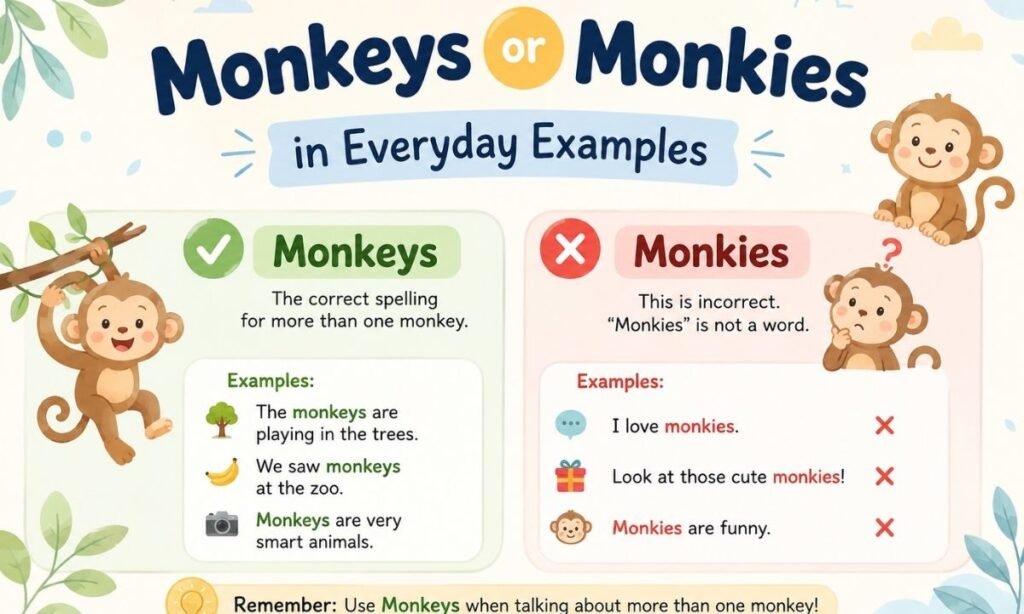
- “The children laughed as the monkeys swung from branch to branch.”
- “Several species of monkeys live in tropical rainforests.”
- “The documentary followed a group of monkeys for an entire year.”
- “Monkeys are highly social animals that live in troops.”
- “Visitors are asked not to feed the monkeys at the park.”
Each of these sentences uses “monkeys” naturally, showing that once the rule clicks, there’s no real ambiguity left in Monkeys or Monkies.
Monkeys or Monkies – Google Trends & Usage Data
Search data for spelling questions like this typically shows correct spellings appearing far more often in published writing, since dictionaries, style guides, and editors consistently confirm “monkeys” as standard. That said, exact search volume or ranking numbers change constantly and shouldn’t be treated as fixed facts in an article like this — if you want current search interest, checking a live tool such as Google Trends directly will give you accurate, up-to-date numbers.
What can be said with confidence is this: “monkeys” is the form used in dictionaries, textbooks, news writing, and academic sources, while “monkies” appears mainly in typos, casual online posts, or intentional meme spelling.
Comparison Table (Keyword Variations)
| Form | Correct? | Example |
| Monkeys | ✅ Yes | “The monkeys played all day.” |
| Monkies | ❌ No | Common misspelling |
| Monkey | ✅ Yes (singular) | “One monkey sat alone.” |
| Monkey’s | ✅ Yes (singular possessive) | “The monkey’s tail was long.” |
| Monkeys’ | ✅ Yes (plural possessive) | “The monkeys’ habitat was restored.” |
Conclusion
When it comes to Monkeys or Monkies, only one spelling is grammatically correct: monkeys. The rule is straightforward once you see it — words ending in vowel + y, like “monkey,” simply add “s” to become plural, with no change to the spelling itself.
Keep this rule in mind, and you’ll never hesitate over Monkeys or Monkies again. Whether you’re writing a casual message or a formal document, “monkeys” is the spelling to trust every time.

Welcome to Grammarrich.com, your trusted source for grammar tips, writing guides, and language learning. With 5 years of experience in the grammar niche, our goal is to provide clear, accurate, and easy-to-understand content that helps everyone write with confidence.
1 thought on “Monkeys or Monkies: Which Spelling Is Correct?”