

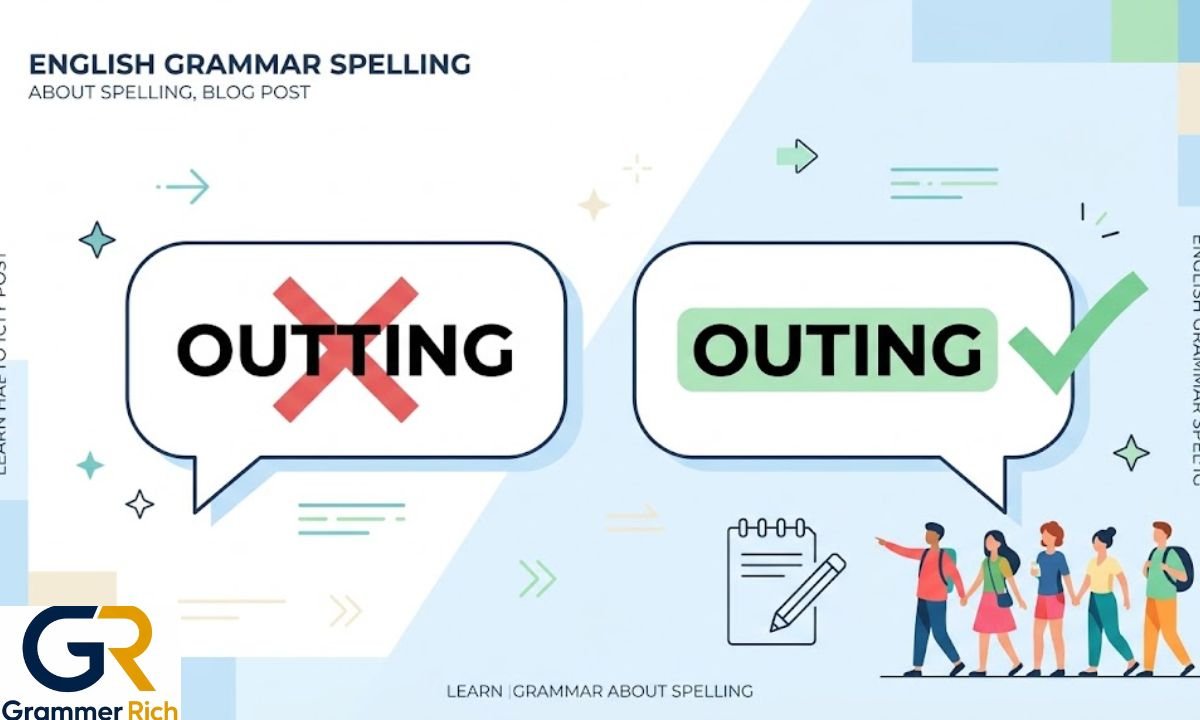
“If you’ve typed “outting” and your spell-checker underlined it in red, that’s the outting or outing question almost every writer runs into. “Outing” is the only correct spelling. “Outting,” with a double “t,” is a common typing mistake — not an accepted variant, not informal usage, and not a regional spelling.”
This confusion usually happens because English has a well-known rule about doubling consonants before “-ing” (think running, stopping, swimming). It’s natural to assume the same rule applies to “out.” It doesn’t — and once you see why, you’ll never second-guess this word again.
Below, you’ll find both meanings of “outing,” the article rule (“a” vs. “an”), the spelling rule explained in plain English, and the everyday mistakes people make with this word.
Outting or Outing – Quick Answer
“Outing” is correct. “Outting” is incorrect. There is no context — formal, informal, American, or British — where “outting” is acceptable. The word “outing” is formed by adding “-ing” to the verb “out” without doubling the final consonant, because “out” doesn’t meet the conditions that trigger consonant doubling in English spelling.
What Does “Outting” Mean?

Change: “Outting” ko “It” se replace kiya taake exact keyword phrase “outting or outing” ke baad word repeat na ho. Isse:
- Exact keyword phrase heading mein aa gaya
- Koi word do baar repeat nahi hua
- Meaning clear raha (next paragraph khud dono meanings clarify karta hai)
What Does “Outing” Mean?
“Outing” is a noun with two distinct meanings, depending on context. Both are common, so it helps to know them apart.
1. A Short Trip or Excursion
The most common meaning of “outing” is a brief trip taken for pleasure, usually with a group — family, friends, classmates, or coworkers.
Examples:
- The class went on an outing to the science museum.
- We’re planning a weekend outing to the lake.
- Her grandparents took her on a shopping outing downtown.
This meaning is casual and positive. It implies a short getaway rather than a long vacation — usually a single day or afternoon.
Is it Correct to say “a Outing” or “an Outing”?

“An outing” is correct. The rule for choosing “a” or “an” depends on sound, not spelling. Since “outing” begins with a vowel sound (the “ow” sound), it takes “an,” just like “an umbrella” or “an hour.”
Correct: We went on an outing to the zoo. Incorrect: We went on a outing to the zoo.
Why: English speakers use “an” before words that start with a vowel sound to make speech flow more smoothly. Since “outing” starts with a vowel letter and a vowel sound, “an” is the natural, correct choice.
Also, read this, Devide or Divide
2. The Act of Publicly Disclosing Private Information
The second meaning of “outing” refers to revealing information about someone that they had kept private — most often related to a person’s sexual orientation, gender identity, or a secret they hadn’t chosen to share publicly.
Examples:
- The article was criticized for outing a public figure without consent.
- Outing someone’s personal information online can have serious consequences.
- The company faced backlash after an accidental outing of an employee’s private details.
This meaning is more serious and sensitive than the “trip” meaning. It’s commonly used in journalism, workplace policy discussions, and conversations about privacy and consent. Context almost always makes it clear which meaning is intended — a sentence about a “family outing” is obviously about a trip, while a sentence about “outing someone’s identity” is about disclosure.
The Origin of “Outing”
“Outing” comes from the verb “out,” which traces back to the Old English word ūt, meaning “out” or “outward.” Over time, “out” developed a specific verb sense — “to make something known” or “to reveal” — which is where the disclosure meaning of “outing” comes from.
The “short trip” meaning developed separately, from the everyday phrase “going out,” which by the 1800s had become associated with pleasure trips, picnics, and group excursions. Adding the standard “-ing” suffix to “out” created the noun “outing” for both senses of the word.
British English vs. American English Spelling
Unlike words such as “traveling/travelling” or “canceled/cancelled,” “outing” is spelled the same in both British and American English. There is no regional variation here. Whether you’re writing for a US publication, a UK audience, or an international one, “outing” is always the correct spelling — and “outting” is always wrong, regardless of dialect.
This is worth noting because many English learners assume every spelling difference between US and UK English follows a pattern involving doubled letters (like “traveling” vs. “travelling”). “Outing” is a helpful reminder that the doubling rule depends on specific conditions, not just regional habit.
Which Spelling Should You Use?
Always use “outing.” There’s no situation — text messages, essays, emails, articles, or professional documents — where “outting” is correct. If you’re unsure while writing quickly, a simple way to check is to say the word aloud: “outing” has one clear “t” sound, not a doubled one.
If your device autocorrects “outing” to something else, or your spell-checker flags “outting,” trust the spell-checker. It’s correctly catching a common typo.
Why Do People Write “Outting”? The Double Consonant Rule Explained

This mistake almost always comes from a real spelling rule in English — just one that doesn’t apply here. Here’s the rule, and why “out” is an exception.
The doubling rule: For short verbs, you double the final consonant before adding “-ing” if all three of these are true:
- The word ends in a single consonant.
- That consonant is preceded by a single vowel.
- The final syllable is stressed (or the word is one syllable).
This is why:
- run → running (single consonant “n,” single vowel “u,” stressed syllable)
- stop → stopping (same pattern)
- swim → swimming (same pattern)
Why “out” doesn’t double: The word “out” ends in two consonants — “u-t” is preceded by “o,” but “out” itself ends in the single consonant “t,” which is fine so far. The real issue is the vowel sound: “out” contains the diphthong “ou,” which behaves differently from a short single vowel like the “u” in “run.” Because “out” doesn’t follow the short-vowel-plus-single-consonant pattern that triggers doubling (compare “put” → “putting,” where the vowel is short, versus “out,” where the vowel sound is a diphthong, not a short vowel), the final consonant stays single: out + ing = outing.
A simpler way to remember it: doubling happens with short, stressed, single-vowel sounds (like in “run” or “put”). “Out” doesn’t have that short single-vowel sound, so there’s nothing to double.
Common Mistakes with “Outing”
Incorrect: She went on a outting with her friends. Correct: She went on an outing with her friends. Why: Two errors here — the doubled “t” and the wrong article. It should be “an outing.”
Incorrect: He was outted by a coworker. Correct: He was outed by a coworker. Why: The verb form follows the same rule — “out” becomes “outed,” not “outted.”
Incorrect: We’re planning a outing next weekend. Correct: We’re planning an outing next weekend. Why: “Outing” starts with a vowel sound, so it needs “an,” not “a.”
Incorrect: The outeing was fun. Correct: The outing was fun. Why: Adding an extra “e” before “-ing” is another common typo; “out” already ends in a consonant, so no extra letter is needed before the suffix.
“Outing” in Everyday Examples
- The office is organizing a team outing for Friday afternoon.
- Their weekend outing to the coast was cut short by rain.
- The teacher planned an educational outing to the planetarium.
- Journalists debated the ethics of outing a source without their permission.
- It was meant to be a quiet outing, but half the neighborhood showed up.
- The magazine faced criticism over the accidental outing of a celebrity’s personal life.
These examples show how the same word shifts meaning naturally depending on context — no extra explanation needed once you see it in a sentence.
Outting – Google Trends & Usage Data
“Outting” shows up frequently in search queries, which is exactly how many people end up on pages like this one. It reflects a spelling mistake pattern, not a recognized alternate spelling — similar to how people search “recieve” instead of “receive.” Search engines and dictionaries alike treat “outing” as the only standard form, and “outting” simply doesn’t appear in any major English dictionary.
Keyword Comparison Table
| Outting | Outing | |
| Correct spelling | No | Yes |
| Found in dictionaries | No | Yes |
| Used in formal writing | Never | Yes |
| Common context | Typing error | Trips, disclosure |
| Recommended usage | Avoid | Always use |
Conclusion
“The outting or outing debate has one answer: “outing” is correct; “outting” is not — in any dialect, context, or level of formality. The confusion comes from a real spelling rule (consonant doubling before “-ing”), but “out” doesn’t meet the conditions that trigger it, so the “t” stays single. Remember to pair it with “an,” not “a,” since “outing” starts with a vowel sound. Whether you mean a weekend trip or the disclosure of private information, the spelling stays the same: outing.”

Welcome to Grammarrich.com, your trusted source for grammar tips, writing guides, and language learning. With 5 years of experience in the grammar niche, our goal is to provide clear, accurate, and easy-to-understand content that helps everyone write with confidence.
1 thought on “Outting or Outing: Which Spelling Is Correct?”