

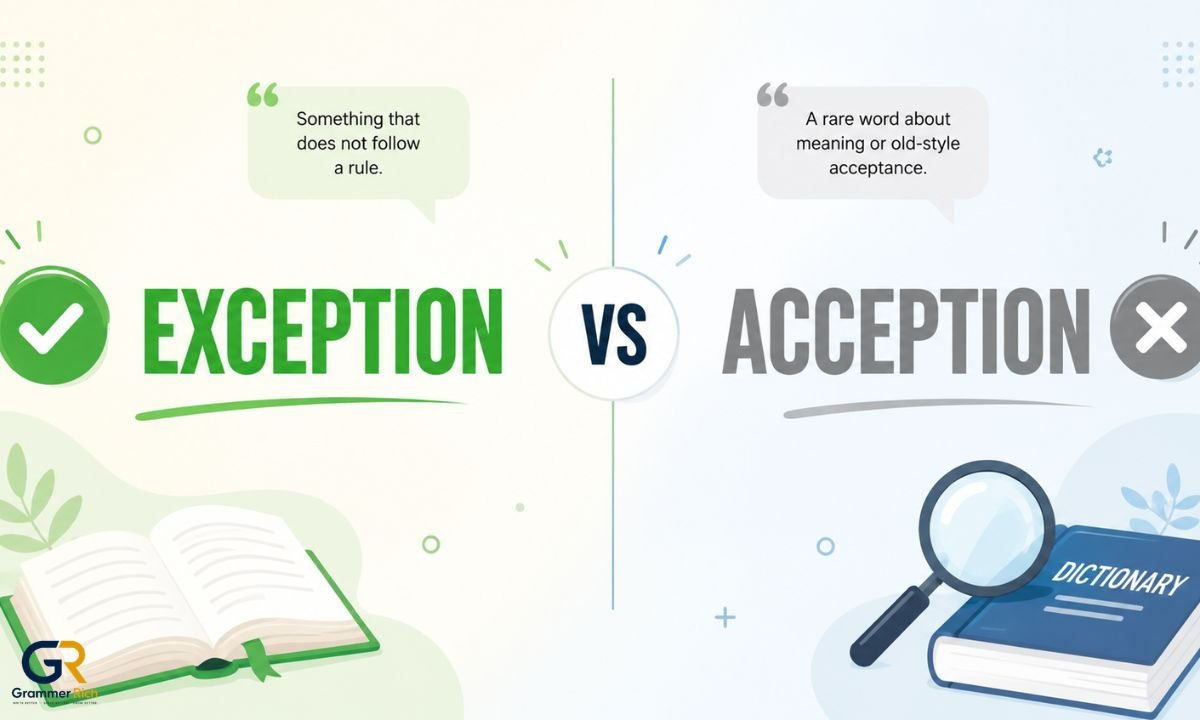
“Acception” isn’t a recognized standard English word—most style guides treat it as a misspelling or rare archaic form. “Exception” is the correct term, meaning something excluded from a general rule. So whenever you’re referring to something that doesn’t fit the norm, “exception” is the word you want, not “acception.”
Confused about acception vs exception? You’re not alone—this mix-up trips up even confident writers. Maybe you’ve typed one and second-guessed yourself, or seen both floating around online. This guide clears up the confusion for good, walking through definitions, common mistakes, and real examples so you’ll never second-guess acception vs exception again.
Quick Answer
If you only have ten seconds, here’s the acception vs exception answer in one line: use “exception,” not “acception.” Exception is standard, dictionary-recognized English. Acception is an obsolete or dialectal form that modern readers will flag as a typo, even though a few historical texts and legal documents once used it. When in doubt, exception is always the safe, correct choice.
What Does “Exception” Mean?
Simple Definition
An exception is something that doesn’t follow the usual rule. It’s a case that’s set apart, excluded, or treated differently from everything else. Merriam-Webster defines it as “someone or something that is excepted”—in plain terms, a case that breaks the pattern.
Examples of “Exception”
- Everyone submitted the report on time, with one exception.
- She’s the exception to the rule; she never misses a deadline.
- The teacher made an exception for students who were sick.
Common Phrases With “Exception”
- Exception to the rule
- With the exception of
- Make an exception
- Without exception
- The exception that proves the rule
These phrases show up constantly in everyday English, which is exactly why the acception vs exception confusion keeps happening—people hear “exception” often but rarely encounter “acception” at all.
What Does “Acception” Mean?
Definition of “Acception”
“Acception” is an archaic or obsolete English word, historically related to “acceptance”—the act of accepting something. Some older legal and religious texts used it centuries ago, but it fell out of common use and isn’t listed in most modern dictionaries as standard vocabulary.
Example of “Acception” (Linguistic Use)
You might spot “acception” in old translations of religious texts or 17th-century legal writing, where it referred to favor, approval, or the act of accepting someone or something. It is not, and never was, a substitute for “exception.”
Important Note
This is the core of the acception vs exception mix-up: the two words look alike and sound similar, but they don’t share meaning. “Acception” relates to accepting; “exception” relates to excluding. Treating them as interchangeable is a mistake, no matter how old or formal the source looks.
What Is the Difference Between Acception and Exception?
The difference between acception and exception comes down to meaning, usage, and modern relevance:
- Exception = something excluded from a general rule (current, standard English)
- Acception = an archaic word loosely tied to “acceptance” (rare, outdated, not standard)
In nearly every real-world sentence you’ll write today, “exception” is correct. “Acception” simply isn’t part of active, modern vocabulary.
Acception vs Exception: Side-by-Side Comparison
| Feature | Exception | Acception |
| Meaning | Something excluded from a rule | Archaic term related to accepting |
| Modern usage | Common, standard English | Rare, obsolete |
| Dictionary status | Fully recognized | Missing from most modern dictionaries |
| Example sentence | “She’s the exception to the rule.” | Found only in historical/legal texts |
| Correct today? | Yes | No |
This table sums up the acception vs exception debate in one glance: if you need a word for “something that doesn’t fit,” exception wins every time.
Why People Confuse Acception and Exception

1. Similar Spelling
Both words share the same ending (“-eption” / “-ception”) and a similar letter count, which makes it easy to type one when you mean the other, especially when typing fast or relying on autocorrect.
Also read this: Is It ’26 or 26
2. Sound Similarity
Say them out loud: “acception” and “exception” sound nearly identical, differing only in the first syllable. That’s a classic setup for a spelling mistake, particularly for ESL learners and fast typists.
3. Confusion With “Acceptance”
Many writers actually mean “acceptance” (the noun form of “accept”) but accidentally write “acception” instead. This three-way mix-up between acception, acceptance, and exception is one of the most common English word confusions online.
Common Mistakes (And How to Fix Them)
Incorrect:
“There’s one acception to this policy.”
Correct:
“There’s one exception to this policy.”
Incorrect:
“He gained acception into the university.”
Correct:
“He gained acceptance into the university.”
Incorrect:
“With the acception of Mondays, the store is open daily.”
Correct:
“With the exception of Mondays, the store is open daily.”
Notice the pattern: almost every real “acception” mistake should actually be either “exception” or “acceptance,” never a standalone acception vs exception toss-up in genuine modern writing.
American vs British English Differences

Good news here: the acception vs exception rule doesn’t change across dialects. Both American English and British English treat “exception” as the standard word for something excluded from a rule, and both treat “acception” as outdated or nonstandard. Spelling and pronunciation of “exception” stay consistent on either side of the Atlantic, so there’s no regional excuse for using “acception” instead.
When Should You Actually Use “Acception”?
Almost never. Unless you’re:
- Quoting a historical or legal document verbatim
- Writing academic linguistics research on archaic English vocabulary
- Intentionally using an old-fashioned tone in creative writing
…you should default to “exception” (or “acceptance,” depending on context). For everyday writing, business communication, and academic papers, “acception” has no real place in the acception vs exception conversation.
Real-World Usage Scenarios
In Business Writing
Business writing values clarity above all. Emails, contracts, and policies should always use “exception” when describing a case that breaks a general rule, such as a refund policy exception or an exception to standard procedure. Using “acception” in professional documents can undermine credibility and confuse readers.
In Academic Writing
Academic writing demands precision, and the acception vs exception distinction matters here too. Scholars discussing rare or historical vocabulary might reference “acception” as a linguistic artifact, but standard academic prose—essays, reports, theses—should stick with “exception” for clarity and grammatical correctness.
Synonyms and Related Words
Synonyms for Exception
- Exclusion
- Anomaly
- Deviation
- Outlier
- Special case
Related Words
- Acceptance (act of accepting)
- Except (preposition/verb form)
- Exceptional (standing out, often positively)
- Excepting (formal preposition)
Knowing these synonyms helps you avoid the acception vs exception trap entirely—if you mean “excluded,” reach for exception, exclusion, or anomaly instead.
Quick Memory Trick
Here’s a simple way to lock in the acception vs exception rule for good: think of “EX-ception” like “EXIT”—both start with EX and both relate to something leaving or being left out. “Acception” isn’t a trick at all; it’s simply not a word you need in modern English. If you ever type “acception,” pause and ask whether you meant “exception” (excluding) or “acceptance” (accepting).
Conclusion
The acception vs exception debate has a clear winner: exception is correct, standard, and modern; acception is archaic and essentially obsolete. Whenever you’re describing something that breaks a rule or stands apart, exception is the word to use. If you’re talking about being accepted somewhere, reach for “acceptance” instead. Keep this simple rule in mind, and you’ll never mix up acception vs exception again.

Welcome to Grammarrich.com, your trusted source for grammar tips, writing guides, and language learning. With 5 years of experience in the grammar niche, our goal is to provide clear, accurate, and easy-to-understand content that helps everyone write with confidence.